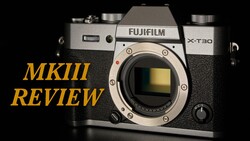
The Fujifilm X-T30 III sits at $1,000 body only, positioning it as one of Fujifilm's most accessible entry points into the X-series system. For that price, you're getting a 26-megapixel APS-C camera with some video specs that don't match what you'd expect from a camera in this range.
Coming to you from Christopher Frost, this thorough video puts the Fujifilm X-T30 III through its paces across stills, video, autofocus, and handling. Frost points out early that the headline feature here is 6.2K open gate video, something that even the Sony a7 V doesn't offer despite costing more than twice as much. You also get 4K at 60 fps and 240 fps in 1080p, which is a genuinely strong spec sheet for a $1,000 body. The camera pairs that with Fujifilm's X-Processor 5 and a film simulation dial on the top plate that visually previews each simulation as you turn it, a thoughtful touch for anyone still learning their way around color grading.
On the image quality side, Frost finds that the default JPEG sharpening is cranked too high out of the box and actually destroys edge detail. Dialing sharpening down to -3 produces noticeably better results that hold more of what the raw file captures. For noise, performance is solid up to ISO 800, starts to soften at ISO 1600, and becomes genuinely rough at ISO 3200 and above. One thing Frost notes in the camera's favor is that the character of the noise from Fujifilm's X-Trans sensor reads as more filmic compared to typical Bayer sensors, which can make moderate ISO shots more usable in practice. Dynamic range is respectable for an APS-C sensor, with raw shadows recoverable to a reasonable degree before noise becomes distracting.
Where things get more complicated is handling. The X-T30 III is small, and the rear buttons are small with it. Frost notes they're raised and tactile, which helps, but anyone with larger hands will find the layout fiddly. The screen tilts but doesn't articulate out, which is a real limitation for video work given how strong the camera's video specs are. There's no in-body image stabilization either, so if you're shooting with prime lenses, you're relying entirely on optical stabilization in the lens or going handheld without it. Rolling shutter is present at every resolution, and the 240 fps mode shows pixelation and moiré on high-contrast edges. Frost also tests the camera with the new Fujifilm XF 13-33mm kit lens for vlogging footage, and even with both optical and digital stabilization active, the results are shakier than you'd want. Autofocus tracking is improved over previous models with subject recognition that mirrors what you'll find on the X-M5 and X-T50, but Frost is honest that it still trails the competition in reliability and can drop subjects.
Check out the video above for the full rundown from Frost, including his side-by-side image quality comparisons and his complete take on whether this camera makes sense over Fujifilm's other current options.





No comments yet