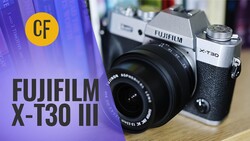
The Fujifilm X-T30 III sits in a strange spot. It looks modest on paper, yet it offers features that push beyond what many expect at this price.
Coming to you from Luca Petralia Photography, this practical video revisits the Fujifilm X-T30 III after more than a month of daily use. Petralia makes it clear this is not a radical redesign. It is the third iteration of a familiar body, refined rather than reimagined. You get the compact size, the retro controls, and Fujifilm’s well-known color rendering, all in a body that stays under $1,000. The 26-megapixel APS-C sensor is not new, but it remains more than enough for large prints, travel work, and paid assignments. This is a camera you can grow into without feeling boxed in after a few months.
Where things get interesting is video. The X-T30 III records 6.2K open gate at up to 30 fps, meaning it uses the full height of the sensor in a 3:2 aspect ratio. That gives flexibility to reframe vertically without throwing away as many pixels as a standard 16:9 capture. Petralia points out the irony that some cameras costing three times as much stop at 4K. It does not mean this body competes with high-end hybrids, but it does show how much Fujifilm packed into it. If you shoot both stills and short-form video, that extra resolution opens options you may not expect at this level.
There are trade-offs. The X-T30 III has no in-body image stabilization and no weather-sealing. The viewfinder is smaller and lower resolution than what you find in higher-tier models. None of this is shocking in an entry-level body, but it changes how you shoot. If you rely on unstabilized prime lenses, you will need to watch shutter speeds more carefully. Petralia used it for landscapes, travel in Budapest, private events, and casual gatherings. He rarely felt limited, except when stabilization would have helped him stretch exposure a bit longer.
Fujifilm introduced the Fujifilm XC 15-45mm f/3.5-5.6 OIS PZ as a known kit option, and more recently the Fujifilm XC 16-50mm f/3.5-5.6 OIS, but this review focuses on the newer 13-33mm kit lens bundled in some regions. Petralia found the 13mm wide end useful in tight spaces, yet missed the reach of 45mm. Stopping at 33mm limits framing flexibility, especially for portraits or compressed street shots. Optically, the lens is decent. Sharp enough, no severe flare, no major chromatic aberration. It does not stand out either. One concern was stabilization reliability. At 1/15 s or 1/25 s on the wide end, some frames were sharp and others inexplicably blurred under identical settings. It happened often enough to affect confidence. That inconsistency may be firmware-related, but it is something to watch.
Petralia also compares this body to the Fujifilm X-T50 paired with the Fujifilm XF 16-50mm f/2.8-4.8 R LM WR. That combination delivers stronger image quality and build, though with a higher cost and slightly slower sensor readout for video. If your focus leans heavily toward stills and you want a more premium lens, that kit changes the equation.
If you are weighing a compact hybrid that will not feel outdated anytime soon, check out the video above for the full rundown from Petralia.


Join the Fstoppers community for free
-
Post comments and join in the discussions
-
Browse the site ad-free
-
Share your work and get featured in the community
-
Compete in the photo contests for fun and prizes
2 Comments
A correction to the title might be helpful: III not II.
Thank you!