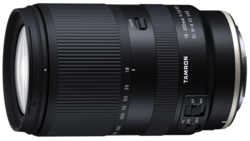
The Tamron 18-300mm f/3.5-6.3 Di III-A VC VXD lens gives you the kind of reach that can replace several lenses in one. That matters because you don’t always want to carry a full kit when traveling or working in unpredictable conditions. Weight, convenience, and flexibility matter as much as pure image quality.
Coming to you from Jacek Sopotnicki, this detailed video looks at the Tamron 18-300mm f/3.5-6.3 Di III-A VC VXD lens and shows what you gain and lose with this kind of superzoom. Sopotnicki points out that at 18mm, the lens is decently sharp in the center at f/3.5 and improves a lot when stopped down to f/5.6. The corners, however, remain weaker even when you stop down further. Sharpness also takes a dip at the longer end, especially beyond 200mm, though images are still usable thanks to today’s sharpening options in-camera or in post. For anyone who has used older lenses in this range, that’s a big step up.
Where the Tamron finds an advantage is against competing zooms in certain focal lengths. Around 100mm, for example, it can outperform Sigma’s 18-300mm in sharpness. Autofocus is generally quiet and reliable between 18mm and 70mm, though at the long end it tends to hunt. That makes it less suited for video work, especially since zooming in and out can cause noticeable focus shifts. If you’re thinking about using it for serious video production, that’s a limitation to keep in mind.
Key Specs
-
Focal Length: 18 to 300mm (35mm Equivalent: 27 to 450mm)
-
Aperture: Maximum f/3.5 to 6.3; Minimum f/22 to 40
-
Lens Mounts: Nikon Z, Canon RF, Sony E, Fujifilm X
-
Coverage: APS-C
-
Minimum Focus Distance: 5.9" / 15 cm
-
Magnification: 1:2 Macro (0.5x)
-
Optical Design: 19 Elements in 5 Groups
-
Aperture Blades: 7, Rounded
-
Focus Type: Autofocus
-
Image Stabilization: Yes
-
Filter Size: 67 mm
-
Dimensions: ø 75.5 x L 127.6 mm
-
Weight: 1.4 lb / 635 g
The lens shows heavy distortion at 18mm, producing barrel distortion that needs correction. Around 100mm, it shifts into pincushion distortion, though by 200mm and above it settles down. This is where lens profiles in editing software make a difference. Vignetting also shows up at several focal lengths, especially at the wide and long ends, though it can be corrected in post. Chromatic aberration is controlled fairly well, which is a relief when shooting high-contrast scenes.
Close focusing ability is one of the pleasant surprises here. At 18mm, you can work extremely close to your subject for macro-style shots, especially if you stop down for extra sharpness. The background blur isn’t flawless, but it’s pleasing enough for casual portraits or detail shots. Image stabilization is decent, though Sopotnicki notes Sigma’s version is stronger, especially at longer focal lengths where shake is more noticeable. Check out the video above for the full rundown from Sopotnicki.




Join the Fstoppers community for free
-
Post comments and join in the discussions
-
Browse the site ad-free
-
Share your work and get featured in the community
-
Compete in the photo contests for fun and prizes
1 Comment
This seems like it is a very useful lens that deserves to be covered here on Fstoppers, but I think this is the 3rd article about this same lens to appear here within the last two weeks. Is that correct?
Why are we putting out identical articles about the same lens over and over? Is it a money grab to get $ via affiliate link sales? Or do we think that no one noticed the first two articles, so we need to keep putting more out here to eventually get everyone's attention?
I am not just writing this as a critical comment; I am genuinely wanting to know why we now have 3 articles on the exact same thing in such a short time. It doesn't bother me that we have these 3 nearly identical articles. But it certainly piques my curiosity. I'm really interested to know - is there is any financial motivation for doing so? Or did Alex honestly just forget that he already put articles out about this lens?
If I am wrong, and this is not the 3rd recent article about this lens, then I apologize for cluttering up the comments with questions based on misinformation.