
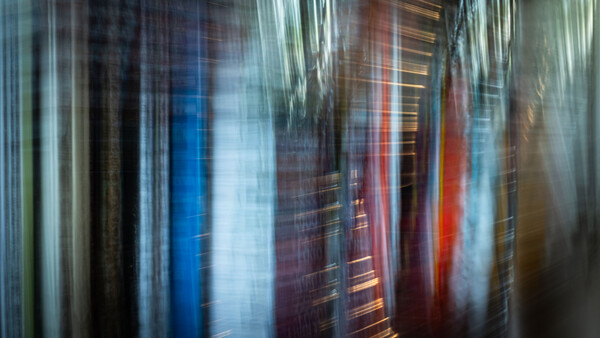
AI can imitate far more of your photography than you probably expect. The part it can't reproduce turns out to be the fastest way to discover what actually makes your work your own.
Photographers usually choose one of two reactions to AI. They either ignore it completely or fight it in comments and articles. Both strategies are comfortable, and both deny you one simple opportunity: to understand what your own photography is actually made of. The fastest way to find out is to ask AI to recreate one of your own photographs.
This isn't because the AI becomes your shooting tool. It works as a mirror. Any good way of understanding yourself is built on comparison: with someone else's work, with past experience, with an alternative. AI turns out to be exactly this kind of comparison tool. The difference is that the comparison isn't with another photographer. It's with a machine that has no body, no history, no presence in the moment. Instead, it has averaged millions of similar shots and knows how this genre, with this subject, is "supposed" to be photographed. Usually, people see only danger in this: depersonalization, mass production. But it's also a way to see your own clichés from outside. If the machine reproduces your technique on the first try, you finally see where your eye ends and the cliché that's been holding you back begins.
The experiment is simple. Don't take just any photograph — take your own: your recognizable subject, your technique, your style, the thing you'd call your handwriting. Ask AI to reproduce it. At first, it looks like the experiment fails because AI reproduces too much.
Much of it comes back almost perfectly: the color palette, the compositional scheme, the familiar visual technique, the mood of the frame, the manner of processing. Much of what looked like individual style turns out to be a stable visual pattern the machine has learned to reproduce.
The experiment gets useful exactly where AI starts to fail. Some things don't reproduce, no matter how many times you try. A portrait of someone who trusts you specifically, not the camera in general. A situation that happened once, in one place, with a reaction you couldn't have prompted the model for. The physical fact of being there — how you walked around the subject, crouched, caught the light at the right angle, and moved through the space with a camera in your hands.
This is where the real border runs, between what gets generated and what happens. These failures are the main result of the experiment. They show you which parts of the photograph were yours all along. The real discovery here is that loss, in this case, is impossible: the model never had access to those parts of the photograph in the first place. This is no longer a question of image quality. It's a question of whether the image came from an encounter with reality or was assembled out of images that already existed.
Most conversations about AI keep circling back to process, because photographers default to a single system of evaluation — one that looks at how something was shot, what it was processed with, and whether it can be repeated exactly. The AI experiment points to another system, in which what counts is the force of the result, what the photograph does to the viewer. The photographs that history tends to remember are usually the ones that hold up under this second kind of judgment.
After an experiment like this, working gets simpler. You stop competing with the machine where it's objectively faster, assembling a plausible picture out of ready-made images. And you start noticing exactly the decisions only a human with a camera can make: where to stand, whom to wait for, and what not to let go of until the right moment happens. That's the real incentive to experiment more boldly, without measuring yourself against the old ruler of process complexity, knowing exactly what in your photography can never belong to anyone else.
The boundaries of photography become most visible where photography stops working. Paradoxically, AI turns out to be the fastest, cheapest way to test that.
Join the Fstoppers community for free
-
Post comments and join in the discussions
-
Browse the site ad-free
-
Share your work and get featured in the community
-
Compete in the photo contests for fun and prizes
39 Comments
You can't be serious?
"Don't take just any photograph — take your own: your recognizable subject, your technique, your style, the thing you'd call your handwriting."
If I do so, don't I understand my photography already?
In most cases, no. Recognizing your own style is not the same as understanding what actually makes it yours. We often recognize our habits, subjects, techniques, and visual preferences as a personal style without knowing which parts are genuinely distinctive and which are common conventions that many others use. That’s precisely what the experiment is meant to reveal.
I was about to ask what do you mean by style. Your second sentence answers it.
It sounds like you're referring to something deeper than techniques and visual preferences, although I'm not sure what you mean by the latter.
But if that's the case, meaning going beyond mimicking some trend, I fail to see the logic in what you propose, and I mean this in a respectful way.
Since AI will only be able to wrongly assume what the style is by relying on visual patterns, the absence of this deeper value that is not presenting itself through AI will not be magically revealed.
If one doesn't get it by themself without AI, another example of mimicking a visual pattern will not reveal anything more.
P.S. I think that worrying about style is pointless. As long as I'm not willingly imitating a particular look, my only concern is to be consistent. Style, to me, is but a consequence of our work, if done with honesty and love.
"After an experiment like this, working gets simpler. You stop competing with the machine where it's objectively faster, assembling a plausible picture out of ready-made images."
I was never competing with the machine. I just take photo's I like. If they are all considered to be cliché: I could not care less. If the machine does my photo's better: great. Enjoy the AI images then. As you see, my life already was way simpler then you probably imagined. To me it feels like you want to complicate it. I even start to wonder if AI company's pay influencers?
AI disgusts me. I don’t know how to “ask AI” anything, at the very least maybe you should have covered that in this “article”.
This is complete and utter nonsense.
I'm sorry but I respectfully disagree, I already understand my photo fully, because I'm the one who took it. You could never replicate your signature photo on AI, the prompts needed you wouldn't even know, so how would AI know, moving the sun for example by just 5° changes everything... Photography is a feeling, AI doesn't have one, yet... Also as I'm having a rant, AI and photography shouldn't be mentioned in the same sentence...
You write, “I already understand my photo fully, because I’m the one who took it.” But authorship does not automatically mean complete understanding of the result. Photographers and artists routinely discover patterns, habits, and structures in their own work that they were not conscious of while making it. This is precisely why critique, editing, retrospective analysis, and even looking through old contact sheets can change how we understand our own work.
The problem is that we often think of AI as a machine that thinks, but it isn’t. AI is essentially an aggregation of existing experience. That’s precisely what makes it useful here. It will recognize and easily reproduce a cliché, an effect, or a common technique that we may mistake for our own unique style. But it cannot recognize and reproduce what is genuinely specific to you, because it has nothing to compare it with and no existing material from which to reconstruct your particular approach. That’s what makes this a test of uniqueness: not by a critic or curator, but simply by a universal tool.
Down to earth: I shoot some flowers. Running them through AI my pictures are identified as a cliché. Result: I would still take these pictures.
Or the other way around: I run my photo's through AI. I identify what is specific to me, and in the future focus on this while taking photo's because it gives me uniqueness. AI evolves, and incorporates my (and everyone's) uniqueness. Now what. Try to be even more unique?
I choose not to bother. I think being afraid of cliché's or conventions or anything holds you back. I would be walking around cramped. The nicest pictures I took were made when I did not seem to be thinking at all, when I was in a certain flow. I treasure that.
By the way: I do respect you take the time and effort to reply to the comments. Other writers can learn from that. 👍
I agree that fear of clichés can become a limitation. The point is not to avoid every familiar subject or force uniqueness into every frame.
My point is to become more aware of our own patterns. AI is simply an interesting tool for revealing things we may not notice in our own work: what makes an image personal and what we may be repeating without realizing it.
A flower can be photographed like Karl Blossfeldt, for instance, or simply as a generic image of a flower. The difference is not in the subject itself, but in how the photographer sees and uses it.
I'll remember this whenever I get bored by my own pictures, but for now... 😬
One thing strikes me: your use of 'we' and 'our', while I do not feel I belong to your target audience. Maybe it's because you are not a native speaker?
And maybe boring you even more: if you would show me in the article what photo's you ran by AI, what it came up with and what you did with the result, it would have more impact.
It's an intriguing experiment and would probably inspire growth in any artist to see their creativity distilled by a machine. I could also see it being humiliating (for lack of a better word) to have your creative efforts trivialized by an algorithm. Beauty (or pain or horror or pleasure, etc) is always in the eye of the beholder, so there will always be a set of humans somewhere who enjoy or hate any given art and creating those emotions in ourselves and others is the real reward. As soon as artists try to capitalize on their creative work it becomes something more complicated-which leads to trying to please others or follow a trend or worry about things like "discover what actually makes your work your own." It's only an interesting experiment if you're worried about making a living with art as opposed to just creating things only because you enjoy it.
I agree with most of this, but not with the last point. I don’t think the question of what actually makes your work your own has much to do with making a living from it. You can have no interest in selling your work or pleasing anyone and still be curious about which parts of your visual language are genuinely yours and which are conventions, habits, or effects you share with thousands of other photographers.
Yes, let's feed our hard work to AI models for free, what a great idea, why didn't I think of that.
In all seriousness though just join a camera club. Ask fellow humans for feedback. It really is that simple.
AI is another tool in the photographer’s toolbox, no different in essence than the tools of other eras; I started over 40 years ago in a darkroom where changing the temp of the water and chemicals made different effects on your image, there was dodging and burning, etc. This is a new set of tools for a new era, and most people will adopt them over time. (Remember the pushback on digital photography around the millennium change, and whether digital was “real” photography?) And I’d bet that most people complaining here didn’t try what you’re recommending before poo-pooing it.
Agreed however with one of the other commenters: the concept of this article is interesting but the author included almost no useful info about *how* to do this; surprising, since that’s the least nebulous part of this whole idea: what do you tell the AI in order to try this? And what worked and what didn’t when the author tried this? Some level of actual instructions would better help the audience decide if this concept has legs or not.
Yes, I started using it too. The machine reproduced my family members on the first try, indicating they had become a total cliché. And sadly, I tend to agree. I am augmenting them with AI: hope the machine likes the result.
Nothing fills up the comments section like an article about 'AI'.
That must have been the goal of this article: it scores. And stupid me fell for it again 😬
The article seems to treat an AI model’s apparent ability to imitate an image as evidence that the image’s visual qualities are clichés—and its inability as evidence of something uniquely human. But different AI systems do things in different ways for different reasons, many of which have nothing to do with the exact elements of the uploaded photo. For instance, prompts may be too broad for an accurate interpretion. Or the model lacks the necessary controls and references. Or it may hallucinate a plausible genre imitation instead of actually an understanding of the source image.
These large language models reflect the biases of their training data, their safety rules, the model maker’s design choices, the prompt interface, and the photographer’s own prompting skill. Calling that an objective test of uniqueness in a photo probably invests the AI output with more interpretive authority than it deserves.
You are right that AI output should not be treated as an objective measure of uniqueness. The result depends on the model, the prompt, and many other variables.
My point was not that AI can determine what is unique in a photograph, but that it can sometimes reveal patterns we may not notice ourselves. I see it less as a judge and more as a tool for reflection.
This answer needs clarification: which model did you use, with which prompt? What are the other variables I should be aware of? What did you feed the machine and what was the outcome: can you please show the results.
My intention here is to define a field for experimentation, not to provide a reproducible technical test with controlled variables. My job is to suggest the question and a way to explore it. Yours is to try it with your own work and tools or simply ignore it if you don't find the question useful.
This was actually the beginning of my experiments with this, about a year ago: https://medium.com/full-frame/liberation-from-the-predictable-8d65c25e3…
That is a very disappointing answer, but sadly an expected one. I registered and read the article you link to: it's more of the same. Again you write that AI being able to reproduce images, shows a lack of uniqueness. But in reply to Hoag Levins you write: "You are right that AI output should not be treated as an objective measure of uniqueness."
In the linked article you show image “Market Square Eater”. The description below it says:
"This image was something I tried to reconstruct using AI many times — without success. The reality that emerges beneath the abstract blur stays “human,” both as a process and as a perception. Its meaning doesn’t lie in the effect itself, but in the experience of seeing — something no prompt can truly simulate."
And then you resume with: "This is all that, for now, cannot be reproduced — not because it is somehow mystical, but simply because it has not yet been published, labeled, and turned into training data for your algorithm."
I am afraid your future looks grim after reading this, or is it your intention to never publish again? But surprise, you write: "And perhaps this is the true gift: a machine that forces us to risk more, to invent more, to create what did not exist — what no prompt can predict and no algorithm can preempt."
Your path to uniqueness is imagery that cannot be captured in a prompt. I would love to know the words you used for the prompts attempting to reproduce "Market Square Eater". Or does the meaninglessness of this image explain the failure to write a prompt?
Every article about AI these days mentions that I am afraid of AI, or suggests I have to join the race or else become outdated. But for me AI being able to reproduce anything is meaningless. It's generated reality, not reality itself. It's annoying, not threatening. Failure to write a prompt AI can use to recreate a photo I took is meaningless. It's more time sitting behind a computer instead of going out in the real world taking photo's: what a waste.
It’s your choice. Mine is different.
Again a great response, you apparently are no longer able to come up with arguments.
I invite everyone to have a look at https://medium.com/full-frame/liberation-from-the-predictable-8d65c25e3…
The examples of the flower pots and your solution making abstract unique work, garbage. This whole exercise boils down to making stuff AI cannot easily replicate, meaning nothing because as you say yourself 'AI output should not be treated as an objective measure of uniqueness'. So what in Maria's name are you doing?
I do like some of your work, but these articles are a lot of 'gebakken lucht' as Dutch people say: fried air. Maybe 11 articles in 2 months is a bit too much.
I think it is more of a response than you deserve at this point.
Hi Edward! You are alive, great. Because as you know I am still waiting for your reply in two discussions.
'Than I deserve'....well, well. And why is that? Or should I just take this as you tell me sir, because it's being said by Edward Wayne? Just like those two comments you do not seem to want to discus any further?
But hey, although you are a bit rude, I am still waiting for your arguments. So, 'more then I deserve at this point': please explain. Is my direct way of communicating not to your liking? Don't you like my arguments? Or did you just see an opportunity to put me in the place you think I belong, maybe even hoping to team up with Alvin?
Come on Edward, be a man. Discus this statement you made "What's the difference between an image made with multiple strobes (artificial light), colored gels and artificial props, or starting with a totally natural picture and adding those type of special effects in Photoshop or AI? Aren't we talking something essentially artificial one way or the other?"
I bet you still know where you wrote this? Hope to see you there after all sir.
Discussions with you, Pop, are not productive exchanges of ideas. Look at your comments to Alvin, describing his writing as “language soup” and “fried air.” Look at your comment history for the last couple months. You appear to enjoy arguing for the sake arguing, relentlessly badgering people with an endless loop of repetitive opinions, unsolicited personal advice and abrasive insults… while never seemingly the slightest bit interested in someone else's thoughts other than serving as a launching pad to express your own opinions on AI and natural photography. Enough is enough.
Yes, language soup and fried air. Buy: only after arguments. And if you paid attention Alvin doged arguments. Very bad.
'Personal advice'? One example please?
'Abrasive insults'. Again, please be concrete.
You have every opportunity to address every supposedly abrasive insult, every badgering directly. Instead you write this post with all your frustrations in one heap of poo.
So you also are avoiding discussion, arguments. Yes, I have a clear opinion on matters like AI. As do you. But show me where I do not use arguments, but instead throw a heap of mud at once like you do?
I have always reacted to arguments people like Alvin throw at me. You don't. It seems you like AI very much, fine. But if you write "What's the difference between an image made with multiple strobes (artificial light), colored gels and artificial props, or starting with a totally natural picture and adding those type of special effects in Photoshop or AI? Aren't we talking something essentially artificial one way or the other?", I have no idea what you expect from me. Be silent? Very strange....
So you want examples? Looking back through your comment history, here are a few that you said:
Personal advice: "You are not a victim Ed, grow up please." or "You are distorting reality now. Maybe take a deep breath and relax." Oh, and this one is so helpful: "Come on Edward, be a man."
Examples of abrasive insults: "O dear, you seem to be suffering from the Stockholm Syndrome." Or... "Discuss your photography for hours (!)...no thanks." How about: "I hope this gets your head straight again." But maybe you don't consider those comments to be antagonistic. Or maybe you forgot that you wrote this about yourself: "I understand people apparently commenting my rudeness. Well, I guess I thought I was a bit rude myself."
If you thought you were rude, guess what? Other people undoubtedly thought so too. I don't expect you or anyone to be silent, but I do expect comments to be respectful of the other person, and when that breaks down, I no longer feel an obligation or desire to respond.
As I wrote above: 'You have every opportunity to address every supposedly abrasive insult, every badgering directly. Instead you write this post with all your frustrations in one heap of poo."
10 days ago....yeah. So now I have a choice to get back on every quote from 6 separate discussion, that are out of it's context, making no sense to anyone. Or I can simply ask you to reply directly in the relevant topic from now on. The last option is the best, don't you think? I'll still respond in the 6 topics themselves.
One exception: the "discuss your photography for hours'. I regret responding to that, because there was no point. If you would have spoken to me about that back then, I would have come up with ChatGPT and it"s new rules about talking about suicide to young people. But again: these comments will make no sense to anyone except you over here.
Well, at least you popped your pimple. Hopefully it gave you some relief. Next time talk to me in the corresponding topic. You can be as direct as I am. But, unlike you, I will respond. 😬👍
Back to this topic/Alvin"s article: I stand for what I wrote. I think this whole article is a joke. If you don't, I"d love to hear why you think I am wrong. Hit me.
No, Pop, I don't think replying to every one of your insults as they occur is in the cards. They are what they are... regardless of context. You asked for examples... I provided them for you.
Well Edward, that's a shame. You dodged a discussion quit a few times now, I asked for your arguments every time. Instead, it's your choice to create a pile over here and call this pile 'the tone of my remarks'.
You sometimes spend a lot of time writing very lengthy comments on this site, except when I call your bluff. Then you suddenly lack the time? Or am I being insensitive and condescending now?
You might have noticed that my comments get dislikes, but also likes. Apparently different people have different opinions. At least I respond when talked to, I take in what is being sad to me.
Yes, if you do not talk to me, even after calling your bluff a few times, I do not change my mind. It's a self fulfilling statement you're making there.
So here you are again, in your own save space. I still wonder why you think a photo and an almost exact AI version of that photo is the same thing. I still hope some day you'll take the red pill.
I don't usually see an aggressive or dismissive comment as being about me; it says more about the person writing it. But I still sometimes respond, because even a poorly framed question can be useful. Trying to answer it may clarify my own thinking, and the answer is often more useful to other readers than to the person who asked the question in the first place.
So, feed your work into AI so it can learn from it.
Brilliant.
I fit in between the two extremes of opinions about AI. Don't feel strongly one way or another. I am certainly curious. Made a few experiments with AI image generating applications. Mostly indifferent at this point. I am more interested in the comment underlying your article about comparisons, where you said:
"Any good way of understanding yourself is built on comparison: with someone else's work, with past experience, with an alternative. AI turns out to be exactly this kind of comparison tool."
I can appreciate the strategic use of comparisons, especially when running a business. I also feel there's a risk in conducting comparisons for any reason. Comparing yourself, say from the standpoint of physical appearance, money or education can clearly cause emotional hangups. But what about comparing our photos for any of the reasons that you suggest?
Does it really matter if our images are considered cliche, unique or reproducible? To an amateur, probably not. To a professional, maybe less than you think. I discuss this with my interior design clients quite often. And what I hear over and over is that they want me to be me. Whether the picture looks like a million others, or is one-of-a-kind matters less. They don't spend hours on end scrolling through social media which would even give them the idea of what constitutes a cliche image. So the idea of comparing myself using any metric or for any reason simply has no useful purpose for me. In fact, I don't think much about the photographs I choose to make. I shoot what I am attracted to... subjects that are visually appealing. Over time, my style emerges naturally, and clients recognize that. It's not scientific... they enjoy buying from humans whom they like. Nothing ever changes in that regard. Too much analysis or comparison along the way just appears to be distracting and potentially counter productive.
Clichés and repetition aren't necessarily a problem in themselves. A familiar or non-unique technique can be exactly the right choice if it serves something meaningful and specific to the work. Uniqueness isn't a goal for me either; I see it more as a way of assessing my own development. Focusing on being unique rarely makes the work better. It simply helps you recognize familiar techniques and effects for what they are, so you can use them consciously when the work actually calls for them.