
"3.6 roentgen. Not great, not terrible." If you've ever browsed vintage lens forums or explored the world of classic camera gear, you've probably encountered a strange warning: "This lens is radioactive." It sounds like the setup to a bad science fiction movie, but it's absolutely true. Some of the most beloved lenses from the 1950s, 60s, and 70s contain glass elements laced with thorium, a mildly radioactive element. These lenses can make a Geiger counter click like a tap dancer on a hardwood floor.
But why would anyone deliberately put radioactive material in a camera lens? The answer lies in a fascinating intersection of physics, engineering ambition, and the optimistic (if somewhat reckless) spirit of the Atomic Age.
The Element: The "Super Glass" of the Atomic Age
The secret ingredient in these legendary lenses was thorium oxide (ThO₂), and manufacturers didn't just sprinkle it in for flavor. Some lenses contain up to around 30% thorium by weight. This was serious stuff, used during what we might call the "Golden Age" of rangefinder and SLR lens development, from the 1940s into the 1970s (and in some specialized applications into the 1980s).
This was the atomic age, a time when nuclear materials were seen as the future of everything. We had atomic energy, atomic clocks, and even the promise of atomic cars. In that context, using a radioactive element to build better lenses probably seemed perfectly reasonable, even progressive.
The Reason: Breaking the Laws of Optics
To understand why thorium was so valuable, you need to understand the fundamental problem that lens designers face. Traditional optical glass presents a frustrating trade-off. If you want glass that bends light strongly (high refractive index), it usually separates colors significantly (high dispersion). This creates chromatic aberration, those ugly purple and green fringes you see around high-contrast edges in poorly corrected lenses. Thorium oxide was a magical anomaly. It possessed high refractivity and low dispersion, the optical equivalent of having your cake and eating it too. This allowed engineers to design lenses that were revolutionary for their time.
Notable Radioactive Legends
Some lenses have achieved legendary status in the vintage gear world, not despite their radioactivity but partly because of it. These are the "hot" classics that collectors seek out.
- The Pentax Super-Takumar 50mm f/1.4 (7-Element Version) is perhaps the most famous radioactive lens in existence. The earlier 8-element version is non-radioactive and commands higher prices. The later 7-element version, however, is the "Atom Lens." It's highly radioactive, incredibly sharp, and very affordable. Almost every copy found today has developed a deep golden-yellow cast, a badge of honor among film shooters who appreciate its unique character.
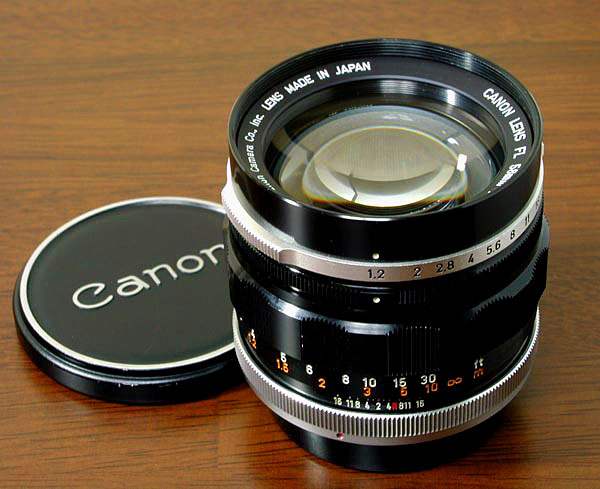
- The Canon FL 58mm f/1.2 represents the speed demon category. Before modern aspherical elements existed, Canon used thorium to manage the optical chaos of f/1.2 apertures. This lens is notoriously radioactive and remains a cult classic for portrait photographers who love its dreamy rendering.
- The Kodak Aero-Ektar 178mm f/2.5 is in a category all its own. This massive lens was built for WWII bombers for aerial reconnaissance. It's one of the most radioactive lenses you can buy, often emitting significantly higher radiation levels than consumer SLR lenses simply because of the sheer volume of glass involved. It's also remarkably sharp wide open and has found new life among portrait photographers willing to adapt it to modern cameras.
- The Konica Hexanon AR 57mm f/1.2 is often cited by collectors as one of the "hottest" consumer lenses ever made. With thorium elements at both the front and rear, this lens represents the peak of radioactive lens design. It's also optically excellent, which makes it particularly sought after despite (or because of) its radioactivity.
The Side Effect: The "Tea Stain" of Time
Here's where things get interesting. If you find a thorium lens that's been sitting in someone's attic for 40 years, it probably won't be crystal clear. Most of these lenses have developed a distinctive yellow or brown tint, ranging from the color of weak tea to strong bourbon.
This discoloration isn't just surface grime. It's caused by the thorium itself. As thorium decays, it emits alpha particles that bombard the silica lattice of the glass. This knocks electrons out of their natural positions, creating microscopic defects called color centers (or F-centers). These trapped electrons absorb blue light, which is why the glass appears increasingly yellow and brown over decades.
The impact on image quality varies. The color cast gives photos a heavy warm tint. Black and white photographers actually loved this, as it acted like a built-in yellow contrast filter, boosting contrast in skies and landscapes. In severe cases, the browning can reduce light transmission, with up to roughly 1-1.5 stops of light loss reported in badly yellowed examples. That f/1.4 lens effectively becomes an f/2.4 lens, which rather defeats the purpose of buying a fast lens in the first place.
The Cure: UV Therapy
The good news is that the yellowing is largely reversible. Those trapped electrons just need enough energy to jump back into their correct positions in the glass lattice, and ultraviolet light (or even intense blue light) provides exactly that energy.
The slow method is elegantly simple: place the lens on a sunny windowsill for 2-3 weeks. Direct sunlight contains enough UV to gradually clear the glass. The fast method involves using a high-intensity UV LED lamp, like the kind used for curing gel nail polish. You can also use short-wavelength LED lamps such as the now-discontinued IKEA Jansjö, which many users have successfully used for bleaching despite not being specifically designed as a UV source. Direct the light into the glass for a couple of days to several days, and the lens will clear up dramatically.
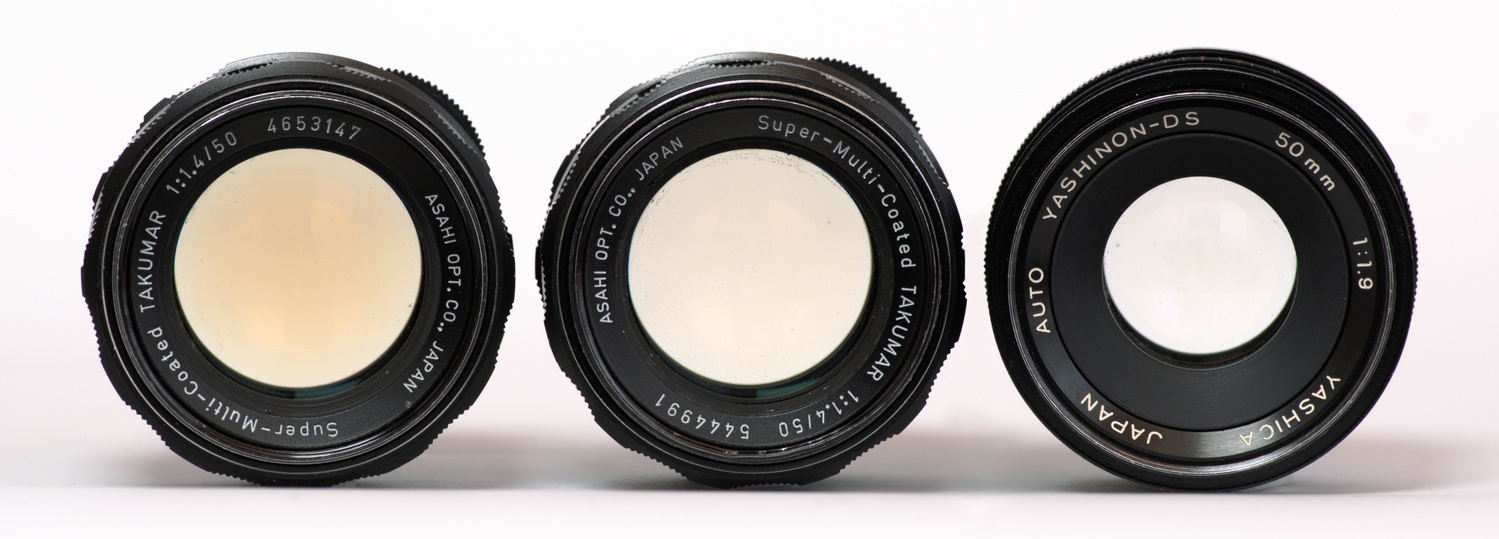
There's a catch, though. Once cleared, the lens will very gradually start yellowing again in dark storage over months and years. That's because the thorium never stops decaying. If you shoot the lens regularly and store it in light, it will stay relatively clear. But lock it in a dark drawer for extended periods, and the color will slowly return. It's a cycle you can repeat indefinitely without damaging the glass.
The Safety Reality: Don't Eat Your Optics
Thorium-232 primarily emits alpha particles, which are relatively heavy and slow-moving on an atomic scale. A sheet of paper stops them completely. The layer of dead skin on your hands stops them. However, thorium's decay chain also produces daughter isotopes that emit beta particles and gamma rays. Unlike alpha particles, gamma rays can and do penetrate the metal barrel of your camera and lens. If you hold a Geiger counter to the back of a camera body with a thoriated lens mounted, you'll detect radiation coming through.
That sounds alarming, but here's the context: regulatory studies estimate that a photographer using a thoriated lens heavily might receive around 0.02 millisieverts per year, while an average user receives roughly 0.007 millisieverts per year. Compare that to the 3-6 millisieverts per year everyone receives from natural background radiation (cosmic rays, radon, minerals in the ground), and you can see why this isn't a practical health concern. The exposure is measurable but quite small.
The main serious hazard is if the lens is broken and the glass dust is inhaled or ingested. Once inside the body, alpha emitters are highly toxic because they're in direct contact with living tissue. But this applies to any thorium-containing object and is easily avoided by the simple practice of not smashing your lenses.
There's one special case worth noting: thoriated eyepieces. If a viewfinder eyepiece or telescope eyepiece were made of thorium glass (more common in telescope and microscope optics than in camera viewfinders), it could cause cataracts after prolonged exposure. The eye lacks the protective layer of dead skin that covers the rest of your body, and the eyepiece sits in direct contact with living tissue for extended periods. This is the main risk scenario highlighted in regulatory assessments involving optical glass, and it's specifically called out in safety evaluations. Camera viewfinders with thoriated eyepieces are rare, but it's worth being aware of if you're buying equipment from the period.
One other minor consideration: if you store film in prolonged direct contact with a highly radioactive lens, it can fog the film over time. Keep a bit of distance in storage, and you'll be fine.
The verdict? According to regulatory dose assessments, these lenses are safe for normal photographic use by people in good health. Just don't sleep with a collection of them under your pillow, and definitely don't use one as a coffee grinder.
The End of an Era
By the late 1970s, manufacturers phased out thorium glass. As regulations around radioactive materials tightened and non-radioactive rare-earth glass formulations matured, manufacturers gradually replaced thorium dioxide with alternatives like lanthanum oxide. These new glasses provided similar optical benefits without the radioactivity or the yellowing problem.
Today, thorium lenses represent a fascinating footnote in photographic history. They're a reminder of an era when engineers pushed the boundaries of what was possible, sometimes with materials that seem shocking by modern standards. They're also still remarkably capable optical instruments, often delivering image quality that competes with far more expensive modern glass.
Disclaimer: This article is for informational purposes only. While thoriated lenses are generally safe for photographic use according to regulatory dose assessments, readers should exercise appropriate caution when handling any radioactive materials. Always follow local regulations regarding radioactive materials, and consult relevant safety guidelines if you have concerns.






So that explains my hair loss!
As a maternity and newborn photographer, this article really got me thinking. I’ve often heard rumours that some vintage lenses were “hot,” but it’s rare to find such a thorough explanation. The fact that certain lenses — especially from the 1950s to the 1970s — were crafted using glass with thorium oxide to improve optical qualities explains a lot.
From a creative standpoint, I can see why some photographers still cherish these lenses: the way they render light, tone, and contrast can give a very distinctive, almost nostalgic character. But from a health- and responsibility-conscious viewpoint — especially when photographing vulnerable subjects like newborns or pregnant clients — this article serves as an important reminder to treat such equipment with care.
For me, this reinforces the value of using optics and tools whose safety is certain. In the context of delicate shoots (maternity, newborn), I want absolute trust in every piece of gear — from lighting to lens — because I am entrusted with people’s most intimate moments.
I have a few of them. The Canon, Pentax, and not mentioned here a Nikon 35mm f/1.4.
I deal with antique avionics and they used radioactive paint to glow in low light. If the glass is cracked that means its leaking. Many women got cancer and died because they would lick the paint brushes between applications.