
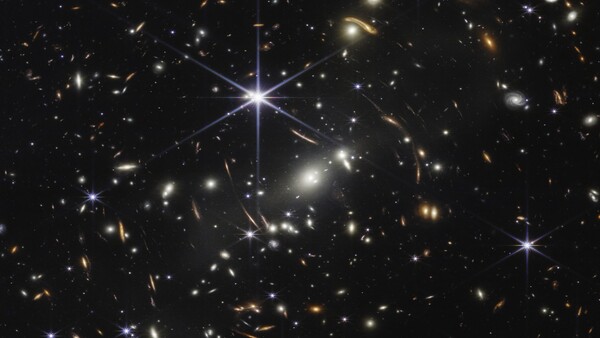
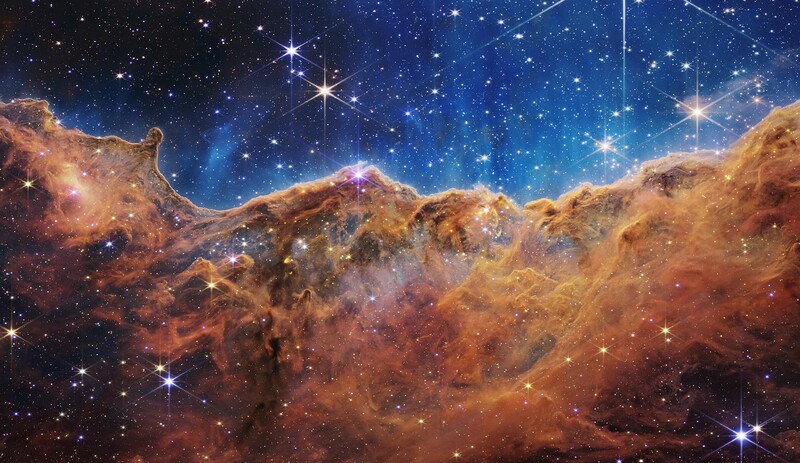
The teal peaks and orange haze of the "Cosmic Cliffs," the Carina Nebula image that helped introduce the James Webb Space Telescope to the world in July 2022, do not exist. Not those colors, anyway. Almost none of the light Webb recorded is light your eye can see, and every filter used for that particular image sits in the infrared. The moment you understand why, the picture gets more impressive rather than less.
Webb Sees Past the Red Edge of Human Vision
Start with the sensor. The Near-Infrared Camera, or NIRCam, is Webb's primary imager, and it works from roughly 0.6 to 5 microns. The Mid-Infrared Instrument, MIRI, reaches out to about 28 microns. Visible light, the stuff your eye and your camera's sensor respond to, tops out around 0.7 microns. So almost everything Webb collects sits past the red end of human vision. Its shortest filters just graze the deep red before the rest runs into the infrared. Much of it is thermal light, the glow of warm dust, along with the stretched-out light of ancient galaxies, not the light of a sunny afternoon.
There is a good reason to build a telescope this way. The universe is expanding, and light from the most distant galaxies gets stretched toward longer wavelengths on its way to us. Ultraviolet and visible light emitted by the first stars arrives here as infrared. Infrared also slips through the thick dust clouds that block visible light entirely, which is how Webb peers inside stellar nurseries that Hubble's shorter-wavelength view could barely penetrate. Put a telescope in the cold and point it at the infrared sky, and you see things no optical instrument can.
This is the detail that catches most people off guard. Webb's detectors are monochrome. Each of NIRCam's ten light-sensitive chips records brightness only, one number per pixel, with no color information at all. A single exposure is a grayscale frame where each pixel can land on any of more than 65,000 shades of gray. Color, in the sense your eye means it, is nowhere in the raw data. For the Cosmic Cliffs specifically, every filter used sits in the infrared, past the wavelengths your eye can perceive.
How Gray Frames Become Color
Webb sees in color the same way it sees anything specific: through filters. NIRCam carries 29 of them and MIRI carries 9. A filter is a piece of glass that lets through one slice of the infrared spectrum and blocks the rest. Some are broadband, passing a wide swath of wavelengths. Others are narrowband, tuned so tightly that they isolate the glow of a single element or molecule. The naming tells you the wavelength directly. F090W passes light near 0.9 microns, F444W passes light near 4.4 microns, and F470N is a narrow filter built to catch molecular hydrogen.
To make a color image, the team shoots the same patch of sky through several filters, one grayscale frame per filter. Then they assign a visible color to each frame and stack them. The rule that governs the assignment is called chromatic ordering, and it is refreshingly logical. Sort the filters by wavelength. Give the shortest infrared wavelength the shortest visible wavelength, which is blue. Give the longest infrared wavelength the longest visible wavelength, which is red. Everything else falls in between as green, orange, and so on. NASA calls that a baseline rather than a rule, and says its processors will sometimes reassign a filter to the next color along the spectrum to support the science. The Cosmic Cliffs image is a case in point. Its published color key runs F090W to blue, F187N to cyan, F200W to green, F470N to yellow, F335M to orange, and F444W to red, which puts the longest filter of the six at yellow rather than out at the red end where strict ordering would have placed it.
This is not a Webb invention, and it is not sleight of hand. It is the standard way astronomers have represented multi-filter data for decades, and amateur astrophotographers do the exact same thing at home. Shoot a nebula through a narrowband filter for hydrogen, another for oxygen, another for sulfur, then map each grayscale frame to a color channel and combine. The famous Hubble palette that colors so many backyard nebula shots is built on precisely this logic. The difference with Webb is only that the light it collects starts out invisible from the very beginning.
What Is Real and What Is Chosen
Now the honest accounting, because the question "is it real" deserves a real answer. A great deal of every Webb image is measured fact. The structure is real. Every filament, cavity, ridge, and pinpoint star sits exactly where the telescope recorded it. The intensity behind every pixel is a measurement, though what reaches your screen has been stretched. NASA runs a mathematical function that lifts the darkest pixels while holding detail in the bright ones, then balances the channels so the background carries equal red, green, and blue. Displayed brightness is a rendering of the measurement rather than a readout of it, which is why you cannot look at two regions and conclude from their brightness alone that one is emitting more strongly than the other. The relative wavelengths are the part that survives all of it. When you see blue and red side by side in a Webb image, you are usually looking at shorter and longer infrared wavelengths in that order, with the caveat that the ordering is a starting point rather than a promise. That relationship is data, not decoration.
What is chosen is the specific hue. There is no law of physics that says 4.4-micron light "is" red. It is red because red is the longest wavelength your eye can see, and the mapping mostly preserves the ordering your brain already understands. Swap in a different set of filters and the same nebula comes out looking completely different, yet neither version is a lie. Both are faithful translations of different measurements. Alyssa Pagan, one of the Space Telescope Science Institute's science visuals developers, put the logic plainly. "In terms of assigning color, we generally do some standard chromatic ordering because it has the most scientific value and meaning in it, and usually also gives you aesthetic images."
The team also has room to make choices, and they use it. Contrast gets stretched so faint structure becomes visible. Cosmic-ray hits and detector artifacts get cleaned out. And when a narrowband filter carries something scientifically important, the processors will sometimes assign it a color that contrasts with its broadband neighbor so the feature pops. That is almost certainly what happened to F470N in the Cosmic Cliffs: it is a narrowband filter tuned to molecular hydrogen sitting almost on top of the broadband F444W in wavelength, and giving the two contrasting colors rather than neighboring ones pulls the hydrogen away from everything else at that end of the spectrum. Pagan has been candid that this is a judgment call. "We will even stray from chromatic order sometimes, if we feel abandoning it helps see detail in a specific filter." That is an aesthetic decision layered on top of hard data, and the team is open about which is which.
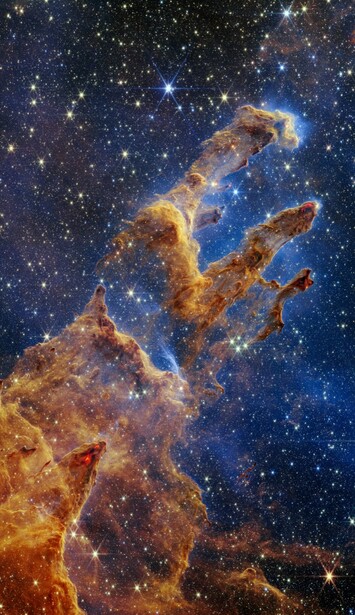
Her colleague Joe DePasquale has described why this flexibility matters using Hubble's Pillars of Creation, which combines three narrowband filters for oxygen, sulfur, and hydrogen. "The sulfur and the hydrogen are both red, so that would make a very red image with some cyan for the oxygen," DePasquale explained. "Being flexible about how you color the data, but maintaining chromatic order, is really what makes the images pop and allows you to pull more detail out." The colors are a visualization choice. The features they reveal are not.
Reading the Cosmic Cliffs
Go back to Carina with all of that in hand. What looks like a mountain range at golden hour is the edge of a gas cavity inside NGC 3324, about 7,600 light-years away. The tallest of those "peaks" stands roughly 7 light-years high. There is no ground, no sky, and no sunset. The cavity was hollowed out by ultraviolet radiation and stellar winds pouring off enormous young stars sitting above the frame, out of view.
The orange, cloudy lower half is dust and gas caught in NIRCam's longer-wavelength channels, which is why it reads warm. The dark blue-black upper region is comparatively empty space glowing faintly in the shorter wavelengths. Then look closely at the boundary. Webb's infrared eyes cut through the murk to reveal hundreds of stars that were completely hidden before, plus little jets and streams shooting off newborn stars still buried in the gas. Add MIRI's mid-infrared view and something else appears. Young stars wrapped in dusty, planet-forming disks light up in pink and red, glowing at wavelengths where their cool dust shines brightest.
None of that detail depends on the specific teal or the specific amber. Recolor the whole thing tomorrow and the stars, the jets, the dusty disks, and the towering ridge would all still be there, in the same places, built from the same measurements. The colors are the map legend. The territory is real.
Why "Assigned" Doesn't Mean "Fake"
The word people reach for is "fake," and it is the wrong word. A weather map colors temperature. A microscope image colors fluorescent tags. An MRI colors tissue density. Nobody calls those fake, because everyone understands they are translations of real measurements into something a human can read at a glance. Webb is doing the same job on a spectrum your eye was never built to receive. Pagan framed the objection and answered it in one breath. "There is an audience of people that think this is fake, just because it's representational. But when you're talking about ultraviolet or infrared, how else are you supposed to represent it?"
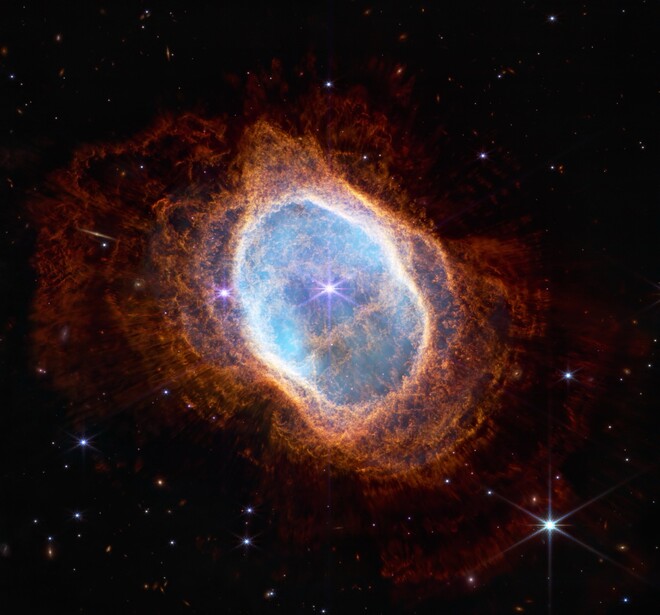
There is a version of these images even closer to raw truth than the beautiful ones, and it is the grayscale frame straight off a single filter. It is honest, it is precise, and it is nearly unreadable to anyone who is not staring at photometry for a living. Chromatic ordering takes six or seven of those frames and folds them into one picture your visual system can parse instantly, without discarding the measurements underneath. You are seeing more of what the telescope actually recorded in a colored composite, not less.
So the next time someone points at a Webb image and asks whether the colors are real, you can give them the whole answer. The colors were assigned, because the light was invisible and had to be. The wavelengths, the structure, and the intensities were measured, and the colors were assigned with the ordering of the data as the starting point. What you are looking at is a faithful portrait of a sky no human eye will ever see directly, rendered by people who tell you exactly what they did to it. That is a stronger claim to reality than most photographs can make.
Lead image. Image credit: NASA, ESA, CSA, and STScI; Public domain. Source



.png)
.jpg)

Join the Fstoppers community for free
-
Post comments and join in the discussions
-
Browse the site ad-free
-
Share your work and get featured in the community
-
Compete in the photo contests for fun and prizes
1 Comment
The way I see this is a form of color shifting, if that is the correct wording. Since everything is in the infrared spectrum, you have to shift the recorded information to the visible spectrum, where we can see and understand what our brain interprets as visible information. If you were to graph this out, it would make perfect sense, as you could see the shift.