
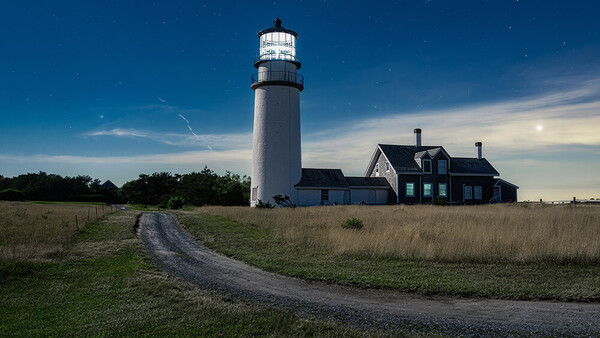
Night photography along the coast: it's evocative, eternal, calming—and surprisingly easy. While many of us enjoy hiking miles into the wilderness, you can create alluring night photos just steps from the car, right at the water's edge. Lighthouses, moonlit water washing over tide pools, and historic piers: the coast offers more night photography subjects than you might expect. Cape Cod or Cambria, the coastlines are already calling you.
Why Coasts?
I think most people are drawn to the ocean in some way. And photographing by the coast at night can be at least as calming as standing in the middle of the desert or the mountains. The infinite, boundless waters make a magical mirror for the moonlight to dance across.
Let's find out just how easy it is by exploring a tale of two coasts: Cape Cod in Massachusetts, then Cambria, along the Central Coast of California. I visited both within a month of each other, which felt like a rare treat.
Night Photography in Cape Cod, Massachusetts
I went to Cape Cod to visit Tim Little, a local night photographer in the area. He was the ultimate tour guide, taking me to his favorite places.
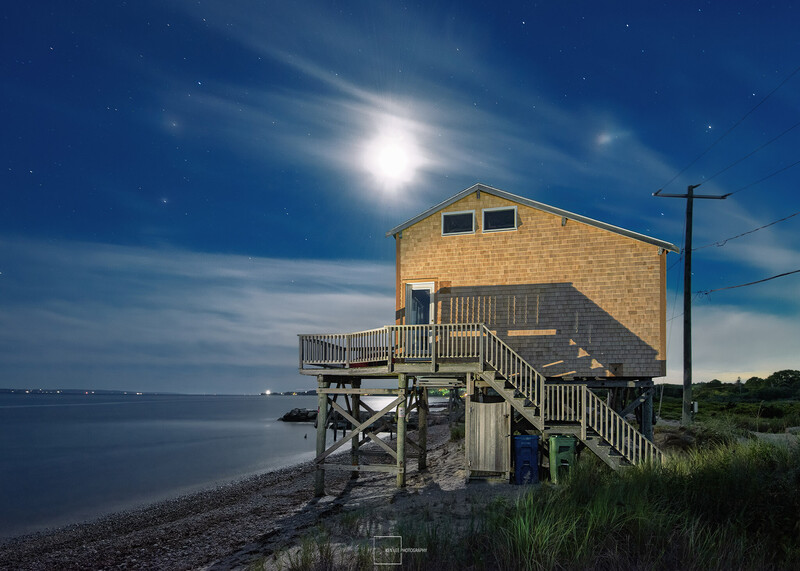
One of the most interesting spots was the stilt bungalow houses along Surf Drive in Falmouth. These immediately reminded me of AT-ATs. The houses could not have been more accessible. We simply parked in an empty lot across the street and walked over.
One of the beautiful aspects of photographing on the beach is how calming the air can be.
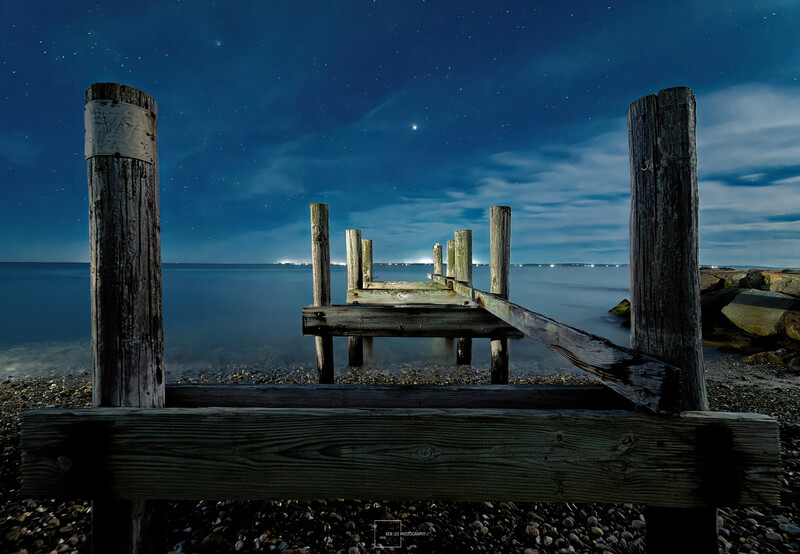
Also, during long exposures, the water smooths into a dreamy confection without any extra effort on your part. After all, a night photo is already a long exposure. Just set up your camera on a tripod, push it into the sand so it doesn't shift, and expose properly. For these photos by the stilt bungalows, I set my camera at a 30-second exposure at f/6.3, ISO 800, since the moon was out. Coastlines such as Cape Cod often have many lights nearby. In these photos from Falmouth, you can see the lights of Martha's Vineyard shining from just a few miles across the water.
Lighthouses
You can't go to Cape Cod and not photograph lighthouses, can you? No, I didn't think so. Nor should you.
Again, access couldn't be easier. Just pull into a parking lot. Many lighthouses on Cape Cod are this accessible, day or night.
The two lighthouses we photographed, Nobska Light and Highland Light, are both still in use, their lights warning ships of danger to this day.
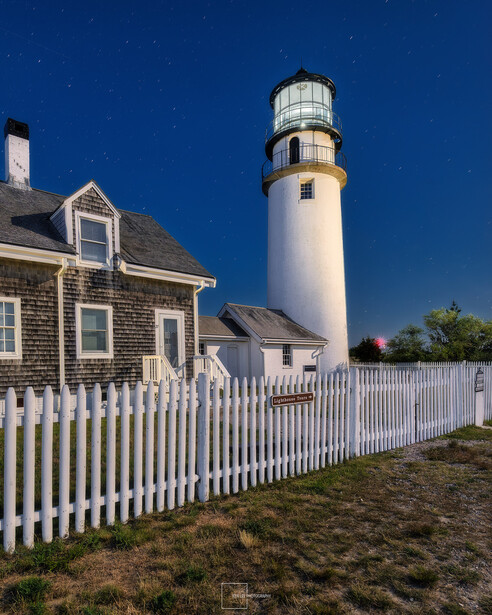
While you often don't need to light paint a lighthouse, I did find that adding a hint of light on Highland Light created more interest and gave a sense of direction to some of the ambient light in the photo.
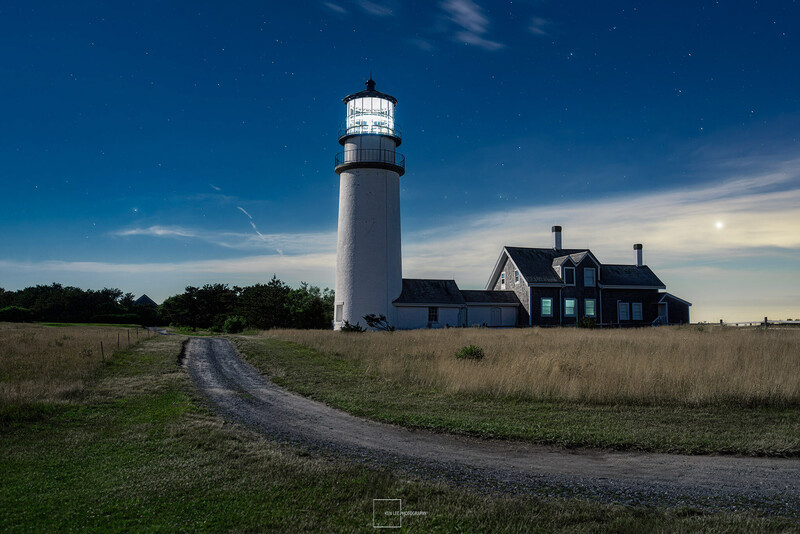
Highland's light has a very cool color temperature. It didn't look that way in person but appeared that way in the photo. This is because I was shooting with a custom white balance of 3,800 K, and the light appeared bluish. I selectively warmed it up in post-processing so it would look more natural.
The Extreme Dynamic Range and Blinking Light of Nobska
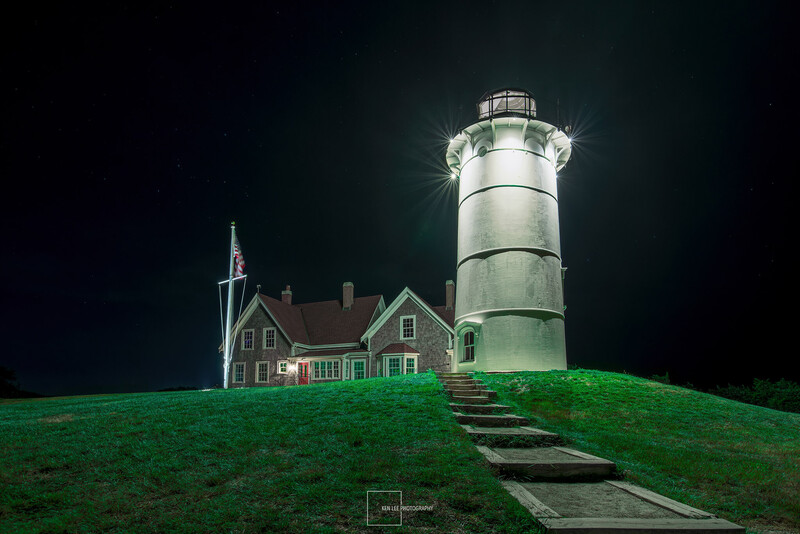
Nobska was lit up brightly. Because of the extreme dynamic range, I chose to take several different exposures by changing the shutter speed, then blend them together using Lightroom Classic. While you might shy away from this sort of post-processing, Lightroom Classic and other programs make it incredibly easy. Just take several exposures at different shutter speeds and let Lightroom do the rest, producing a final image that more closely resembles what our eyes actually see on location.
In the case of Nobska, however, it wasn't quite that simple. Because the light blinks on and off, Lightroom Classic struggled with what to do while blending the top light. Consequently, I chose the best single exposure of the light itself and blended it in manually using Photoshop.
And yes, we did visit Nauset Lighthouse on the trip, the one that appears on the bag of Cape Cod Potato Chips. However, we didn't photograph it at night. Next visit!
Photographing the Milky Way on the Coast
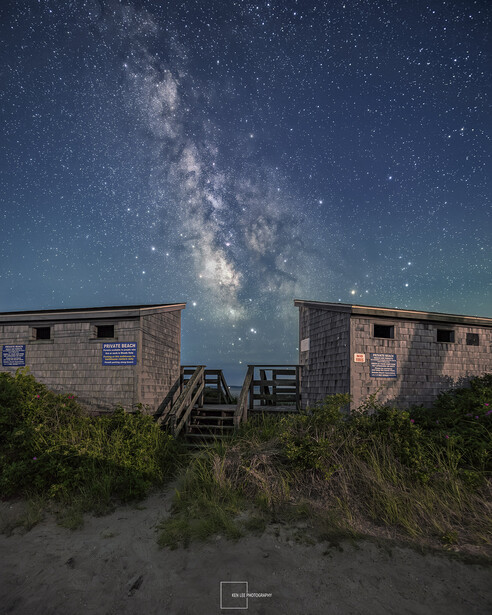
We had an opportunity to photograph the Milky Way before the moon appeared. Here at Woods Hole in Falmouth, the bathhouses bracketed the Milky Way core beautifully, and I felt as if I could walk up the stairs to the stars! I have a version where we light-painted the bathhouses. However, I went with the more subtle lighting provided by the ambient light nearby.
For a deeper look at astrophotography and post-processing, see Photographing the World 2: Cityscape, Astrophotography, and Advanced Post-Processing.
I realize I'm repeating myself at this point, but the ease of walking across the street, setting the camera down, and beginning to photograph the Milky Way so quickly felt like a treat. Where I live in the desert, it usually requires a bit of a drive to get away from the lights. Here, it just felt so easy. And again, the ocean air was very calming.
Night Photography in Cambria, California
Cambria is a very small town on the rugged Central California Coast, just south of San Simeon, where Hearst Castle is located. I was there on vacation with my wife, who wanted to spend a week by the coast. I snuck in three consecutive nights of night photography. And every night, I still managed to get in before midnight.
Photographing a Wooden Pier at Night


San Simeon Pier, California.
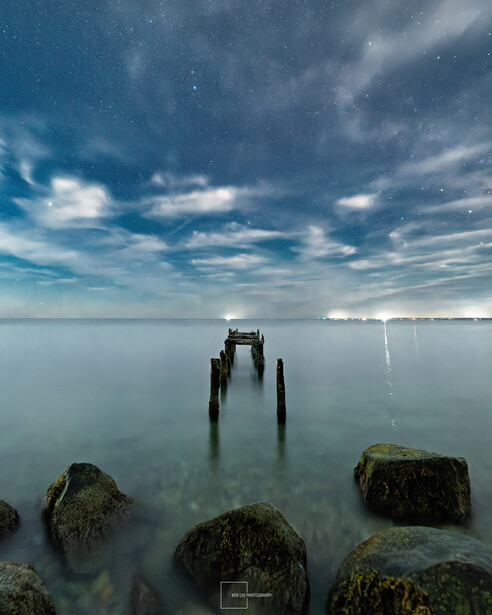
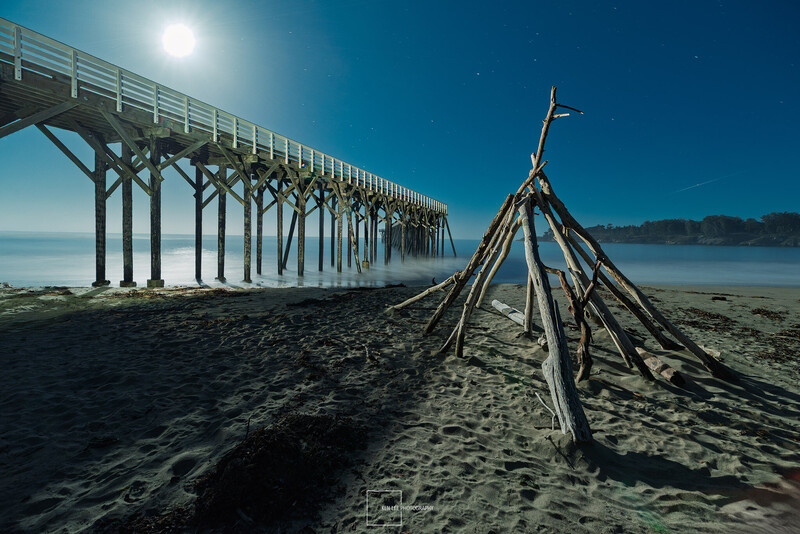
The first night, I went to San Simeon Pier, located just on the other side from the famous Hearst Castle. This involved simply parking on the street and walking through the open gate and through the park to the pier. The ocean was noticeably louder than Cape Cod, as its movements are less blocked by land and the surf is stronger.
I took several photos on the dock. Unlike other docks I've photographed, such as the one at Cayucos, this one had no lights whatsoever, making it comparatively easy to expose. The surf was so loud that a fisherman walking past me on his way to the far end of the dock startled me completely. I never heard him coming.
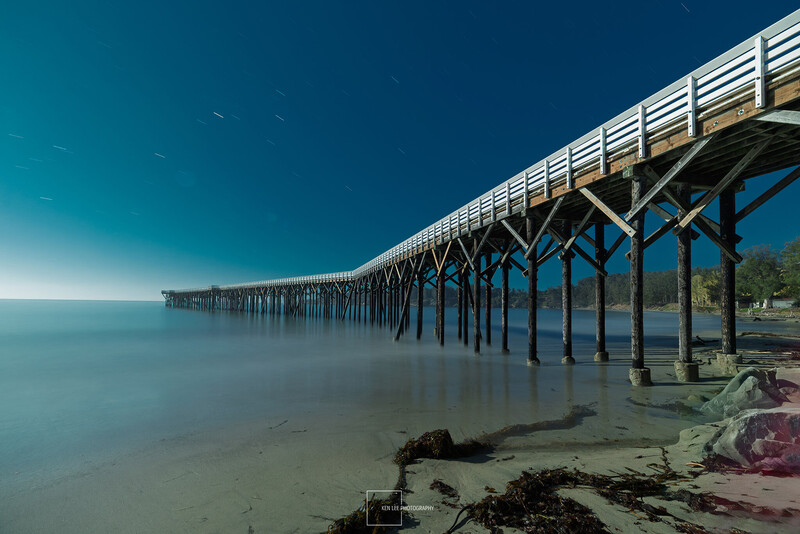
Photographing from beach level was also simple and accessible. I did a long five-minute exposure to smooth the water in one photo, just to see how it would look. On a one-minute exposure, I got lucky and captured a meteor.
The Rocky Shoreline
One of the things I love about the Central Coast of California is the rugged shoreline. Cambria has a little of this, although it's not nearly as rugged as its neighbor to the north, Big Sur.
Moonstone Beach


Moonstone Beach, Cambria, CA.
I photographed in a couple of places along the evocatively named Moonstone Beach. Here, there was ample parking right by the beach. No gates, no entry fee, nothing. A boardwalk runs the length of Moonstone Beach, with several access points, many of which have beautifully worn wooden steps leading down to the beach.
Here, you'll likely have company if you begin photographing just after dark, as I did. Both locals and tourists love to walk the boardwalk and linger at the benches. Who wouldn't want to do this?
Leffingwell Landing
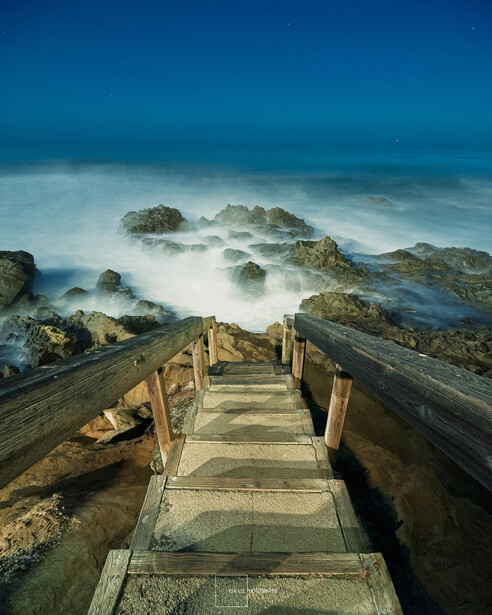
This access point is easy, although they close the gate after a certain hour. The workaround is to park just south of Leffingwell Landing and walk back into the parking lot. It also has stairs that lead to the rocky coast below, where the water meets the rocks.
Two Months, Two Coasts
Two coasts, two completely different personalities, and both surprisingly easy to photograph after dark. Cape Cod gives you history, lighthouses, and the quiet of the Atlantic. Cambria gives you raw Pacific energy, rocky shorelines, and the kind of dramatic foreground that makes night photographers very happy. But what both share is accessibility. Park, walk, shoot. No permits, no long hikes, no special gear. Just you, the water, the sea air, and the glorious night sky, bringing you whatever that brings you.
Sometimes that's a meteor. Sometimes it's a fisherman you never heard coming.
But you always have the seemingly limitless sea. And that means limitless opportunities for night photography.




Join the Fstoppers community for free
-
Post comments and join in the discussions
-
Browse the site ad-free
-
Share your work and get featured in the community
-
Compete in the photo contests for fun and prizes
No comments yet