

You use a red headlamp when you're walking around. It preserves your night vision. But if there are other astro-landscape photographers nearby, you're likely ruining their shots. You were trying to do the right thing. But you weren't.
Most of us were taught that red light is the night photographer's best friend. It is, but only for your eyes. Cameras don't care what your eyes prefer.
https://www.youtube.com/watch?v=_9rY7OYSpJ4
Red Alert! 35 photographers at work! This 2-hour, 43-minute time-lapse shows how often red lights leaked into the scene all night when night photographers used red lights to look at their cameras and get things from their backpacks, even though nobody meant any harm, even when they were 50–70 feet away from the foreground, in this case, Arch Rock in Aztec, New Mexico. Remember that even though this looks like lots of flashes of red light in this time-lapse, in reality, many of these lights were on for quite a few minutes. When there are this many photographers, you stay more for the social aspect than the astro-landscape photography.
How Thirty-Five Astrophotographers Ruined Each Other's Shots for Hours
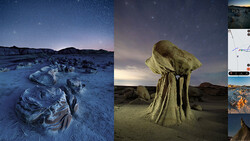
I made two presentations at the 2026 Nightscaper Photo Conference in Farmington, New Mexico, near Four Corners. One company organized an outing for Arch Rock in nearby Aztec. They had a sign-up sheet for about 15–20 people. Somehow, 35 people showed up.
Everyone set up in an approximate semicircle at the bottom of the valley, pointing at Arch Rock. About ten decided to photograph from the cliffsides on either side as well, mostly because there was not enough space in the bottom of the valley.
I was surprised at how often a group of 35 night photographers and astro-landscape photographers would flick on their red headlamps, and often for ten minutes at a time. I would have thought that most of them would be able to operate their gear without needing to keep lights on for long periods of time. And I would have hoped that they knew how much red lights ruin high-ISO astro-landscape shots since you would think that they would have affected their photos as well.
No such luck.
I decided to do a time-lapse video, which you can see above. The video illustrates how many times red lights leaked into the photo despite people's best intentions. And bear in mind that everyone in this photo except for one person was at least 50 feet behind the arch.

Why Everyone Thinks Red Lights at Night Are a Great Idea
Human night vision relies on rod cells. Rods are least sensitive to red light. Fantastic. If you use a red light, your eyes stay more adapted to the dark. That's the reason astronomers have used red lights for decades, and it's good advice for anyone who wants to see the sky.
The problem is that this is about eyes, not sensors.
Your Camera Is Not Your Eye
Your camera sensor records red light very well. The red filters over the pixels pass it right through. During a long exposure, the camera sensor keeps registering it for as long as the shutter is open. A light that feels dim to you can look surprisingly bright after 20 or 30 seconds. And if your camera has been modified for astrophotography with the infrared filter removed, it is even more sensitive to deep red.
Red light also doesn't stay where you point it. It bounces off rocks, sand, light-colored dirt, and tree trunks, and it ends up in frames even when the lamp isn't aimed at anyone's camera.
Then there's brightness. Many red headlamp modes are much brighter than people realize. Because red doesn't feel harsh, people tend to leave it on high and wave it around while they hunt for the buttons on their camera or whatever's in their backpack.
So What Should We Do Instead?
First, I would encourage everyone to be able to operate their camera in the dark. There typically aren't very many buttons on it anyway, and much of it is menu-driven or touchscreen-based.
When we begin night photography workshops, we ask that no one use red headlamps or red lights when we are photographing out in the field. Even though we often have our group of 8–10 people spread far apart, it's amazing how a faint glow of red light can light up the side of a building, hillside, or ground, ruining someone else's photo.
Instead, we encourage everyone to communicate and show common courtesy. We'll model this behavior as well. Before we use light, we ask if anyone else is "open." In other words, we are asking if anyone else has their shutter open before we shine a light.
Even if you are not in a night photography workshop, I am encouraging you to show common courtesy. If there are other photographers nearby, I would encourage you not to use red headlamps or other red lights unless you know that it won't cause an issue with them. Common courtesy goes a long way.
If you must use a red light, it's better to keep the beam pointed at the ground and at your feet, not across the landscape. While it may not prevent red light from being reflected, it certainly won't make it as bad. On familiar, relatively even terrain, you can generally walk perfectly fine with light pointed at your feet instead of blasting the area in front of you. Of course, safety comes first, particularly on unfamiliar or uneven terrain where more light may be necessary. A little courtesy goes a long way.
The Better, More Considerate Light
For walking around, I've started using a Nitecore TUBE V2.0 on its 1-lumen setting.
I know, 1 lumen sounds like nothing. But when your eyes have adjusted to the dark of night, it's amazing how much it lights up everything. I've hiked for many miles with this tiny light and used it to retrieve things from my backpack if I need a light (I generally have the location of most of my camera bag contents in specific areas so I can find them in the dark).
And yes, the Nitecore is a white LED light. And white light does wreck adaptation more readily than red light. All that is true. But I've found that since it's very dim and I am pointing it at the ground, it takes very little time to adapt to darkness again.
The Nitecore light is a tiny keychain light that doesn't light up half the landscape and lasts for over 50 hours on one charge. It's far less likely to cause trouble for the people around me. It still isn't invisible to a camera, so the same rules apply: point it down at the ground, use your hand to block light, and ask before using it if there are other photographers around you.
And not to worry, if for some reason, 1 lumen is not enough for you, it ramps up to as high as 55 lumens. But in the six months that I've used this light, I've never had to use higher than 1 lumen.
As a bonus, I find that inadvertent light from white 1-lumen lights is considerably easier to remove from photos in post-processing than the rude, brighter, ugly glow of red light leaking onto everything.
The Bottom Line
Red is better for your eyes. It is not better for other people's astro-landscape photos. Knowing this can make such an enormous difference when there are other night photographers nearby.
What's the worst light intrusion you've ever had on a shoot? Tell me in the comments.
Join the Fstoppers community for free
-
Post comments and join in the discussions
-
Browse the site ad-free
-
Share your work and get featured in the community
-
Compete in the photo contests for fun and prizes
1 Comment
So 35 photographers are at the same subject… people not using their headlamps is just not gonna happen. Be realistic, saves a lot of frustration. And just avoid these overcrowded spots.
I would absolutely avoid such busy places, however great they might be. My take on this is not a red light problem ruining Astro shots, but everyone’s need to do the same thing and be at the same locations.