
A few weeks ago, I was preparing a talk about marketing for photographers when I found myself doing some math on my Instagram account. Like most photographers, I have made social media part of my weekly routine. I create content, respond to comments and messages, post recent work, and generally try to keep the account active. When I sat down and estimated how much time I spend on Instagram, I came up with roughly six hours a week. At first, that didn't feel particularly significant.
It didn't sound particularly dramatic until I multiplied it by 46 working weeks per year. Suddenly, Instagram wasn't six hours a week anymore; it was 276 hours a year. Seeing the number laid out like that made it feel far more substantial, and it prompted me to take the calculation a step further.
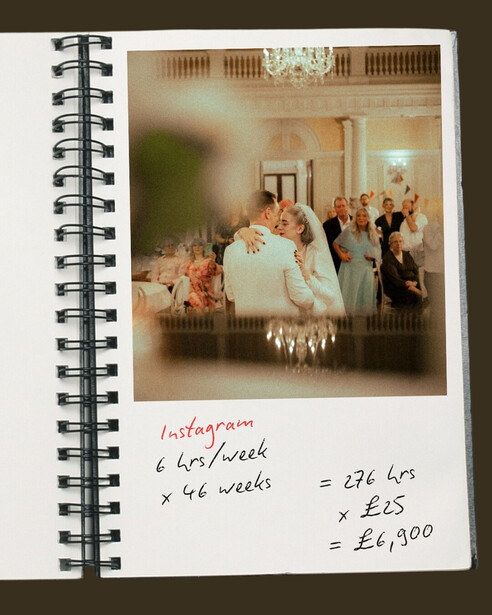
Out of curiosity, I decided to put a value on that time. I picked a conservative figure of £25 per hour. Nothing extravagant, just a reasonable estimate of what that time might be worth if it were spent elsewhere in the business. The result was £6,900, and that was the moment the question changed.
For years, the conversation around Instagram had always been the same one photographers have everywhere online: should I post more, should I post less, are Reels still worth doing, is Instagram dead, is it still worth the effort? But once I had a number attached to it, none of those questions felt particularly important anymore. The question became whether Instagram was worth £6,900 a year. Not because that's what Instagram costs financially, but because that's what it costs me in time.
The more I thought about it, the more I realized that photographers have a strange relationship with marketing. We're surrounded by marketing advice (arguably too much of it). Open any photography Facebook group, and you'll find endless discussions about content strategies, posting schedules, SEO, blogging, TikTok, Pinterest, email marketing, Google Ads, and a hundred other ways to attract clients. Yet despite all those conversations, very few photographers seem to know how their inquiries actually found them.
The Photography Industry's Favorite Hobby
If photographers have a favorite business pastime, it's discussing marketing tactics. Should you post three times a week or every day? Should you focus on Reels? Is TikTok worth it? Does blogging still work? Should you niche down? Should you show your prices?
Most of these discussions go round in circles because they start from the assumption that there must be a universal answer. The reality is that marketing is rarely that simple. A strategy that works brilliantly for a luxury wedding photographer in London may be completely useless for a family photographer in rural Norfolk, and a tactic that generates inquiries for one business may produce nothing for another.
Yet photographers often talk about marketing as if there are hard rules. That's how we end up with statements like "Nobody reads blogs anymore," "TikTok is only for teenagers," "Wedding fairs don't work," "Instagram is dead," and "SEO takes years." The thing that fascinates me about these statements isn't whether they're true or false, but how rarely anyone asks for evidence.
Marketing Folklore
I've started thinking of these ideas as marketing folklore. Folklore isn't necessarily wrong; in fact, it often starts with a genuine observation. A photographer tries TikTok and gets no inquiries, another books several weddings from a wedding fair, and a third sees success from blogging. Those experiences are real.
The problem is what happens next. Personal experiences become recommendations, recommendations become accepted wisdom, and eventually, nobody remembers where the original claim came from. At that point, the advice stops being tested and starts being repeated.
The photography industry is full of these inherited beliefs. We pass them around from photographer to photographer until they begin to feel like facts. The problem is that what feels true isn't always what holds up in reality. Feelings aren't facts. What matters is data and firsthand experience, not hearsay or repeated opinions.
What Our Data Actually Said
One of the most useful things we've done in our business is track where inquiries come from: not where we think they come from or where photographers online tell us they come from, but where they actually come from.
Looking at last year's figures, our sources broke down as follows:
- Google: 45 inquiries and 17 bookings
- Word of mouth: 10 inquiries and 6 bookings
- Instagram: 9 inquiries and 5 bookings
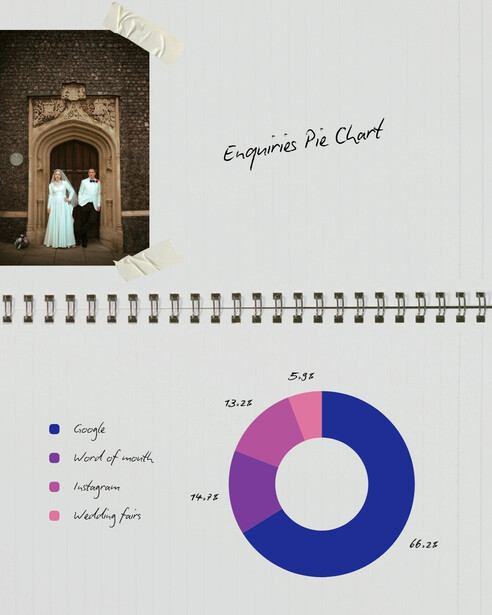
Those numbers don't prove that Google is better than Instagram, and they don't prove that social media is a waste of time. What they do provide is evidence. Without that information, every conversation about marketing becomes speculation. With it, we can start making informed decisions.
Of course, marketing channels don't exist in isolation. Someone might discover us through Google and then visit our Instagram before inquiring. Likewise, a past client might share one of our posts, which leads to a recommendation months later. Marketing is rarely as tidy as a spreadsheet. But that's precisely why measuring everything you can is more useful than relying on assumptions.
One of the things that struck me when looking at the figures was how different they were from the conversations photographers tend to have online. Social media dominates marketing discussions in photography circles: entire conferences, courses, podcasts, and Facebook groups are built around it. Yet the strongest source of inquiries in our business wasn't social media at all. It was Google.
Had we not been tracking our inquiries, I suspect I would have overestimated the importance of Instagram simply because it's more visible. That's another trap photographers fall into: we tend to pay attention to whatever is most obvious.
We Measure What Is Easy
The uncomfortable truth is that photographers often measure the wrong things. We know how many followers we have, how many likes our last post received, how many people viewed a Reel, and what our engagement rate is. The trouble is that none of those metrics tell us whether our business is growing. Followers aren't bookings, reach isn't revenue, and views aren't inquiries.
Those metrics can be useful, but only if they're connected to something that matters. The problem is that social media platforms make those numbers incredibly easy to see. Every time we open the app, we're greeted by fresh statistics, so it's no surprise that we become obsessed with them. Tracking inquiries, bookings, and return on investment is harder, but those are the numbers that actually determine whether your marketing is worthwhile.
If you would rather put those hours into work that compounds, a structured course such as The Photography Business Training System by SLR Lounge covers the business side that most of us learn by trial and error.
The Most Overlooked Marketing Metric
The concept I keep coming back to is opportunity cost. Every hour spent on one activity is an hour that can't be spent somewhere else, and the 276 hours I spend on Instagram every year don't exist in a vacuum.
Those hours could be spent improving our website, writing blog posts, building venue relationships, improving client experience, or even doing absolutely nothing and taking a well-earned break.
It's also worth saying this clearly: Instagram isn't free. It might not cost money to use, but it costs time, and time is one of the most valuable resources in any business.
That's why I think the question "Does Instagram work?" is often the wrong question. The better question is whether Instagram is the best use of those 276 hours.
The same applies to every marketing activity: blogging, networking, wedding fairs, Google Ads, TikTok. None of them exist in isolation. Every marketing decision involves choosing where to invest limited resources.
Why I'm Experimenting With TikTok
At the time of writing, I'm running an experiment with TikTok. Not because I'm convinced it's the future of photography marketing, not because somebody told me I need to be on it, and certainly not because I know it's going to work. I'm doing it because I don't know.
I've heard photographers claim TikTok is essential, while others insist it's a complete waste of time. Rather than choosing a side, I've decided to test it. The experiment is simple: post consistently and track whether TikTok generates a genuine inquiry.
I don't care about views, followers, or likes. I care about whether it generates an inquiry. The result might be positive, negative, or somewhere in the middle, but whatever conclusion I reach will be based on evidence rather than opinion.
Ask Better Questions
The longer I've been in business, the less interested I've become in marketing tactics and the more interested I've become in marketing questions.
Instead of asking whether Instagram is dead, ask how many inquiries it generates. Instead of asking whether blogging works, ask how many visitors it brings to your website. Instead of asking whether wedding fairs are worth it, ask how many bookings they produce.
Most importantly, whenever somebody gives you marketing advice, ask a simple question: how do you know? Not because they're wrong or because you're trying to catch them out, but because evidence matters. And remember that what works for their business might not work for yours.
The photography industry doesn't have a shortage of marketing advice. If anything, it has an oversupply of it. What it lacks is a culture of measurement.
The photographers who build sustainable businesses aren't necessarily the ones chasing every new platform or trend. More often, they're the ones paying attention to what actually works in their own business. They're tracking where inquiries come from, understanding what converts into bookings, and making decisions based on evidence rather than assumptions.
Marketing will never be completely predictable. There will always be uncertainty, but uncertainty becomes a lot easier to manage when you're measuring the things that matter.
And that starts with a surprisingly simple question: how do you know?




Join the Fstoppers community for free
-
Post comments and join in the discussions
-
Browse the site ad-free
-
Share your work and get featured in the community
-
Compete in the photo contests for fun and prizes
1 Comment
If everything I know is wrong, then I'd say that the last 50 years in business was a disastrous waste of time. The fact is, I've enjoyed my career and done well, throughout decades prior to the existence of social media, and without it during the last 20 years when every self-proclaimed marketing expert was saying that I couldn't survive without Facebook or Instagram.
The key idea you're driving at is that what's best for one business is not necessarily best for another. Very true. A key factor, from my position, is whether you're predominantly business-to-business, or business-to-consumer. The narrower you can focus your marketing message to your target audience, the more effective your advertising will be. Marketing 101. Everybody knows that. But social media has sort of a magical drawing power because it's so easy, with an illusion that it's doing all the marketing I need to do. There's nothing inherently difficult about posting to social media. At least not like the discomfort of, say, making an unsolicited phone call introducing yourself, or greeting a stranger at a networking conference. But that's exactly what has kept my business going all these years. Social media is not marketing. It is merely one tool at the disposal of a larger overall marketing plan. As a wedding photographer, I can see how Facebook could leverage your exposure to the friends of those people who hire you to do their wedding. That would fall into the referral category, and a lot of businesses exist solely from referrals. Most wedding couples would seemingly choose a local photographer, so what good does an Instagram reach around the planet actually doing for you? If you're looking to make a splash with a commercial or travel photography business, then maybe that exposure makes sense. For most of us, I suspect Instagram is a shot in the dark.
You're right though.... 276 hours a year is a major investment in your business. I have a routine of making a few phone calls every day (M-F), rarely taking more than 20 or 30 minutes. I call qualified prospects in the interior design industry within about 300 miles, covering both Denver and Salt Lake City. I try to ask what sort of problems they're having with sourcing artwork. I follow up with email and snail mail note cards. Not everything from the past is irrelevant today. I am 71; my customers are every age from 25 - 85. You would never know by listening to one of our conversations that there are generational differences between us. There are a lot of young people who are as curious or skeptical of AI as old people who are defensive about it. People appreciate the human touch, and genuinely enjoy having someone who listens. It never goes out of style.