

One company photographs roughly 30 million children a year. Not over a decade. In a single school year. A kid sits on a stool, a stranger says "chin down, eyes up here," a strobe fires, and the whole thing is over in the time it takes to sneeze. Multiply that by tens of millions and you have the largest sustained portrait operation the world has ever run.
The company is Lifetouch, and for most of a century it has owned the American classroom the way a utility owns the power lines. Those 30 million are the numbers its chief executive gave in early 2025, alongside contracts with around 50,000 schools and childcare centers, and the footprint has narrowed since: Lifetouch Canada is now privately owned by Everest Solutions, and a block of U.S. high school accounts transferred to a competitor in 2026, with Murphy saying the company would turn a sharper focus to K-8 and select high schools. It has bought more than 250 smaller studios to get there. Before those divestitures, and depending on who was counting, it controlled somewhere between a third and half of the entire school photography market, which is enough that people who work in the trade have spent decades calling it a monopoly.
What makes picture day fascinating is not that it produces good photographs. What makes it fascinating is that it is one of the most efficient image-making machines ever built, and almost nobody thinks of it as an industry at all. It hides in plain sight, inside a manila envelope your parents left on the kitchen counter.
From a $500 Idea to 30 Million Faces a Year
The story starts in 1936, in the middle of the Great Depression, when two men named Bruce Reinecker and Eldon Rothgeb pooled $500 and set out to bring what they called "school photography of distinction" to one-room schoolhouses across rural Minnesota. They named the company National School Studios. Within a little more than a decade, it was one of the largest school photography firms in the country.
The name most people know it by came later. The company adopted the Lifetouch brand in the 1980s, and it is still headquartered in Eden Prairie, Minnesota. Reinecker made one decision along the way that shaped everything about how the business grew. In 1978, he transferred 100 percent of the company to its workers through one of the first Employee Stock Ownership Plans created under new federal law. For decades afterward, Lifetouch was the world's largest employee-owned photography company, and the photographer standing in your school gym had an ownership stake in the negatives.
Scale was the whole strategy. A studio portrait is a craft product. A school portrait is a logistics product. The genius of the model was realizing that the photograph is almost incidental. What Lifetouch actually sells is access, a repeatable process, and a distribution network that reaches nearly every child in the country on a predictable calendar. Once you frame it that way, you understand why the company kept buying competitors instead of trying to take better pictures than them.
How the Machine Actually Works
Picture day runs like a factory line because it is one. A photographer, or a small crew, arrives before the first bell with a collapsible backdrop, a strobe or two, a stool, and a laptop for tethered capture. Classes are marched down in sequence. A helper hands the photographer a pre-labeled card or scans a barcode so the image is tagged to the right student before the shutter even fires. The child sits, gets thirty seconds of direction, and is replaced by the next child. A fast shooter moves through hundreds of kids in a day, sometimes a thousand across a big school, at a pace closer to a toll booth than a portrait sitting.
The mottled blue or gray canvas behind you is a deliberate choice. It is neutral, it hides wrinkles, and it reproduces consistently under a single hard light no matter which gym or cafeteria the crew is working in. That last part matters more than it sounds, because consistency, not beauty, is what lets a national company promise the same product in Ohio and Oregon.
More operators now shoot against a green screen instead. The reason is pure economics. Chroma key lets a parent choose a background later, from a wooded autumn scene to a marbled studio gradient, without the crew hauling ten physical backdrops or reshooting anything. Green is the standard color because it sits far from human skin tones and rarely shows up in clothing, which is exactly why picture day scheduled on St. Patrick's Day has produced a small internet genre of children who appear to be floating disembodied heads after their green shirts keyed out along with the background
Then there is the safety valve that keeps the line moving: retake day. Because the crew cannot stop to coax a smile out of a crying kindergartner, the system is built to absorb failure. Blinks, scowls, and cowlicks are all fixed by simply scheduling everyone who wants a redo onto a second date weeks later. Students are typically photographed whether or not the family orders anything, because the image may also be needed for ID cards, yearbooks, and rosters, though the specific uses vary by school and parents can generally opt out. The portrait exists first as administrative data. The keepsake is a byproduct the company then tries to sell back to you.
None of this is glamorous work, but it is genuinely hard to do fast and well. Directing a nervous six-year-old to a usable expression in under a minute, hundreds of times a day, is a real skill, and it is closer to the volume discipline behind a good fast, repeatable headshot than most people assume. The difference is that a headshot photographer might shoot one subject for an hour. The school photographer has about the length of this sentence.
The Economics of the Order Form
The order form is where the business actually lives, and it is a small masterpiece of behavioral design. Packages typically run from about $15 at the low end to more than $100 at the top, and they are built around a unit almost no one has used since the flip-phone era: the wallet-size print. A mid-tier package might bundle one 8x10, a couple of 5x7s, and a sheet of wallets, sized so that a parent can peel off a print for every grandparent, aunt, and coworker who might expect one.
The pricing ladder does the persuading. The first package is full price, and each additional package is discounted, which nudges families toward buying more sheets than they will ever mail. Premium tiers layer on retouching, digital downloads that let you own the file for roughly $25 to $35, and extras like magnets or class-composite prints that cost almost nothing to produce at volume. A Lifetouch survey cited by Consumer Reports found that 96 percent of parents want the official school photo, though wanting one and buying a package are different things. Lifetouch chief executive Ken Murphy has said the company needs roughly 30 percent of parents at a school to buy, at an average order around $25, to cover labor, transportation, equipment, printing, and shipping. What is close to universal is the audience, and it renews every single year with a fresh batch of five-year-olds.
Fall picture day alone accounts for roughly half of Lifetouch's business. The rest comes from spring photos, sports and club pictures, class composites, yearbooks, senior portraits, and the preschool and daycare market, each with its own order form and its own package ladder. Estimates of the total U.S. school photography market vary by source, from a little over a billion dollars a year to broader industry-research figures approaching three billion, but every version of the number describes the same thing: an enormous, recurring, almost recession-proof river of small transactions. Nobody pays a lot for school pictures. Enough people pay a little.
The economics of running that kind of volume operation are counterintuitive, and they are worth understanding for anyone who thinks about the business side of commercial photography. The margin is not in any single sitting. It is in owning the contract with the district, showing up every year, and converting a captive, guaranteed audience at a modest rate. The contract itself is not the payday. Nobody pays Lifetouch to turn up on picture day; the deal buys the right to work the job, and the money comes back only when parents order. To win that right, the company often promises the school or district a cut. Murphy says commissions run anywhere from 15 to 50 percent of sales, sometimes instead a flat $2 or $3 per package, sometimes a guaranteed minimum or a signing bonus, and those payments are baked into what parents are charged. A portrait studio lives and dies on marketing. Lifetouch never had to find its customers. The customers were required by law to show up in a building the company already had a contract with.
A Near Monopoly Built on 250 Acquisitions
You do not photograph a third of American schoolchildren by being slightly better than the competition. You do it by buying the competition. Over the decades, Lifetouch absorbed more than 250 smaller school-photo firms, rolling regional studios into a single national network until, in many markets, the local company that used to shoot your school simply was Lifetouch under a different logo.
That kind of consolidation is durable because the barriers to entry are quietly brutal. A challenger does not just need a good photographer. It needs the crews, the printing and fulfillment plants, the customer-service operation for a million order questions, the software to tag and track tens of millions of images, and, above all, the relationships with school districts that get renewed year after year on inertia and, in a lot of places, on a commission the district would have to give up to switch. A superintendent has very little reason to switch vendors for a service that basically works and that no parent is demanding be improved.
The market is not frozen, though. Regional players like Inter-State Studio have real footholds, Jostens dominates the yearbook side, and newer companies pitch schools on better galleries and less pushy sales. In August 2025, a company called CADY, founded in 1999, acquired Lifetouch's high school photography accounts and its Prestige senior portrait brand in select schools across the Mid-Atlantic, Southeast, and Texas, with the accounts serviced by Lifetouch through the 2025-2026 year before transitioning in the summer of 2026. The senior-portrait end of the business, where families spend real money on something they actually care about, is exactly where a focused competitor can pry the giant's grip loose.
The Ritual Nobody Chose but Everybody Kept
Strip away the business and what remains is one of the last truly universal American rituals. Picture day arrives on the calendar like a minor holiday. There is the outfit debated the night before, the comb kept in a teacher's desk, the awkward instruction to fold your hands on an invisible ledge, the tilt of the shoulders no human body naturally makes. For one morning, an entire generation of children performs the same small ceremony in front of the same mottled cloud.
The output is a strange and specific document. School portraits are almost never world-class photographs by any standard a working shooter would apply, and that is the point. They are honest. The bad haircut, the missing tooth, the shirt your mom made you wear, the year you decided to try a smile that did not work: it all gets fixed at the same focal length, under the same flat light, with the same slightly startled expression. Lined up in a row down a hallway wall, they become a flip-book of a person becoming themselves, and no one directed it toward flattery.
That is why the pictures survive in shoeboxes long after better photographs get deleted. Your parents ordered too many wallets, and decades later a stack of them turns up in a drawer, and the sheer sameness of the format across every grade is what makes the change legible. A wedding photographer chases a moment. Picture day just shows up, every year, and records that you existed at that height, on that date, with that expression, whether or not it was a good one.
What Changed, and What Didn't
In January 2018, Shutterfly agreed to buy Lifetouch, and the deal closed on April 2 of that year for $825 million in cash, on a cash-free, debt-free basis. Shutterfly financed the whole purchase price with an $825 million incremental term loan that closed alongside the acquisition. Shutterfly, a company built on turning digital photos into printed books and cards, expected the acquisition to add roughly $935 million in annual revenue. It was buying the one thing an internet photo company could not manufacture: a guaranteed, recurring, physical relationship with tens of millions of families, delivered through the school system instead of an app.
Almost nothing about the underlying machine changed. Phones killed the market for casual prints, and they took a real bite out of picture day as well. Murphy calls the smartphone a seismic shift and says that where three out of four families once took part, fewer do today. What did not happen is a collapse, because the school portrait was never really competing with your camera roll. It is a credential, a ritual, and a keepsake all at once, and no parent has figured out how to reproduce the class composite or the yearbook headshot at home. The technology under the hood modernized, from film to tethered digital to green-screen compositing, but the transaction stayed exactly the same. A stranger photographs your child at school, and a few weeks later you decide how many copies of that face you want to own.
Somewhere this fall, a photographer is setting up a stool in a gymnasium before sunrise, taping down a backdrop, and preparing to make several hundred portraits before lunch. None of them will hang in a gallery. All of them will outlive most of the photographs taken with far better cameras that same day, sitting in drawers and yearbooks and hallway frames, quietly doing the one job the largest portrait operation on earth was built to do.
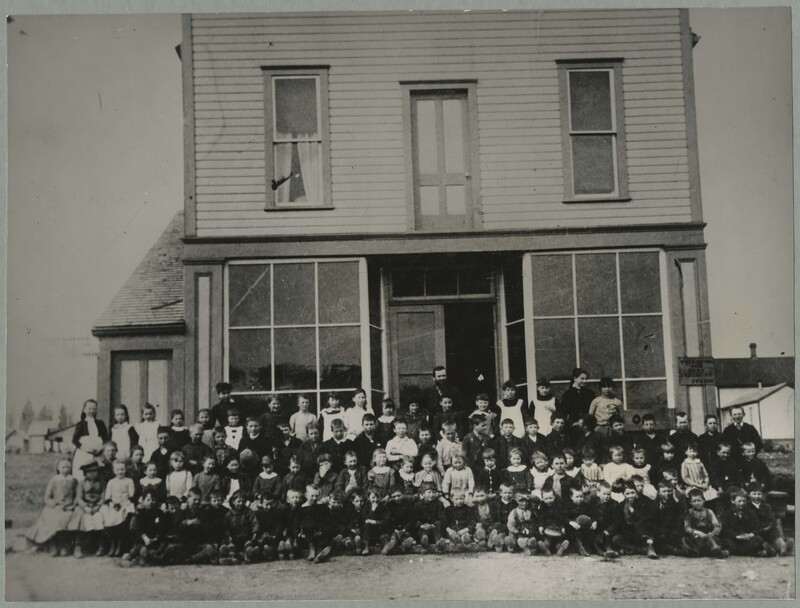
Lead image: a vintage American class portrait, circa 1890, the same universal ritual the largest portrait operation on earth would later industrialize. Photograph by Novelty Photo Co. via the Digital Public Library of America. Public domain. Source.





Join the Fstoppers community for free
-
Post comments and join in the discussions
-
Browse the site ad-free
-
Share your work and get featured in the community
-
Compete in the photo contests for fun and prizes
No comments yet