

I learned early that a lot of "broken" film cameras aren't broken—they're just stuck. The symptoms were always the same: you'd cock the shutter, press the release, and nothing would happen… or it would fire once and then lock up like it was offended you asked it to work in 2026. Sometimes it wasn't a dramatic failure, just that dead, sluggish feeling of old grease turning into glue.
Back then, I treated it like a gritty mechanical problem you could muscle through. And sometimes I got lucky. But the longer I stayed in the analog world, the more I realized something important: a shutter isn't a door hinge. The difference between "it works again" and "it works accurately" is where most DIY confidence goes to die. These days, I'll still chase the obvious, external culprits—battery issues, corrosion, sticky controls, basic function checks. But when the problem lives inside the shutter mechanism (especially leaf shutters and compact internals), I don't romanticize it. That's when I'd rather pay for a real CLA than gamble my favorite camera on guesswork. The point isn't fear—it's respect for precision.
The Economic Reality of 2026: Why Repair Is Your Best Investment
In the current market, a camera that isn't firing accurately isn't just a nuisance; it's a financial liability. We are living through a period where film has transitioned from a casual hobby into "luxury craft" territory. Since 2022, we have seen repeated price hikes from major manufacturers. Fujifilm saw increases as high as 52% in 2025 on certain stocks, and Kodak Alaris adjusted prices multiple times leading into 2025.
The raw materials are adding pressure to this "narrower window" for film shooters. Silver—the literal building block of traditional emulsions—broke the psychologically important $30/oz threshold in May 2024, touching its highest levels in over a decade. When you combine expensive film with rising chemistry costs, every "blank" frame caused by shutter lag or a light leak is money literally evaporating.
A professional clean, lubricate, and adjust (CLA) often starts at $150–$250 for many 35mm SLRs and can run $300+ for rangefinders, leaf shutters, and medium format—especially when parts or calibration are involved. While that feels steep upfront, consider that color film is now a "premium hobby" where a single roll is a "treat, not a habit." If your camera ruins just four rolls of film a year through mechanical inconsistency, a professional CLA has already paid for itself in 2026 dollars.
The DIY Threshold: What Stays on Your Desk?
Before you ship your heirloom off for an eight- to fourteen-week sabbatical, there are "low-friction" fixes you can manage at home. For parents and teachers, these can serve as a STEM lesson in cause and effect for the Gen Alpha generation.
1. Battery Corrosion and Contacts
If a camera won't power on, don't assume the electronics are fried. Often, old batteries have leaked, creating a crust of potassium carbonate.
The Fix: Neutralize the crust with a mild acid (like vinegar) and a Q-tip, followed by high-percentage isopropyl alcohol.
Why it matters: Many "dead" electronic SLRs from the 1980s are revived this way for pennies.
2. Replacing Light Seals
Light leaks are the most common reason for ruined film. If you see orange streaks across your frames, your foam has likely perished.
The Fix: Buy a pre-cut foam kit. Scrape out the gummy residue with a bamboo skewer and apply the new seals.
The Benefit: This is a safe, high-impact repair that requires zero mechanical disassembly.
3. The "Exercise" Ritual
Mechanical cameras are like athletes; they shouldn't sit idle. Old lubricants can settle and become "adhesive" over years of storage.
The Fix: If a shutter is sluggish, fire it 50–100 times across all speeds without film. Sometimes, the friction generates enough heat to temporarily loosen the "glue."
The Limit: If the speeds still sound "slow" or "sticky" after exercise, the grease has chemically changed and must be professionally replaced.
4. Black and White as the On-Ramp
If you are learning the ropes of camera care, start with black-and-white film. It is simpler and cheaper to process at home with a plastic tank and a changing bag. Because you are overseeing the development, you can quickly diagnose if a problem is mechanical (e.g., repeating light leaks) or chemical (e.g., uneven agitation). Furthermore, bulk loading 100-foot rolls of black-and-white film can bring your per-roll cost down to a fraction of retail.
The CLA Directory: Where to Send Your Gear
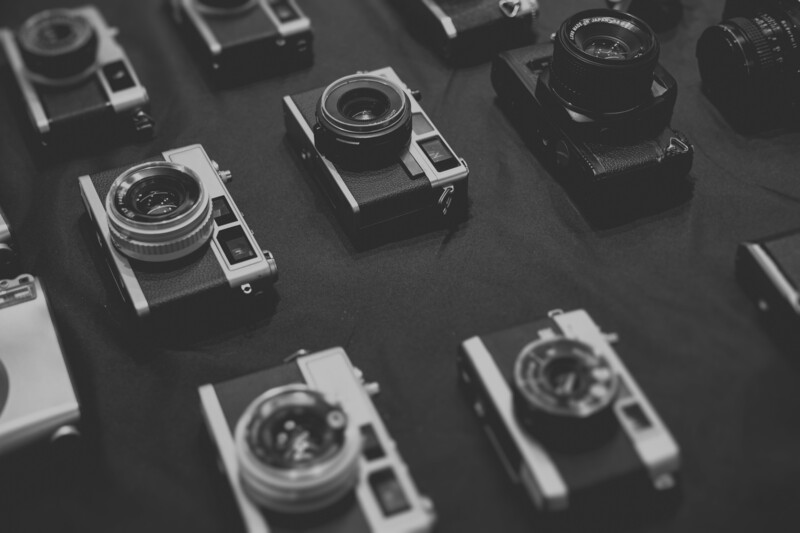
When the problem moves from the battery door to the internal gears, it's time to call the specialists. These are the shops that ensure your "time machine" actually works when you need it.
1. The SLR Generalists
These shops specialize in the workhorse SLRs that defined the late 20th century—the Nikons, Canons, and Pentaxes that are the most common entry points for film photography.
Garry's Camera Repair: Known for being an accessible entry point for Minolta and Canon shooters. He is often the fastest way to get a "first camera" back into a student's hands.
Precision Camera Works (Chicago area): Specialists in medium- and large-format lenses and panoramic film cameras, with clear model coverage and repair intake updates. Great when your issue is beyond a basic tune-up.
2. The Rangefinder and Leica Wizards
Rangefinders are instruments of high precision. Because the focusing system is decoupled from the lens, accuracy is the only thing that matters.
Youxin Ye: A legend in the Leica community for M and LTM bodies. He understands the "tactile connection" and "intent" required to keep these machines functional.
DAG Camera (Don Goldberg): The final word on complex repairs. If a part is no longer manufactured, Don is often the only one who can source or fabricate a replacement.
3. Leaf Shutter and Medium Format Specialists
Leaf shutters are incredibly quiet but notoriously finicky.
Ross Yerkes: He specializes in the "watchmaker" internals of Rolleiflex and other leaf-shutter systems. These shutters are often found in vintage half-frame cameras, which are seeing a resurgence because they double your exposures per roll. Long-running Rollei/Kowa-era specialist with a smaller, old-school operation—call ahead and confirm current model coverage and turnaround before shipping.
4. The Modern Alternative
If vintage gear feels too risky, 2024 saw the launch of the Pentax 17, a brand-new half-frame 35mm camera with a zone-focus design. It offers the "magic" of film with the reliability of a new product warranty.
The Technical Intersection: Why CLA'd Gear Scans Better
Many photographers blame their home scanning setup when their images look "soft" or "lifeless." They buy a flatbed like the Epson Perfection V600, see a "muddy" scan, and decide the hardware is at fault. However, your scanner is often just an "unforgiving mirror." If your camera's pressure plate is loose or the film isn't traveling flat across the gate, no amount of workflow magic will fix that lack of inherent sharpness.
Flatness and Focus: A V600's optics are designed for film to sit at a specific height. A professional CLA ensures your camera's film transport applies the correct tension, giving the scanner a "fighting chance" to resolve detail.
Cleanliness Starts in the Body: A mirror box or film back filled with perished foam dust will ruin your "digital negative" before you ever click "scan."
Bit Depth and Tones: When your shutter is accurate, your exposures are consistent. This allows you to scan in 48-bit color or 16-bit grayscale and preserve the "subtlety in the tones" without having to push sliders to extremes to fix botched exposures.
Resolution Realities: A well-maintained camera allows you to scan at 2,400–3,200 dpi and resolve real detail, rather than just enlarging "softness."
The "Analog Armor" Packing and Shipping Guide
Shipping a vintage camera in 2026 is a high-stakes endeavor. Parts are scarce, and transit is brutal.
1. Internal Prep
De-load: Never ship a camera with film inside.
Power Down: Remove all batteries to prevent acid leaks.
Cap It: Use a body cap. If you don't have one, tape a piece of clean cardstock over the mount with low-tack painter's tape.
2. The "Double-Box" Strategy
The Mummy Wrap: Wrap the camera in three layers of large-cell bubble wrap.
Box One: Place the wrapped camera in a small box. Fill voids so it cannot shift.
Box Two: Place the small box inside a larger shipping box with at least two inches of space on all sides, filled with high-density packing peanuts.
The Shake Test: If you hear anything move when you shake the box, you need more padding.
3. Documentation
Include a sheet inside the box with your contact info and a list of specific symptoms (e.g., "shutter sticks at 1/15th"). Insure the package for its replacement value, not what you paid for it.
The Triage Table: Pro Repair vs. "Safe" DIY
Symptom: Orange streaks on film
- DIY: Replace light seals
- Why it matters: Cheap foam can save a roll of "premium" color film.
Symptom: Sluggish shutter speeds
- Pro: Full CLA
- Why it matters: Old grease turns into glue; "muscling through" can snap delicate springs.
Symptom: "Dead" light meter
- DIY/Pro: Check for corrosion
- Why it matters: Vinegar can clean contacts, but circuit failure requires a tech.
Symptom: Fungus/haze in lens
- Pro: Optical cleaning
- Why it matters: Mold is biological; if not removed, it can etch glass permanently.
Symptom: Scratched negatives
- Pro: Check film gate
- Why it matters: If the camera is scratching film, no scanner can "un-see" those marks.
Conclusion: Preservation as a Discipline
If we want the next generation to "discover" film as a material process rather than a digital filter, we have a responsibility to keep the hardware functional. The "doorway" to analog is still open, but it is undeniably narrower.
Maintaining your camera isn't just about technical perfection; it's about respect for the medium. When you invest in a CLA, you aren't just fixing a "plastic box." You are preserving a tool that requires intention, patience, and a "tactile connection" that modern generative AI tools can never simulate.
Don't wait for your favorite camera to fail. Pick one body, send it to a master, and ensure that when you load your next roll of "ceremonial" color film, the only thing you have to worry about is the light.





Join the Fstoppers community for free
-
Post comments and join in the discussions
-
Browse the site ad-free
-
Share your work and get featured in the community
-
Compete in the photo contests for fun and prizes
No comments yet