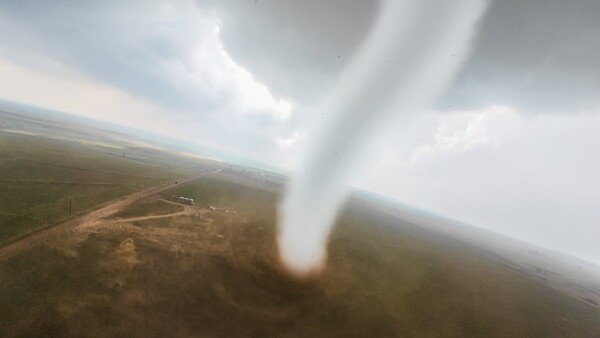
A small crew of storm chasers is doing something that sounds impossible: flying camera drones straight into active tornadoes. The OTUS Project — short for Observations of Tornadoes by UAV Systems — has now pulled off more than a dozen successful intercepts, and this June it live-streamed a drone punching into an EF3 for the first time.
Piloting purpose-built drones into winds topping 100 miles per hour, the team gathers surface-level data — temperature, moisture, and wind — that is nearly impossible to measure any other way, and along the way it captures a first-person view from inside the funnel that genuinely has to be seen to be believed. Here is what that looks like, captured on one of their intercepts near Arnett, Oklahoma:
So what actually survives a tornado? Nothing you can buy. These are built from scratch: Louis Tucker, who won the National Collegiate Drone Racing Championship in 2023, is the team's primary builder and pilot, and engineer Tanner Beard machines the parts on a mill, a lathe, a welder, and a bank of 3D printers in his home workshop. The airframes are 3D-printed, weigh roughly two pounds, and will do 220 mph — which is exactly what lets them punch through debris and vertical wind loads instead of being swatted out of the sky. Each one carries a GoPro plus sensors logging temperature, humidity, pressure, and 3D wind loads at once. The fleet runs to about 15 aircraft, some worth around $2,500 apiece, and Tucker reckons the team has poured more than $25,000 of their own money into it in a single year.
The reason there is no off-the-shelf option is that they had to invent the instrument. Working with NIST, Nelson Tucker developed an omnidirectional wind sensor able to measure a tornado's vertical wind component — something ground-based instruments simply cannot do — because nothing on the market was light enough to fly. The flight profile is just as deliberate: orbit the funnel at several altitudes, then tighten the circles until the drone crosses into it.
The spectacle is the hook, but the mission is science and safety: richer data from the core of a tornado could sharpen warnings and buy people precious minutes. For anyone who shoots video, it is also a staggering example of where a small drone can now fly, capturing imagery that would have been pure fantasy only a few years ago.


Join the Fstoppers community for free
-
Post comments and join in the discussions
-
Browse the site ad-free
-
Share your work and get featured in the community
-
Compete in the photo contests for fun and prizes
No comments yet