
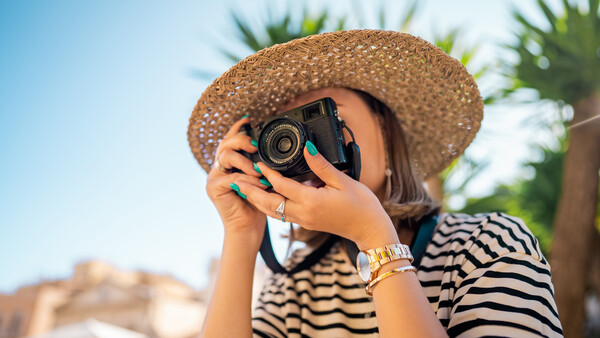
There's a term in photography that sounds like it belongs in a nature documentary, and in a way, it does. "Chimping" describes the behavior of looking at your camera's LCD screen immediately after taking a photo, and the name supposedly comes from the excited noises photographers used to make when digital cameras first became mainstream. It's also a potentially detrimental habit that can cause you to miss shots.
The problem is that chimping has evolved. What once represented genuine excitement about instant feedback has become something far less charming: an insecurity reflex, a compulsive behavior that many photographers don't even realize they've developed. We don't chimp because we're excited anymore. We chimp because we're anxious. We chimp because we don't trust ourselves. We chimp because the alternative, staying present in the moment, requires a kind of confidence that constant screen-checking slowly erodes. The fundamental issue is simple but profound: if you are looking at the past (the screen), you cannot see the present (the subject). Every second you spend reviewing what you just captured is a second you're blind to what's happening right in front of you.
Sign 1: The 'Look Down' Reflex
The most obvious sign that chimping has become a problem is when it stops being a choice and starts being a reflex. Watch yourself the next time you shoot. Do you physically lower the camera from your eye before the shutter has even finished closing? Does your thumb instinctively reach for the playback button before your brain has consciously decided to review the image? This is muscle memory at work, and not the good kind. You've trained yourself to associate the sound of the shutter with the action of looking down, and now your body does it automatically whether you want to or not. The telltale sign is when you catch yourself checking the screen even when shooting a burst of ten identical frames. Nothing has changed between frame one and frame ten, yet there you are, hunched over the LCD, verifying that yes, the exposure is still exactly what it was three seconds ago.
Sign 2: You Miss the 'Laugh After the Smile'
Portrait photographers know that the posed smile is rarely the best shot. People tense up when they know the camera is pointed at them, and that tension shows in their faces. Their smiles become slightly forced, their eyes lose a bit of their natural warmth, and the whole image takes on a quality that reads as "photograph" rather than "moment." The magic happens in the transitions: the split second after you've clicked the shutter when your subject thinks the photo has been taken and they can relax. That's when you get the genuine laugh, the relief smile, the natural expression that makes a portrait feel alive.
If you're chimping, you miss all of it. You take the portrait, look down at the screen to check sharpness, and while your head is buried in the LCD, your subject lets out a genuine, unposed laugh. Maybe they crack a joke about how awkward it feels to have their picture taken. Maybe they share a glance with someone off-camera. Maybe their face simply relaxes into the expression they actually wear in real life, the one their friends and family would recognize instantly. These micro-expressions happen in the split seconds between poses, and they're worth more than a hundred technically perfect shots of someone doing their best impression of a pleasant expression. But you can't capture them if you're not looking, and you can't be looking if you're checking the screen after every click.
Sign 3: Your Subject Stops Engaging
This sign is particularly destructive for anyone who photographs people professionally, whether that's portraits, events, or commercial work. Pay attention to what happens during a shoot. You click the shutter. You look at your camera. Your subject waits. You look back up. You click the shutter. You look at your camera. Your subject waits again. After a few cycles of this, something shifts in the dynamic. Your subject stops moving naturally and starts posing and pausing. They begin waiting for your approval after each shot rather than flowing through expressions and positions. They become self-conscious, wondering if the last photo was good or bad, trying to read your face for feedback that never comes because you're too busy staring at a three-inch screen.
Sign 4: You Are 'Editing' Instead of Shooting
There's a difference between checking an image and editing it, and chimping has a way of blurring that line until you're doing full post-production in the field. The casual glance at the screen to verify exposure is one thing. That might take half a second and serve a legitimate purpose. But be honest with yourself about what you're actually doing when you chimp. Are you zooming in to 100% to check critical focus? Are you scrolling through the last few shots to compare them? Are you mentally rating images, deciding which ones are keepers before you've even finished the shoot? Worst of all, are you deleting "bad" shots in the field, culling your work in real-time while you're still supposed to be creating it?
This behavior represents a fundamental confusion about what shooting mode should feel like versus what editing mode should feel like. Creating photographs and evaluating photographs require different mental states, and trying to do both simultaneously is exhausting. You're engaging your analytical brain while trying to use your creative brain, switching between critical evaluation and artistic intuition every few seconds. This constant mode-switching fatigues you and, more importantly, makes you overly critical of your work while you're still in the process of making it. That hyper-critical voice gets louder, and your willingness to take creative risks gets quieter. Save the culling for the computer. Save the pixel-peeping for the editing suite. When you're shooting, your only job is to shoot.
Sign 5: You Don't Trust Your Gear
Perhaps the most revealing sign of problematic chimping is when you catch yourself checking the screen for exposure or focus even though you've done everything right. You composed the shot carefully. You set your exposure based on the conditions. You saw the image in your viewfinder, and it looked exactly how you wanted it to look. Then you pressed the shutter, and immediately, you had to check. Not because anything went wrong, but because you were terrified that something might have gone wrong despite all evidence to the contrary.
The Cure: How to Stop Chimping
The good news is that chimping is a habit, and habits can be changed with intention and practice. The most effective first step is to disable your camera's automatic image review setting. This is the feature that immediately displays the photo on your LCD after you take it, turning the screen into a persistent temptation. With this setting turned off, looking at the screen becomes a deliberate choice rather than an automatic response. You have to press the playback button and consciously decide to review your images, which creates just enough friction to break the reflexive behavior. You might be surprised how often you realize you don't actually need to check the screen once checking it requires an active decision.
For those who need a more structured approach, try the "10-shot rule." Force yourself to take 10 distinct frames before you're allowed to check the screen. Not ten frames of the same thing, but ten genuinely different compositions or moments. This forces you to stay engaged with your subject and environment, and it often reveals how unnecessary most of your chimping really was. After 10 shots, you'll look at the screen and realize that yes, your exposure is fine, just like it was fine for the first nine images you didn't check. The rule trains you to trust your settings and stay in the creative flow rather than constantly interrupting yourself for validation.
If exposure anxiety is specifically driving your chimping, learn to use your camera's live histogram or exposure meter in the viewfinder. Most modern cameras can display this information in real-time, giving you exposure feedback without ever taking your eye from the finder. If the histogram looks right before you press the shutter, the image will be properly exposed. There's no need to verify by checking playback. The information you need is already in front of you, available at a glance rather than requiring you to lower the camera and break your engagement with the scene.
Conclusion
The moment you just captured is already gone. It exists now only as data on a memory card, and nothing you do will change what's recorded there. Looking at it on the screen won't make it sharper or better exposed or more emotionally resonant. But while you're looking at that past moment, present moments are happening all around you. Light is shifting. Expressions are changing. Compositions are presenting themselves and then disappearing, unremarked and uncaptured, because your attention was elsewhere.
Photography is ultimately about presence. It's about being fully engaged with what's in front of you, anticipating rather than reacting, staying in the flow rather than constantly stepping out of it. Chimping is the opposite of presence. It's a retreat into anxiety and second-guessing, a way of seeking reassurance that only makes you more uncertain. The best photographers have always known this instinctively. They trust their preparation, trust their equipment, and trust themselves enough to keep their eye in the viewfinder and see what happens next. The screen will still be there when the shoot is over. The moment won't.
Join the Fstoppers community for free
-
Post comments and join in the discussions
-
Browse the site ad-free
-
Share your work and get featured in the community
-
Compete in the photo contests for fun and prizes
33 Comments
Have you ever wondered how photographers in the film era managed to produce such outstanding images?
They had no way to chimp but they had confidence in their abilities. 🙂
It's easy to romanticise film photography but we just don't know how many missed opportunities happened to photographers because the framing or focus wasn't to their satisfaction. Bear in mind, when you think of the greats from the film era, we only really see their best work, not the thousands of missed shots they would have taken.
There is a reason why there are not many truly great action shots of wildlife or sports from the film era.
I mean if you pick up a National Geographic magazine from the 1980s and look at any of the photos of wildlife, in which the subject is in motion, most of them are fairly bad from a technical standpoint, and the detail rendering is poor. And yes individual feather and hair detail is really important in a wildlife photo, even when the critter is in motion.
It isn't just about "telling a story" .... it is about showing something in a precise and detailed way that the eyes just aren't capable of seeing on their own.
Good photography shows the viewer what they could have seen with their own eyes if they had been there ..... great photography shows the viewer what their eyes could never have seen, even if they were right there next to the photographer.
That is precisely why I cringe when people say sharpness doesn't matter. In my opinion, the very best images are the ones worth exploring the fine details.
Sharpness matters, just not always. Depends on the intention and genre. Any photography considered art doesn't have to be sharp to be appreciated for example but I imagine submitting client work for magazines and websites does need to be sharp in the right places.
Agreed. Nobody that I'm aware of ever accused Robert Capa of failing to get sharper pictures on D-Day in Normandy. Street photography can tell a strong story regardless of its sharpness. In that case, the concept or idea carries the picture. For virtually all of my images however, details in the subject are what I'm hoping captures viewer interest, so I want them to be sharp and clear.
For my type of work, the closer I get to my subject, the greater clarity is demanded; otherwise it's like reading with eyeglasses that have the wrong prescription, and you get a headache.
Sharpness and detail are also important for conveying the sense of texture. Neither of these images would work if slightly blurry. We all engage in photography for different reasons. These are the type of images that I enjoy making. Something, especially in a print, that makes you want to explore, read it and touch it.
Yes, I have thought about that a lot. And I've come to the conclusion that the math and science would have been more than my brain could have wrapped itself around. When I look at Ansel Adams' book "The Print," I am amazed at the complexity of his work. I would have needed a lot of hand-holding as an assistant of some sort to have ever even begun developing my own film and prints. Self-education, in the manner that most of us become photographers today, may have been impossible then. Motivation plays a big part in how well we learn something new, so I may have been inspired after all to jump into darkroom chemistry, but I'm thankful for that huge inkjet printer sitting in my home which spits out wonderful prints... without having to understand the machine itself or be incredibly smart about it.
In my opinion, and for my genre, those film era photographs weren't so outstanding.
I have to look through dozens of wildlife photos from old National Geographic magazines before I finally see one that makes me think, "wow - what a great photo!" Whereas I only have to look at a couple digital-era wildlife photos before I have that "wow!" reaction.
And how many poor images were produced despite the film photographer's confidence?
Chimping is the only worthwhile addiction that I know of...
I suppose it really depends on the situation. Sure if you are capturing split second moments then chimping will take you away from that. Sometimes when I'm trying to capture precise framing, I find it can be tricky holding the camera steady enough so will need to take several shots to be sure. The luxury of having a review of the photo has at times saved me from going home without the perfect shot.
Agreed... there's a theoretical and a practical side to everything. The latter serves this discussion better.
Depends entirely on how fast your subject is changing. Facial expressions in a portrait can be a split second. I get it. The portrait photographer probably never takes their eye off the subject. A landscape photographer might watch the same scene for a few minutes or an hour. In that case, why not take advantage of one of the most useful tools that your investment of thousands of dollars in a camera has given you. The histogram is invaluable, and it appears along side the review of every image I take. It's an analysis of the technical aspects of your photo... whether that task in creating a landscape photo is performed before or after the click of the shutter in a digital camera really doesn't make any difference.
I think that chimping bothers some people because of how it looks. That guy's always looking down at his camera, like he has no idea of what he's doing. It's perceived as amateurish. With my camera sitting on a tripod at eye level, chimping isn't quite so obvious to other people, and it still serves a critical purpose in digital photography... if the time allows for it.
Thank you for writing another original article, Alex! I love these!
I always miss shots because I am chimping. But if I don't chimp, then my exposure is off a bit, and I might as well have missed the shot because I am so picky about getting the exposure just right. Editing never makes it just as good as it would have been if it had been exposed precisely at the time of capture.
If only there was an exposure mode in our cameras that would guarantee the exact exposure we want, every time, then we would not have to waste precious moments double-checking and making adjustments. We could just spend all of our time shooting and not miss anything.
Despite all the improvements that modern cameras have undergone, they are still lacking in some of the most basic fundamental areas, exposure being chief among them.
EDIT:
To clarify what I wrote above .... I do not like to chimp. It is a pain in the ass that can be costly. But it is, unfortunately, necessary, because I can not trust my camera to do everything perfectly on its own.
So Alex is absolutely right when he writes:
"Sign 5: You Don't Trust Your Gear"
My camera may get the exposure wrong by 1/3 of a stop or 2/3 of a stop, so I need to micromanage it because it simply is not good enough to be trusted.
And no, editing does not ever make the image as perfect as it would have been had the exposure been absolutely perfect in the first place. I can always see an ever so slight difference between a frame that was perfectly exposed vs one that was a wee bit off and then adjusted via editing (I am speaking of my own work viewed on my own computer with the editing program that I use).
Many times, when I get home after a day of shooting wildlife, and see the images on my big monitor, I think, "damn ...... I wish I would have chipmped before shooting off that burst" ..... because there will be a whole burst of photos in which the exposure is off by a bit and has to be adjusted and then it just doesn't look super perfect. But almost never have I thought, "darn, I wish I wouldn't have chimped".
But then again, I am of the mindset that I would rather have no photo at all than one that misses the mark a bit in the technicals. I understand that most of you, including the author, have a different mindset, and care more about getting the shot than whether the shot is super precise in all measurables.
It's hard for me to believe that two pictures... one with minor edits to exposure and the other with no edits could be distinguishable. If you say so, I respect that... but I've been editing pictures since dinosaurs roamed the earth, and if I get exposure in the ballpark (at least since acquiring the D800 in 2013), it will print perfectly fine. Most often is the case where a scene pushes dynamic range and I'm trying to recover detail in dark shadows. And it works. And I'm picky. Would be nice to look over your shoulder and see what you're seeing.
In cases of extreme dynamic range, which is most of what I have been shooting lately, it is apparent, especially using the editing software I use.
I mean when the white spots on a Harlequin Ducks head are exposed properly, it leaves the rest of the duck about 4 stops under-exposed. So exposing for those little white markings to still have detail means a big huge compromise on the way the rest of the whole image looks. Yet, expose just 1/3 of a stop too much, and you lose the tiny little detail n those white spots. Exposure really is ultra critical when working with such thin margins.
Here is an example ... I tried to expose for the white spots, but still failed to capture ALL of the tiny feather detail in those areas, because there is too much exposure ... yet there is not nearly enough exposure for the super dark blue on the head, and so I didn't get that super tiny feather detail either. If I had exposed one third of a stop less, then at least the feather detail on those little white spots would have been captured properly, and the too-dark areas could be brought up brighter via editing .... but my editing software still doesn't give as much latitude as I need to bring those super dark blues on the head look luxurious and perfect when I add exposure to them. Everything is so damn critical, right down to the third of a stop. Frustrates the hell out of me. I love these ducks and being out there on the edge of the ocean with them, but trying to get perfect photos makes me want to cry and go into a rage of frustration because no matter what I do the pics end up sucking in some way or another because of the dynamic range.
This example of running up against the limits of dynamic range makes more sense. I realize there are compromises to be made there. I thought you were referring to all images, even those with limited contrast and fitting comfortably inside the dynamic range limits of your camera. Slightly lightening an image with very limited contrast shouldn't be a problem, is it? In other words, if the white areas of this image were dark gray instead of white, you wouldn't be so disappointed if you had to edit the overall exposure in post-processing, would you?
Oh no, being off by as much as a full stop is no problem with images that have little / normal dynamic range. But when do I ever get to shoot such things? Almost everything I shoot lately seems to be at the most extreme and difficult exposure challenges. I can't wait until I get to shoot some things that are fairly even across the frame.
What a ridiculous premise for an article. There's absolutely nothing wrong with checking your images as you go, especially if you shoot landscapes, architecture, travel etc. I suggest you worry about your images and stop trying to dictate your preferences to others.
It's not ridiculous at all, and it's not written as a mandate; it's an invitation to think more about the subject. And if you think the subject is totally irrelevant, consider this story...
A sports photographer apparently missed capturing a critical moment in sports history in 2013 because of chimping. And in the process of looking down at her camera, blocked another photographer from capturing the key moment too. The event set off a chain reaction, from a ruckus in the photographers pit, to publishing an inaccurate photo and not the real event photo, and eventually to the photographer being fired.
https://petapixel.com/2013/09/20/usa-today-drops-sports-photographer-mi…
As has been said before, in many cases it has no particular consequences, but in sports, portrait, and wildlife photography, there can be significant consequences to taking your eye off the subject for a split second.
As a professional portrait photographer I always look at the screen many times during a session, some people blink a lot and I do not see that when working with them. Once had a person blink in 50% of the photos.
Well yesterday and the day before I was photographing wild ducks, and I had to chimp relentlessly. Why? Because there is only so much space on my memory card. So I have to make sure that any time that I take a frame, that the frame is so good that it is worth keeping. So I have to look at each group of shots and quickly delete any that are a bit off. This is so that I will have enough space on the card to keep taking photos. I stopped at Best Buy to buy an extra memory card on my way to the river ..... but the cards are prohibitively expensive. I have tried to buy another external hard drive to back up my recent photos on, as my existing drives are all full. But again, the external drives are also too expensive to be able to afford. So I absolutely MUST chimp just to make sure I have space to keep shooting. And sometimes I have to delete frames that are pretty good, in hopes that the next frame will be even better.
Does anyone else have this issue, or do y'all have so much money you can just buy as much storage and as many cards as you need?
SD and CF memory cards are plentiful including external storage and last but not least, a good I-phone can store a lot of data...maybe some of us Fstoppers can donate a few memory cards to you...what do you think ???...
I have two memory card slots in my D800... one holds a 32GB Compact Flash card and the other holds a 32GB SD card. These are very small memory cards by today's standards. But each one can store 400 RAW 36-megapixel files. I realize you probably shoot bursts of pictures, whereas I shoot one and evaluate before going on to the next. It appears, however, that you can buy a 128GB card for $32, or 256GB for $50. That would store 1,600 - 3,200 RAW images by my calculations for my camera. That's not enough?
I already have umpteen memory cards, albeit none anywhere near this big.
What I really need is to have a much bigger internal drive installed in my computer. But that is prohibitively expensive and I won't be able to afford that until March or April. In the meantime, as a temporary measure, I was hoping to get an external SSD that could hold (back up) all of my images, which total about 5 TB. But that is also prohibitively expensive. If I spend $32 on another memory card, then that is $32 that I will no longer have to go toward the 5TB SSD that I really need. So it doesn't make sense to spend that much on a very temporary measure, when that will further delay the more sensible, more permanent solutions of getting a proper SSD backup drive and/or a larger internal drive.
I will fill up the 128GB memory card in a week ..... and then what? I will be right back to where I am now. So you see how spending that $32 will only postpone my problem by a week? If I am going to spend any more than $10 or $15, it needs to be for a solution that will not be so short-lived.
You're talking about two separate issues... permanent storage capacity related to your computer, and in-camera storage capacity related to shooting habits on a daily basis.
It's the in-camera capacity that gets to the point of this article which is chimping. You shouldn't have to constantly check your camera screen (and delete photos in camera while in the field) if you can store 3,200 images on one memory card, or swap cards while out in the field. Granted, shooting all day with 30fps burst rates adds up to a lot of images, but it also adds up to a colossal post-processing job. Maybe a burst rate of 10 or fewer would accomplish the same result and cut down on computer work?
Of course, camera body memory cards are not a permanent storage solution. But I'm always curious why photographers are compelled to save virtually all clicks of the shutter. You said yourself that it's been almost a year since you made a wildlife photo that you were really happy with. So why the need to keep thousands upon thousands of unsatisfactory images? Out of a burst rate of 30 images, would there not be just one or two worth keeping and toss the rest? I have the last 12 years worth of images stored as about 400GB on one internal hard drive, plus two rotating backup portable passport drives... one goes into the safe deposit box at my bank. And I probably still have far more images than I need to keep.
By the way... one point on SSD drives. While generally considered to be more reliable due to the lack of moving parts, the failure rate for SSD and HDD drives is not totally worlds apart. I have a friend who recently lost an SSD drive. Both technologies fail, and SSD can be more sudden, with HDD giving maybe a bit of a warning. Recovering data from a failed SSD drive can be more complicated too. If you're editing images directly on the external drive, SSD has a definite speed advantage. If you're just using the external drive for backup, then speed probably isn't an issue, and HDD might be a better option for about half the price.
These issues are not separate at all. If I had room on my computer to keep all my photos, and if I had room on external drives to store my archives, then I would be able to format (delete images) my memory cards and have their full capacity to work with. But because my computer drive is so tiny, and my external hard drives are totally full, I have no way to back anything up now. So I HAVE TO / MUST keep the really good shots on the memory cards, or else they could all be lost forever.
Given this, I am not sure I understand why you see these issues as separate.
For the sake of reliability, SD or CF memory cards would be the last place that I'd store my pictures permanently. Some brands appear worse than others, but their overall reliability over time makes me assume that nobody would use them as a replacement for storing images on internal/external hard drives. That's why I see camera memory cards and hard drives as separate functions. If you're transferring images to a computer, memory cards are temporary storage devices and with their capacity, chimping is not necessary. You obviously have a different workflow. But I'd be cautious about keeping those valuable images on a single SD memory card.
"For the sake of reliability, SD or CF memory cards would be the last place that I'd store my pictures permanently."
Ugh. The more I try to explain things, the more I type and type and type, the less you seem to understand.
I never said anything at all about wanting to use SD or CF cards for permanent archive storage. Never. Ever. Ever.
What I did explain is that right now, until I can buy a viable form of permanent storage, is that I need to keep the best recent shots on the memory cards because that is the only form of backup available until I can afford an SSD external drive. And yes, the "best recent shots" does mean a few thousand of them.
"You said yourself that it's been almost a year since you made a wildlife photo that you were really happy with. So why the need to keep thousands upon thousands of unsatisfactory images?"
Because during this year I have taken thousands of images that will be good enough to get on magazine covers, sell in art galleries, sell as stock images for things that are used by hundreds of different publications, advertisements, blogs, websites, etc. Just because I am not completely happy with an image does not mean that it is not good enough to be used in umpteen different ways by several different agencies and publishers.
"By the way... one point on SSD drives. While generally considered to be more reliable due to the lack of moving parts, the failure rate for SSD and HDD drives is not totally worlds apart."
I didn't realize there was any difference at all between the two formats, inasmuch as reliability is concerned. Within the past 3 years, I have had an SSD fail once and a non-SSD fail once, so as far as I'm concerned, the reliability is identical.
The reason I vastly prefer SSD is because of the speed. Because of the way I back my photos up; it is extremely inconvenient to back my lifetime archives up to a non-SSD drive, due to how insanely slow they are. No, for me backup is not a "set it up and then walk away while the transfer happens" .... conversely it is a labor-intensive process that needs to be "babysat" for every step along the way.
I really do not want to be challenged as to how I back them up, and then be told that I could back them up differently. That's my business, and mine alone. Suffice it to say that speed actually is really important to me in my backup regimen, and that is the sole reason I demand SSD. I have backed up to non-SSD hundreds of times. And I have backed up to SSD hundreds of times. And you know what, to me, it sucks when I back up to non-SSD and it doesn't suck when I back up to SSD, so that is why I will only consider SSD for my next archive backup drive.
When I started, it wasn't chimping. But I had to get my eye off the viewfinder anyway, only so I could forward the film. Then motor drives took care of that and I could continue following the subject and shoot again ... and again and again. I didn't need burst shots most of the time, but I would get more of the action than I could have if I had stopped to look at the results (which, back then, technology wouldn't allow.)
Nowadays, coming from a lifetime of sending my film away for processing, I probably chimp too little. I catch myself from time to time having forgotten I took those pictures and only a few days later look at them. Then it could happen that I wish I had given the somewhat problematic angle at which the sun was creating shadows on the faces of my subjects a bit more attention at the time. But then, it also would not have helped much, because that same sun would have made it impossible to notice that problem, because you can't see anything on the screen in bright sunlight.
Which points a finger at another problem: Using the screen on the back of the camera (or phone) you have to be really good at guessing if you have framed the picture correctly, because you can't really see what you are doing ... (Luckily I am doing something rather different for a living ...)