

Have you felt burned out? Stuck? Lacked motivation? Had a fear of failure or felt silly? I will discuss several approaches for creating opportunities for creativity to flourish. You never know, but for some, this might be one of the most influential photography articles they ever read.
Our Mindset: Giving Ourselves a Chance
First, I want to talk about a mindset for creativity. And more than that, I want to emphasize how so often, when we begin doing something, we are frequently awful. We do things that suck. But this is the way of life. Things evolve from nothing.

Do we give ourselves a chance? A tiny seed in a field can turn into a meadow of radiant flowers. But a tiny seed in the middle of the street turns into nothing. It's how we cultivate our creativity that matters. It's how we regard ourselves that matters.
Do we give ourselves a chance?
We're frequently told, "You can't do that." We hear that creating something is for other people. Other people are talented. They have a gift. But not us.
It's Within You
How tragic it is to go through life thinking, "Those people, they were given this beautiful talent. They create beautiful art. They create beautiful photographs. But not me. I was never given that. I don't have it within me."
Think about how different our lives might be if we didn't ascribe these feelings to ourselves. Think about this. How different would our lives be if we acknowledged that wonderful things come from nothing?
You and I will continue to make photos that suck. But I submit that this is absolutely necessary. It's important. This is how we grow. But to grow from it, we must give ourselves license to do so.
Also, while we're at it, give yourself license to experiment, relax, and have fun. Fun. Yes, fun. It's supposed to be enjoyable.
But what follows are some strategies to try to jump-start your creativity.
By the way, my photo examples will be night photos because, well, I'm a night photographer. But of course, these apply to anyone interested in photography.
Use Completely Different Lenses
Our first strategy is quite easy. What we're trying to do is get out of habits and shake things up. And one of the simplest ways to do that is by using a very different, unfamiliar lens. Choose a lens that is unusual and different from what you would ordinarily choose. I'll go over three, but you can think of more. This can challenge you and make things feel new and fresh.
Fisheye


Various uses of fisheye can offer instant creativity for the photographer who feels stuck or uninspired.
Fisheyes automatically seem to make everything strange. Unless you are a fish, you don't see the world this way. Fisheye lenses make everything weird and surreal. We can often include a strange 180-degree view. In my case, I can include more of the Milky Way as well as the earthbound elements.
It can be as easy as this: by simply aiming your lens straight up, you can include the periphery around you. For example, if you are in a forest, you can get trees surrounding the entire sky. Fun, huh?
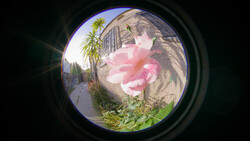
You can also make the ordinary extraordinary. Jam that fisheye lens up close to something and let everything else fall away. You can make the ground curve up or down, unless, of course, you keep the fisheye level, in which case the horizon will remain straight. But tilt it up or down, and you get these fantastic curves!
There is no end to the experimentation and exploration you can do with a fisheye lens! And it's fun.
Long Zoom Lens


Using a long lens, especially for genres that don't ordinarily use them, can be great for different perspectives, including making the smaller things in the distance a little larger relative to the subject.
Use a loooong zoooom. Zooming in allows you to get close to subjects, creates compression, and brings faraway elements closer to the subject. It lets you get detailed shots of places that might otherwise look far away and allows you to see the world from a different perspective. I've seen portrait photographers use a zoom lens to get more bokeh behind the subject or offer a more epic-looking perspective. And of course, as I mentioned, you can create a bit of compression between the subject and the background, which is great if you have mountains or tall buildings in the distance.
Character Lenses


I've used what I call "character lenses" for these photos. This includes some old Soviet lens as well as Lensbaby lenses, sometimes using them to selectively blur specific parts of the images. I especially value the fun and physicality of Lensbaby lenses, bending them to change the plane of focus. It's tactile and so enjoyable.
You can use old lenses for unique flares, softness, or unusual bokeh. That's what this is all about. "Character" or "artistic" lenses are intentionally designed — or, in the case of Soviet-era lenses, historically produced — with optical "imperfections" that can render images in a dreamy, painterly, or non-clinical way.
Choose lenses for their distinctive bokeh, such as the swirly, rotating background blur of the Helios-44, the Mir-1V, or the "Petzval" effect.
If you can't find an old lens, fear not. There are numerous lenses, such as Lensbaby lenses or Lomography lenses, being made currently. Comb their websites and see what "speaks" to you creatively.
One of the aspects of photographing with Lensbaby lenses — besides the creamy, fascinating bokeh — is the physicality of it. They're designed to be fun to use. Yes, fun. With many of the lenses, you bend the housing of the lens. Why? Bending a Lensbaby lens alters the plane of focus and stretches background light into painterly, blurred effects (bokeh). To bend the lens and manipulate the bokeh, you tilt the flexible lens housing while adjusting the aperture, focus, and background. Yesssss!
Unconventional Perspectives
Try different perspectives to shake things up, challenge yourself, and make things feel fresh.
Get Low


Getting low to offer different perspective. It's fun, and it separates your image from other people's images. I'll sometimes spend much of a photography shoot creating images from only a super-low perspective.
One fascinating perspective is to get low. Real low. An ant's-eye view. This can allow your subject to look very different from everyone else's perspective. Your subject can look large and in charge, or simply unusual.
Look Up


Looking up high is an easy way to create different, interesting perspectives.
What about pointing your camera up at something? This works too. An easy way to get a great-looking photo in a forest, for instance, is to point your camera straight up at the tops of the trees. But of course, you can do this with all sorts of subjects, not just trees.
Dutch Angle

Dutch angle. The camera doesn't always need to be straight, does it?
Conventional wisdom tells you to keep the horizon level. But if wildly crooked horizons worked for 1960s Batman episodes, they can work for you as well. If you use a Dutch angle, make sure it's obviously intentional, not just a tiny bit crooked.
I'll bet you can think of some more unusual perspectives.
Stuck in the Mud


Stuck in the Mud example, where I am photographing the same building for most of the evening. It's a great exercise at looking for different angles, and can positively inform just about any form of photography.
The "Stuck in the Mud" approach in photography is a creative exercise designed to break through creative blocks by forcing photographers to slow down, stay in one place, and deeply investigate their surroundings rather than hunting for obvious subjects. You can extend your creativity by staying within, say, 20 or 30 feet of where you are and seeing how many different interesting compositions you can create. It's an exercise that can stretch the boundaries of what you can do as a photographer, giving you more tools for creativity.
Try Different Genres of Photography


Try different genres of photography. For me, that's meant macro, intentional camera movement, using props, concert photography, and event photography. It keeps me fresh and invigorated, and I often learn things that inform my primary genre of photography.
This is not only fun and challenging, but it expands your ability, gives you more skills and flexibility, challenges you, and makes you think about your photography differently, making things feel fresh and new.
Are you a night photographer? Do event photography. A portrait photographer? Try architecture. Trying different genres informs your primary work. You can take some of the philosophies, compositions, techniques, and approaches from one genre and apply them to another.
For a structured introduction to several different genres, The Well-Rounded Photographer: 8 Instructors Teach 8 Genres of Photography explores eight photographic disciplines with eight instructors.
Be Ready


Getting prepared to go. The bag is a WANDRD PRVKE 21L V4.
It's great when you are feeling energized and brimming with ideas. But don't wait for that to happen. Half of creating is just being there and reacting to the beauty around you. Have your equipment ready to go. Ideally, you should have as much as possible in your bag already.
And of course, make sure that you have blank memory cards or film and freshly charged batteries.
But more than that, take some time to do other, less creative things to get ready. Not only charge batteries, but clean the camera and lens, organize everything, install software, write captions for your photos, scout locations, or watch YouTube videos about inspirational places to go photograph. You get the idea.
And then... just go. Just go. Even if you keep your camera in the car, you've gotten out of the house. You're probably somewhere interesting. For me, even if I go to a beautiful part of the desert at night and I never take the camera out of the car, I've already "won." I'm outside underneath the desert stars. And that's such a beautiful thing.
Make Plans to Go
Schedule a time to go. Treat it like you would other important things in your life. Make plans and try to stick to them. Plan a trip. Make hotel reservations. Make plans with friends. Meet people there. Then show up with all your batteries charged, your film or cards ready to go, and the equipment you need. Then use some of the techniques and approaches from this article and make it happen.
Experiment. Have Fun. Relax. Create.
This is ideally the mindset.
Give yourself grace for experimenting and having it fall short. You're there to have fun and relax. And quite frankly, if you already have a camera in your hand, you've already won. In this busy world, it can feel like a luxury to wander and photograph and nothing more.
What Do You Do to Jump-Start Your Creativity?
If you have other techniques for jump-starting your creativity, tell us about them in the comments. Other photographers would love to hear what you are doing to feel more creative and engaged.
Join the Fstoppers community for free
-
Post comments and join in the discussions
-
Browse the site ad-free
-
Share your work and get featured in the community
-
Compete in the photo contests for fun and prizes
No comments yet