A long exposure on a bright, sunny morning sounds like a contradiction, yet it is exactly what turns restless water into smooth glass around breakwaters and sea markers. Hard coastal light forces tougher choices about filters, exposure blending, and whether an image survives in color at all.
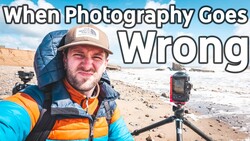
Tide tables don't always behave the way you expect, and Gary Gough arrives to find the water already at the right height more than two hours before high tide, so he has to start shooting earlier than planned. The beach is shingle, lined with breakwaters covered in a slick green surface, and his first plan is to get low. Standing in the sea in his wellies, he wants the camera close to that green texture so the foreground dominates, and he considers focus stacking to hold sharpness from near to far. His composition puts one marker in the bottom left and another in the top right, with the breakwater carrying your eye out toward the horizon, and he trims clutter from the left edge so the diagonal reads cleanly. Before committing, he runs a test: a 1/30 s base exposure, then a 10-stop ND filter pushes it to about 30 seconds. Placing subjects on opposite thirds gives a seascape a path through the frame instead of a cluster in the middle, and it costs nothing but patience.
The sea doesn't cooperate for long. Each bigger wave nudges the tripod, and he can feel the legs shifting during the exposure. Shingle holds better than sand when you dig the legs in, but the rising tide eventually pushes him back onto the rocks, and the wellies fill with water anyway. From the new spot, he plans three frames: a 2-minute exposure focused close, another focused far, and a third underexposed for the sky, since the sea and sky sit too far apart in brightness for one frame. For bright days, his default is a 15-stop ND filter, which gives him one repeatable calculation to reach 2 minutes, and he mentions pairing a 10-stop with a 3-stop or 6-stop as an alternative. That approach keeps a low, close foreground and a bright sky in one image with no graduated filter in the mix.
Each stop doubles the exposure time, so a 15-stop filter multiplies it by 32,768. A base reading of 1/250 s, typical for bright sun around f/11 at ISO 100, becomes a little over 2 minutes. Working backward is simple: adjust aperture or ISO until your unfiltered meter shows roughly 1/250 s, then put the filter on. Most cameras top out at 30 seconds for timed exposures, so going longer usually means bulb mode with a remote release, or an extended shutter range or built-in bulb timer if your body offers one. Stacking two filters to reach similar density adds more glass and another gap in the holder. That raises the odds of flare, color casts, and light leaks, so shading the holder and covering the viewfinder eyepiece on an SLR helps. At these durations, even small movements add up. A tripod that creeps a millimeter during a 2-minute frame will soften every edge, which is why solid footing on the beach becomes part of the exposure plan.
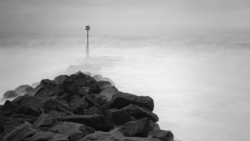
Midway through the morning, the light turns harsh, and a large group of schoolchildren doing beach surveys settles in right where he's working, followed by a family who sit down beside him on an otherwise empty beach. He shifts to a pipe running out toward the water and shoots 2-minute and 4-minute exposures aimed straight into the sun, with separate frames to pull the sun and sky down. With almost nothing else in the frame, the scene leans hard into minimalism, and the contrast pushes several of his shots toward black and white. It's also unusually warm for late September, somewhere in the mid-60s Fahrenheit, which only adds to the glare he is squinting through.
To see how the breakwater and pipe images turn out and how Gough handles that brutal light, watch the video above.


Join the Fstoppers community for free
-
Post comments and join in the discussions
-
Browse the site ad-free
-
Share your work and get featured in the community
-
Compete in the photo contests for fun and prizes
No comments yet