A gray February woodland does not look promising, yet that is exactly when your skills get tested. If you rely on mist, frost, or golden light, you miss the quiet scenes that build discipline and sharper vision.
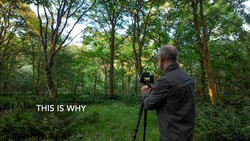
Coming to you from Simon Booth, this grounded video follows Booth into a flat, overcast forest with no obvious drama. He heads out anyway and commits to finding images in conditions many would avoid. The message starts with one rule: show up. Not when it is perfect. Not when the forecast excites you. Just show up. Booth argues that most days you head out, you come back with something workable, even if it will not win awards. That repetition builds familiarity with your camera and steadies your technique so you are not fumbling with settings when a stronger scene appears.
He slows himself down in a small patch of woodland where two habitats meet, an open broadleaf area and a stand of larch. That transition zone holds variation in color and texture. Instead of roaming, he drops his bag, mounts the camera on a tripod with a nodal rail, and works a tight space. The lens choice matters here. The Canon EOS R5 gives him the resolution to isolate fine detail, and the Canon RF 100mm f/2.8L Macro IS USM lets him move in close without disturbing the scene. He photographs a single sycamore leaf resting among larch needles, focusing on vein structure, subtle color shifts, and a natural frame created by fallen needles. Settings are simple and steady. ISO 100, f/16, around a third of a second, raw capture, cloudy white balance.
The next scene shifts to a shallow ravine with a skeletal leaf lying on pebbles near a stream. Here Booth changes emphasis. Instead of just finding a subject, he refines it. He studies the edges of the frame. Twigs creep in. Bright leaves distract. A stem cuts across the corner. He does not accept what is there without question. He removes small distractions with tweezers and adjusts the angle so the leaf runs diagonally through the frame. A polarizing filter helps control sheen on wet stones, and he exposes for the brightest parts of the leaf so the background falls into a deeper tone. The result looks deliberate rather than casual. ISO 100, roughly half a second, aperture again around f/16.
Notice what is not happening. There is no rush to chase something better a few yards away. He calls that restless behavior “spaniel mode,” always thinking the next spot will be stronger. You have likely done the same, moving on too soon and missing what was under your feet. Working a 25-meter square area can produce multiple images when you stay patient. Small shifts in angle create new compositions. Tiny changes in light on overcast days still change contrast and texture.
The video shares three clear themes: show up, stay in one place long enough to see it properly, and clean up the frame before pressing the shutter. Booth goes deeper into each and shows the final images on screen, along with a few additional refinements worth studying in detail. Check out the video above for the full rundown from Booth.





Join the Fstoppers community for free
-
Post comments and join in the discussions
-
Browse the site ad-free
-
Share your work and get featured in the community
-
Compete in the photo contests for fun and prizes
No comments yet