A storm that cancels an event usually sends everyone home, camera included. On a long trip, the days that fall apart often produce the frames you end up keeping, and with film you won't know which ones worked until the rolls come back.
Over close to two weeks on North Carolina's Outer Banks, Willem Verbeeck kept shooting through a string of plans that didn't go the way anyone expected. The biggest example is a small dirt speedway about an hour inland, a track he'd wanted to visit for years. Drivers had their cars set up when a tropical downpour rolled in and the event got called. Crews started loading cars back onto trailers, and he ran straight into the rain with a Canon EOS-1N, a camera with no claim to being waterproof. Tracks in California cancel at the first hint of rain in the forecast, so he'd never had a chance to photograph a speedway in bad weather. A rained-out race gives you things a finished one doesn't: soaked crews, scrambling drivers, headlights through sheets of water, and people too busy to notice a camera.
Getting there involved a free ferry to Ocracoke, an even more remote island where you can drive your car right onto the boat. The ferries run full of tourists and locals together, and that mix makes the deck a ready-made stage for candid pictures. After dark, the boat switches on an overhead light that draws in seagulls, so many that it looks like thousands of birds are trailing the ferry. Verbeeck and a friend spent a lot of film photographing the gulls with flash as they swept past. Flash on moving birds at night is a gamble on film, since you can't confirm the timing or the spread of the light until later, and the results are worth seeing in the video.
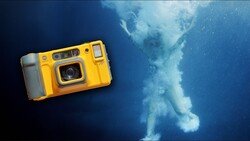
The underwater camera a friend handed him during a surf lesson comes from a different lineage than the Minolta Weathermatic he'd used in Hawaii. Nikon introduced the Nikonos in 1963, building on an existing French amphibious camera design, and kept the line going until the Nikonos V was discontinued in 2001. Those bodies take interchangeable lenses and were made for real diving, well past anything you'll meet on a beach. The Weathermatic is a simpler tool: a fixed lens, few controls, and sealing rated for splashes and shallow water. If most of your water shooting happens from a board or waist-deep in the surf, the simple camera covers a lot of ground, and you can stop worrying about it. A dedicated system starts to earn its cost once you want manual exposure control or a sharper lens. Used Nikonos bodies still sell regularly, but the O-rings on any old housing need checking or replacing before the camera goes near water, because decades-old seals fail without much warning.
Not everything worked. Verbeeck burned through roughly a whole roll at Jennette's Pier during a week of frequent lightning and didn't get a single strike on film. He suspects drier air made the bolts quicker and less persistent than the lingering lightning you sometimes get on hot, humid nights. The EOS-1N has no way to fire itself when a flash goes off, so he was left trying to time each exposure by hand. Anyone who has tried this knows the frustration: by the time you see the strike, it's gone.
There were quieter stops too, including a Coast Guard reenactment at one of the original life-saving stations on the Outer Banks, with everyone in period uniform during a brutally hot afternoon. It was his first time photographing a reenactment, and costumes against a historic building make for scenes that look decades old on film. On the drive back from the speedway, a long, unusual band of cloud stretched across the entire sky after the storm passed. They pulled into the first spot with a clear view, which happened to be a gas station. He says he's never seen anything like it and asks anyone who knows weather to tell him what it's called.
The rain-soaked speedway frames Verbeeck made with his EOS-1N come right after the surf lesson in the video.




Join the Fstoppers community for free
-
Post comments and join in the discussions
-
Browse the site ad-free
-
Share your work and get featured in the community
-
Compete in the photo contests for fun and prizes