Choosing the right lens for a Sony APS-C camera is genuinely difficult right now, because the options have multiplied fast and the differences between them aren't always obvious. Curtis Padley has been shooting Sony APS-C for six years and has run through enough glass to have strong, experience-backed opinions about what actually works.
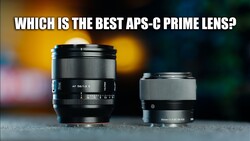
Coming to you from Curtis Padley, this thorough video ranks his top five APS-C lenses for both photo and video work, and the list has a few surprises. He kicks things off at number five with the Sigma 16-300mm f/3.5-6.7, a travel-friendly superzoom that weighs 615 g and costs $694. It covers wildlife, motorsports, landscape, and travel without a lens swap, which is a real convenience. Corner sharpness softens in the telephoto range, and shallow depth of field is largely off the table, but as an affordable entry point into longer focal lengths, it's hard to dismiss. Fourth place goes to the Sigma 18-50mm f/2.8, a lens Padley openly admits he once considered the best all-round APS-C zoom. At 290 g and $659, it's compact, sharp at every focal length, and capable across a wide range of shooting situations. The lack of weather-sealing and optical image stabilization are the main sticking points, and Padley specifically flags that pairing it with something like the Sony a6400 for video will leave you with unusable, shaky footage.
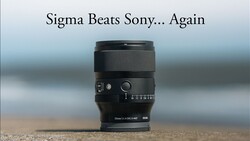
Bronze goes to the Sigma 10-18mm f/2.8, which Padley describes as the world's smallest ultra-wide zoom with a constant f/2.8 aperture for APS-C. At 255 g and $679, it's lighter than the 18-50mm and versatile enough to cover cityscapes, street work, architecture, real estate, and vlogging. One detail worth knowing: the front element doesn't protrude, which means you can mount an ND filter directly on it. It also works on full frame cameras with some limitations, and Padley says active stabilization clears up any vignetting almost completely. He's replaced his Sony 16-35mm f/2.8 G Master with it as his primary vlogging lens. Second place is the Sigma 56mm f/1.4, which behaves like an 85mm full frame equivalent and delivers the kind of subject compression and background separation that portrait, street, and car work demand. At $579 and 290 g, Padley calls it the only prime he needs when paired with his top pick.
That top pick is the Sigma 17-40mm f/1.8, and the reasoning behind putting it at number one is specific and practical. It covers the focal lengths of several popular APS-C primes in a single lens: 17mm, 20mm, 23mm, 30mm, 35mm, and 40mm, all at f/1.8. Buying those primes individually would run you $2,276 and 1,299 g of weight. The 17-40mm costs $919 and weighs 535 g. Padley shot with it extensively across Porto, Vietnam, and New York City, and says it rarely left his Sony a6700. There is some chromatic aberration at f/1.8 in controlled tests, and barrel distortion shows up at the wide end, but both are correctable with the lens profile in Lightroom.
Check out the video above for the full breakdown from Padley, including real-world footage from each lens and his thoughts on the tradeoffs that didn't make it into this summary.


Join the Fstoppers community for free
-
Post comments and join in the discussions
-
Browse the site ad-free
-
Share your work and get featured in the community
-
Compete in the photo contests for fun and prizes
No comments yet