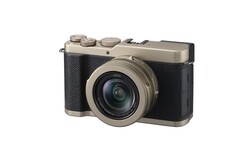
A dedicated compact camera now has to justify itself against a phone that already lives in your pocket and shoots surprisingly good telephoto images. The Lumix L10 makes its case with a retro body, an eye-level viewfinder, and a Micro Four Thirds sensor, and whether that combination earns a place next to your phone is a fair question.
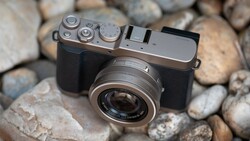
People keep asking whether a camera at this price beats a modern smartphone. Bobby Tonelli answers with the act of shooting itself: raising the camera to your eye, shutting out everything around you, and watching a moment play out through the finder. The Lumix L10 backs that up with a 2.36-million-dot EVF, a top plate he believes is metal, and a fixed zoom equivalent to 24-75mm at f/1.7-2.8. Its closest Lumix sibling by size is the Lumix S9, a video-first full frame camera with no mechanical shutter and no hot shoe. The L10 has both. Its shutter is a leaf shutter built into the lens, topping out at 1/2,000 sec before you hand off to the electronic shutter. Leaf shutters are typically quiet and can sync flash at faster speeds than a focal-plane shutter, which helps on the street and with a small strobe.
Inside is the same BSI sensor with phase-detect autofocus found in the Lumix GH7, Panasonic's newest hardware at this sensor size. Tonelli puts the autofocus speed right alongside what he gets from the Lumix S1RII, and he says battery life easily outlasts that full frame body. Crop zoom shows up here too, a feature usually reserved for Panasonic's more expensive cameras. You can push to roughly 200mm at around 3 megapixels, or stop near 100mm and keep about 10 megapixels. Assign it to a function button and you get quick reach well past the optical zoom without carrying a second lens.
Fixed-lens compacts have had a strong few years. The Fujifilm X100VI sat on backorder for months after its 2024 launch, Leica released the D-Lux 8 the same year, and Ricoh followed with the GR IV in 2025. Buyers clearly want something small and deliberate that still feels like a camera, and the L10 lands in that same space with a zoom instead of a single prime. Crop zoom is easier to judge once you consider where most of these photos end up. A 3-megapixel crop is roughly 2,000 pixels across, enough for a photo shared online and viewed on a phone, while the 10-megapixel setting leaves room for modest prints.
Panasonic also loaded the L10 with new film-inspired looks, including vintage-leaning options and an L.Monochrome style for stark black and white. These sync with the Lumix Lab app, which lets you load LUTs and custom photo styles straight into the camera. At higher ISOs, the sensor produces noise that reads more like film grain than digital mush, with a bit less dynamic range to go with it. On the video side, you get 5.2K open gate along with V-Log and a full set of codecs. Stabilization is optical in the lens only, with no in-body stabilization, so smooth handheld footage takes help from electronic stabilization or a tripod. Startup time is slower than some street shooters will want, since the lens has to extend before you can take a shot.
Tonelli's night shoot at a temple in Singapore and more are in the video above.



Join the Fstoppers community for free
-
Post comments and join in the discussions
-
Browse the site ad-free
-
Share your work and get featured in the community
-
Compete in the photo contests for fun and prizes
1 Comment
The L10 is a perfect camera for everyday use. It's also a very capable street camera and it also works really well in documentary situations where you want to be quiet and discreet. It's not at all intimidating to people. The leaf shutter also gives you flash synch up to 1/2000th of a second, so for flash fill outside it opens up a wide range of possibilities. I shoot for a living using m4/3 gear, and use L10 on the job now when I want to go minimalist.