Since Apple's keynote I have made two videos about the iPhone 18 Pro's new variable aperture lens, and in both of them I made predictions about how it would actually perform. Both phones are now sitting on my desk. I shot the same scenes on the 17 Pro and the 18 Pro, indoors and outdoors, at every aperture the new lens offers, then pulled all of it into Lightroom and zoomed to 400 percent. Some of what I predicted held up. A fair amount of it did not.
Only One Camera Actually Changed
Apple is famously vague in a keynote, and the rule I go by is simple: if they do not mention that something was upgraded, it was not upgraded. I predicted that the reason Apple spent so much time on the variable aperture was that the other three cameras were carried straight over from last year. After shooting all of them on both phones, and after comparing notes with reviewers who got to speak to Apple directly, I am confident that is exactly what happened. The ultra wide, the telephoto, and the front camera are unchanged.
I will go a step further than Apple has been willing to. I believe the main camera is using the same sensor as the 17 Pro as well. If that is right, the only camera hardware Apple changed on this phone is the glass and the set of blades sitting in front of that sensor.
I Was Wrong About Wide Open
Last year's main lens was fixed at f/1.78. Apple opened the new one about half a stop wider to f/1.48, which is where the "50 percent more light" line in the keynote comes from, and added blades so it can also close down to f/4. My argument in the first piece I wrote about this lens was that no lens is at its best wide open, so Apple built one that can sit slightly stopped down for most shots and only open all the way when the room is genuinely dark. I still think that is the right read.
What I got wrong was how ugly I expected f/1.48 to be.
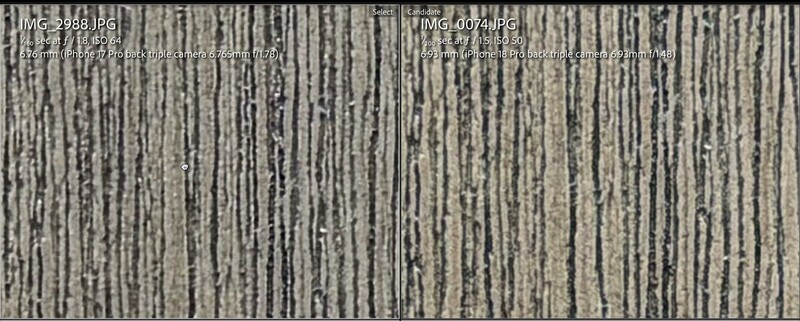
In the center of the frame these are almost the same picture. If you pushed me I would give the 17 Pro a very slight edge, but I was expecting a gap you could spot from across the room and it simply is not there. Move out to the corners and the 18 Pro does go softer wide open, which is what any lens does at its widest setting. It is still far better than I predicted.
The Diffraction I Predicted Never Showed Up
My other prediction was that f/4 would go visibly soft from diffraction. Not because the sensor is small, but because the photosites are. Apple is packing 48 million pixels onto a sensor the size of a fingernail, and the smaller the photosite, the more obvious any diffraction becomes.
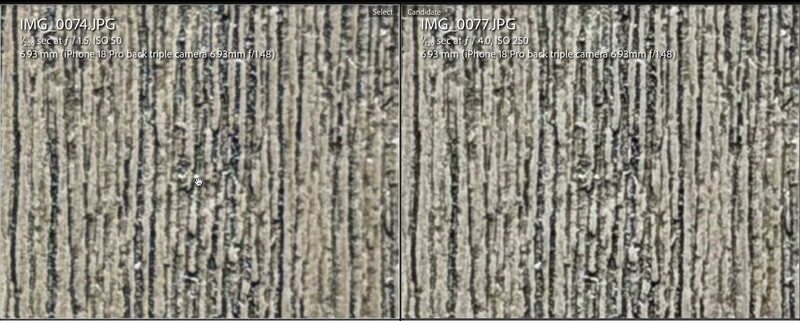
I zoomed all the way in expecting both ends of the range to fall apart, and neither did. If anything, f/4 is slightly sharper than f/1.48. If you made me pick the best aperture on this lens I would say f/2.8, but the honest answer is that all four settings land close enough together that nobody is going to spot the difference in a real photograph.
Side by Side, This Is Last Year's Camera
That is the good news. Here is the bad news. If the widest aperture and the smallest aperture both perform better than expected, and the middle of the range looks like this against last year's phone, then the range itself is the story.
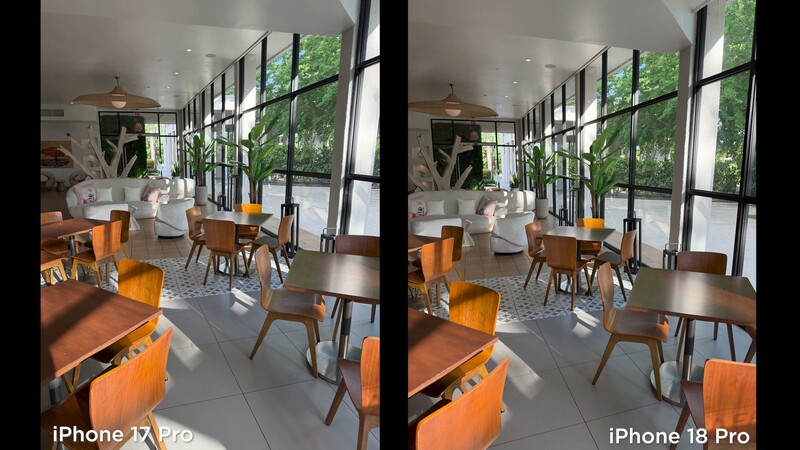
In ordinary light this camera takes essentially the same photograph as last year's did. I spent a morning shooting matching images on both phones and to my eye they are the same pictures. I am not seeing a meaningful jump in image quality anywhere.
What the Aperture Actually Does to Depth of Field
The lens does move through a real range, so it has to do something to depth of field. The thing to keep straight is that an f-number is not a measurement of depth of field. It is a measurement of exposure. As far as your light meter is concerned, f/4 is f/4 on a phone, on a full-frame camera, and on medium format. Depth of field is a separate question, and it depends on the size of the sensor behind the lens.
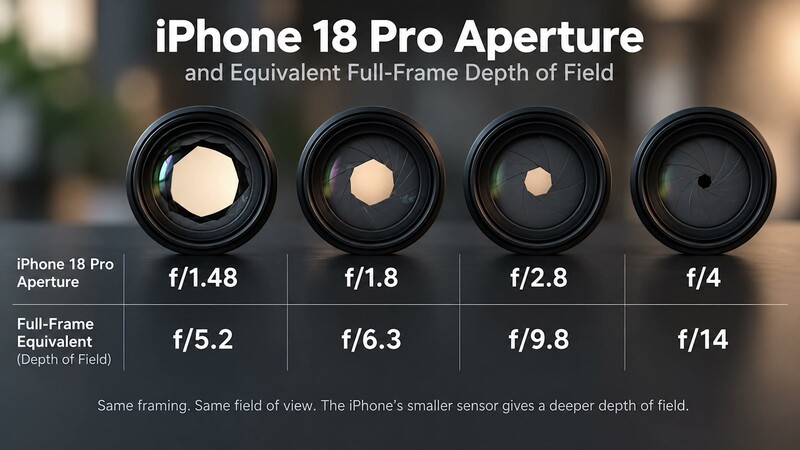
The entire range of this lens lives between roughly f/5.2 and f/14 in full-frame terms. That is a real spread, but it sits at the deep end of the scale, which is why outdoor shots at f/1.48 and f/4 are so hard to tell apart. Standing close to my son I could see a slight change in the background. It was not dramatic.
The one place the aperture genuinely earns its keep is at minimum focusing distance, and that is also where the trap is. The main camera does not focus especially close, so as you move in on a subject the phone quietly hands you off to the ultra wide camera. If you do not notice that happening you get a worse photo, and your aperture setting stops mattering entirely, because you are not using that lens anymore. Anyone attempting real close-up work on a phone needs to watch for it.
The Videographers Were Half Right
After my last two videos the comments told me I was missing the point: the aperture is not for photographers at all, it is for video, so you can hold a 180 degree shutter at 1/48 of a second and get natural motion blur. That is a fair use for it, and in some lighting it will help. I went through that whole argument here.
Most of the disagreement, though, comes down to people misreading what an f-number is. Half the comments treat it as a depth of field measurement, which it is not. The other half look at an equivalency chart like the one above and assume those numbers describe exposure, which they also do not. If you have shot video for any length of time you already know instinctively that you cannot lock 1/48 of a second at ISO 50 and expose correctly at f/4 in daylight. It will be blown out. Outdoors you are still going to need a neutral density filter, exactly as you did on every iPhone before this one.
I also think Apple is solving this in the wrong place. There is software like ReelSmart Motion Blur that adds convincing motion blur to footage shot at too fast a shutter speed, and these phones already do an enormous amount of processing to every frame of video they record. Handle it computationally and nobody has to think about shutter angle on a phone again.
The Real Upgrade Is the Software
Which brings me to what I think is the actual headline feature of this camera, and it is not hardware at all. Apple has finally given us manual control over shutter speed and aperture in the native camera app.
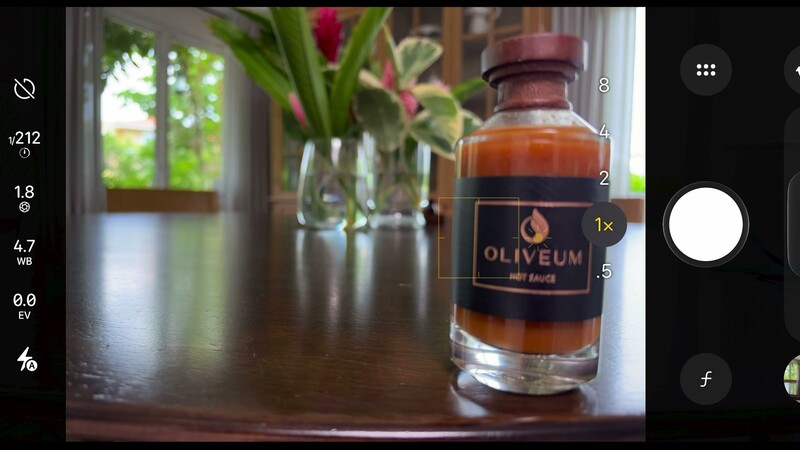
Somebody is already typing that they have had full manual control through a third party app for years. True. But have you noticed that those pictures look bad? It is not the developers' fault. The reason an iPhone photo looks the way it does is the processing behind it. Every time you press the shutter the phone captures a burst and combines it. Lock the ISO and the shutter speed in a third party app and you get one frame with a fraction of the dynamic range, and it looks nothing like what the stock app would have handed you.
That is also why Apple still will not give up ISO. The phone is shooting several exposures at different values and blending them, so picking one number does not really mean anything anymore. Video is less clear to me. I do not know how much processing is happening there, and it seems like ISO control would be reasonable. At a minimum I would like to see what the ISO currently is, so I can decide whether the scene needs more light.
The other genuinely useful addition is being able to fine-tune and lock white balance. For video that is a big deal. White balance is the setting that is always slightly wrong, and it is one of the main reasons I have reached for third party apps in the past. Now I can do it in the stock app.
The frustrating part is that none of this came to the 17 Pro. It is software. I assumed it would appear the moment I updated my older phone, and it did not.
Should You Upgrade
You could say the iPhone 18 Pro's camera performed better than I expected, and that is true. You could also say I had very low expectations, and that is equally true.
If you are asking whether to upgrade from last year's phone specifically for the camera, my answer is the same one I have given for several years running. Probably not. This is the best iPhone camera Apple has ever made, and it is not meaningfully different from the one before it. If your phone is a few years old you are going to be thrilled. If you are holding a 17 Pro, keep it.
One Last Thing
If you read this far you are probably the same kind of nerd I am, which means you are also running a ridiculous number of apps and windows on a Mac. I built an app for that. It is called Better Dock, it replaces the macOS Dock, and it gives you over 100 settings you can change. If you run multiple monitors it can put a dock on every screen showing what is actually running there. It is in open beta with more than 2,000 users, it is free to try, and there will always be a free version.
Join the Fstoppers community for free
-
Post comments and join in the discussions
-
Browse the site ad-free
-
Share your work and get featured in the community
-
Compete in the photo contests for fun and prizes
2 Comments
Hi,
Maybe allowing the picture to open full screen on this article will improve the comparaison... Just saying
What photo are you referring to?