The NEEWER Q120 is a new compact 120Ws battery-powered strobe that's packed with features, but the most impressive thing about it might be the price. It sells for $159.99 at B&H ($219.99 list), while its two direct competitors, the Godox AD100Pro II and the Profoto A2, cost $299 and $895.
A light this size sits between a speedlight and the next class of battery strobe up, like the Profoto B10X. You get roughly 2/3 of a stop more light than a speedlight in a package that's close to the same size.
USB-C on the Light and on the Battery
The first thing I noticed out of the box was a feature I love. The Q120 has a USB-C port in the side of the light, and NEEWER also put USB-C on the battery itself. You can run the light plugged in, or charge a stack of spare batteries off to the side without a proprietary charger. I'm sick of proprietary chargers, and I wish every battery I own worked this way.
The Remote Is Better Than the Light's Own Controls
The button layout and menus on the light are okay, but not as intuitive as I'd hoped. I appreciate having a physical knob, but it isn't as quick or as accurate as I'd like, and it doesn't compare to Profoto's knobs, which work incredibly well. Each time something like that annoyed me, I had to remember what this light costs.
NEEWER also sent me its new touchscreen remote, the QZ, and it's almost strange how good it is compared to the controls on the light itself. The touchscreen is fast, and there's a physical knob you can press and turn if you'd rather not touch the screen, which is great if you're wearing gloves. It can also control Godox lights. NEEWER lists the Godox V1, V100, IT32, AD100Pro II, and AD200Pro II as compatible, so if you already own some of those, you could add a cheap light and run everything from one remote. One important note: the remote and the light can work on the Godox X system or NEEWER's Q system, but not both at the same time. After playing with the remote for a few minutes, I assumed it would cost more than the light. It's about $85.
Mounting Modifiers
A light this small has no clips or standard mount built in, so NEEWER sent its CRB1 Bowens adapter, and it's a clever design. Leave the sliding plate in and the adapter clamps onto a speedlight. Slide it out of the way and the Q120 drops right in, then a rubber clamp screws down on top. It gets tight. There's no way that light is moving.

NEEWER also sent three softboxes, and they're so much better than the old style with individual rods that constantly fall out and get lost. You press a button on each arm to open it and press it again to collapse it. Each one comes with a diffusion panel and a grid. My one request: print the size on the bag. I own a lot of softboxes, and when the bag doesn't say, I have to build one to figure out which it is.
More Features Than I Expected
The more I dug through the menu and the spec sheet, the more I found. The head has an adjustable beam angle you set in the menu, like the zoom on a speedlight, so you can throw light further or spread it wide. There's a built-in optical slave, high-speed sync up to 1/8000s, around 420 full-power pops per battery, app control from your phone, and magnetic accessories, some included and some sold separately.
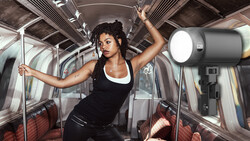
As for how powerful it is, here I'm standing in shade with direct sunlight behind me. With the Q120 at full power, I can get an even exposure. If balancing flash against the sun is new to you, Lighting 4 by SLR Lounge covers it in depth.


NEEWER Q120 vs. Godox AD100Pro II vs. Profoto A2
Here is every published spec for the three lights side by side, split into sections so it's readable on a phone. Green marks the leader in each row where one is measurable.


A few notes on the chart. NEEWER's product page lists the Q120 at 5600K ±100K, while the comparison sheet NEEWER sent to press lists 5800K in a Constant Color Temperature mode that doesn't appear in the published specs, so that one is worth metering. Profoto lists the A2's recycle time as 0.05–1.3s, and B&H lists 0.1–1.6s; the chart uses Profoto's figure. The 28–105mm zoom range is NEEWER's number. I confirmed the beam angle adjusts, but I didn't measure it.
Is It the Right Light for You?
When it comes to features for the money, I don't think anything else comes close right now. It really comes down to whether this type of light fits how you shoot. I occasionally shoot events, and for that I'd lean toward speedlights, since this only gets you about 2/3 of a stop more. If I needed more output, I'd probably step up to a larger battery-powered strobe. But many photographers never shoot events and don't like speedlights at all, and for them, this might be the ultimate battery-powered strobe.
If you'd like to see another super nerdy flash shootout comparing this light to its competitors on every front, let me know in the comments.
This video was sponsored by NEEWER.
Join the Fstoppers community for free
-
Post comments and join in the discussions
-
Browse the site ad-free
-
Share your work and get featured in the community
-
Compete in the photo contests for fun and prizes
No comments yet