
For the past six months, I've had the opportunity to thoroughly test the Hasselblad XCD 35–100 E — Hasselblad's brand-new all-around zoom lens. With this lens, I've photographed commercial campaigns for Hasselblad, documented a family wedding high up in the Alps, and captured my photo workshop in southern Spain — all without changing the lens even once. And honestly: the 35–100 E has impressed me in every single situation.
But there's something that's made me think. After half a year of relying entirely on this zoom, I now find myself facing an interesting decision. Because the very thing that makes this lens so incredibly versatile and capable might also be the reason why I don't want to use it permanently.
What I mean by that — and what my experiences with the XCD 35–100 E have been — you'll find out in the following blog post.
You can watch the full video review with plenty of sample images.
First Impressions and Technical Overview of the Hasselblad XCD 35–100 E
When I first took the Hasselblad XCD 35–100 E out of the box, I was immediately impressed. This is exactly how I've always imagined a true medium format lens: robust, precise, and with a reassuring sense of substance. Compared to its V-series prime siblings, the new zoom feels noticeably more substantial. With a diameter of 90 mm, it sits solidly in the hand and instantly conveys the feeling of working with a tool of the highest quality.
The build quality is outstanding. Both the focus and zoom rings move smoothly with just the right amount of resistance. The metal housing feels premium, and the engravings and controls immediately evoke the design language of Hasselblad's iconic V-series lenses. The only thing I miss on this model is a focus clutch for quickly switching to manual focus.
Despite the large image circle required for the medium format sensor, the lens is surprisingly compact. At 894 g, it's almost identical in weight to the Canon RF 24–70mm f/2.8 L IS USM (900 g) and significantly lighter than the Fujinon GF 45–100mm f/4, which tips the scales at over 1 kg. With a length of 13.3 cm, it's slightly longer than the Canon counterpart (12.6 cm) but far from the bulky 17.5 cm of the Fujifilm.
There are differing reports online about the focal length conversion. This likely stems from Hasselblad's official datasheet listing an actual range of 36–97 mm. Converted to full frame, this corresponds to roughly 28–76 mm f/2.2–3.2 — a highly versatile range that covers a wide variety of use cases. Compared to the classic "Holy Trinity" full frame zoom (24–70mm f/2.8), you lose about 4 mm on the wide end but gain 6 mm on the telephoto side — an advantage that becomes especially noticeable in landscape work. With a maximum aperture of f/2.2, the 35–100 E competes with the Canon RF 28–70mm f/2 L USM and is only about one-third of a stop slower than a standard f/2.8 zoom at the long end. Even among medium format competitors, the XCD 35–100 E stands out: no Fujifilm zoom offers a comparable focal range or a maximum aperture wider than f/4.
The maximum aperture changes across the zoom range as follows:
- 35 mm: f/2.8
- 38 mm: f/3.2 (≈ ⅔ stop slower than the XCD 38V)
- 55 mm: f/3.5 (≈ 1 stop slower than the XCD 55V)
- 70 mm: f/4 (≈ ⅓ stop slower than the XCD 75P)
While these subtle variations make the lens slightly slower than some primes, they ensure consistently high optical performance throughout the entire zoom range. Hasselblad also maintains its reputation for precision in the shutter design: the built-in leaf shutter operates from 1/4,000 second to 68 minutes, and with the low base ISO of 50 or 64, it allows for wide-open shooting even under bright sunlight — with beautifully smooth bokeh.
In short, the XCD 35–100 E combines technical precision, versatility, and the signature Hasselblad feel in a remarkably well-balanced lens.
Field Experience with the Hasselblad XCD 35–100 E – Flexibility Without Compromise
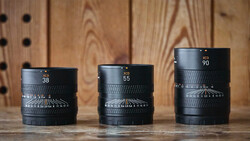
Enough with the technical details — how does the XCD 35–100 E actually perform in real-world photography? While shooting the campaign for the Hasselblad XCD 20–35 E, I often felt that the lens was a bit too wide for my personal taste. With the XCD 35–100 E, however, I immediately felt at home. It covers exactly the focal lengths I use most often and essentially combines my two favorite lenses — the XCD 38V and XCD 90V — into a single body.
Accordingly, during the first two months, I used the lens almost exclusively at the two extremes of its zoom range: 35 mm for wide overviews and 100 mm for compressed details.
This flexibility proved to be a major advantage, especially during the Hasselblad X2D II launch shoot. The lighting and weather conditions changed constantly throughout the production, yet the 35–100 E allowed me to react instantly to each situation and create a cohesive yet diverse portfolio of images.
On windy days, I noticed that the lens, when fully extended, picks up significantly more movement than the more compact prime lenses. Whenever possible, I positioned myself in front of the camera to act as a windbreak — a simple yet effective trick to avoid camera shake.
A particularly memorable experience was my brother-in-law's wedding in the Zillertal Alps, where I had the chance to test the lens under true reportage conditions. Since no official photographer was hired, I took on the role of documenting the ceremony and capturing a few couple portraits. In such a breathtaking mountain setting, I wouldn't have been able to resist pressing the shutter anyway — and the XCD 35–100 E proved to be the perfect companion.
Paired with the new X2D II, shooting was pure joy. From intimate portraits to sweeping landscape shots and close-ups of the wedding rings — this setup created a genuine "flow" feeling. In just 40 minutes, I captured over 300 images, and not a single one was out of focus. The continuous autofocus with subject detection tracked the couple with precision as I ran across the alpine meadows, zooming in and out while focusing entirely on composition.
For those who understand the relationship between focal length and subject distance, this lens can produce beautifully three-dimensional bokeh at any setting — one that preserves context while gently separating the subject from the background. Even during the ceremony itself, when every shot had to count, the 35–100 E and the X2D II performed quickly and reliably.

Traveling Light – The XCD 35–100 E on the Road
In my most recent photography project, portability was the main focus. For my photo workshop in southern Spain, I traveled with carry-on luggage only — no extra backpack, no unnecessary gear. Clothing, camera equipment, and my laptop for the editing sessions all had to fit into the new Peak Design Roller Pro and a Medium Camera Cube as my personal item. That meant: no tripod, no alternative lenses — just the Hasselblad X2D II, the XCD 35–100 E, and a set of ND and polarizing filters.
Despite this minimalist setup, the weight became noticeable over the course of long shooting days. With temperatures around 30 °C, the camera started to feel increasingly heavy, and hanging from the shoulder strap, it pressed perceptibly against my hip while walking. Not dramatic, but clearly more than with the roughly 500 g lighter XCD 38V. The advantage of this setup, however, was obvious: I didn't have to worry about dust on the sensor. A zoom lens that never needs to be swapped is probably the most effective dust protection one can get for a Hasselblad camera.
Once again, the strength of this system became apparent — its versatility. With just one camera and one lens, I was able to switch effortlessly between completely different subjects:
- Long exposures up to one second handheld
- Architectural photography with precise line control
- Close-up detail shots in a botanical garden
- And even a spontaneous beach portrait session with an influencer
Everything was possible — and the image quality, as expected from Hasselblad, was outstanding. Even wide open, details remain tack-sharp right into the corners. In day-to-day shooting, I noticed no chromatic aberrations, and the slight vignetting visible at wide apertures disappears completely around f/8 to f/11 — exactly the range I work in most often.
The 35–100 E even proved surprisingly capable for astrophotography. At 38 mm and f/2.8, it produces impressive results even without moonlight. To keep the stars pin-sharp, exposure times should be limited to around eight seconds — at ISO 3,200, this combination delivers highly detailed images, such as those I captured in El Torcal de Antequera Natural Park.
Even the workshop participants were impressed by the handling and image quality of the new zoom — so much so that at times, I could hardly get the lens back into my own hands.

Personal Conclusion on the Hasselblad XCD 35–100 E – Between Versatility and Photographic Discipline
Let's return to the hesitation I mentioned at the beginning regarding the Hasselblad XCD 35–100 E. After all the praise and justified enthusiasm, you might assume there's hardly anything to criticize about this lens — and that's basically true. I'm convinced that the 35–100 E could become one of the best-selling lenses in Hasselblad's entire lineup. It's versatile, optically outstanding, and at the same time smaller, lighter, and more affordable than buying two high-quality primes.
Still, after six months of intensive use, I'm genuinely looking forward to returning to my trusted XCD 38V and XCD 90V. My way of working is highly structured. As you may know from my projects and videos, I usually work on clearly defined themes with a deliberate visual language and a precise approach to composition and focal length. With the 35–100, I noticed that I tend to "go with the flow" — zooming intuitively rather than choosing focal lengths deliberately for their characteristic look and impact on image composition.
A prime lens forces me to work more consciously. My eye becomes accustomed to a fixed frame, and I start actively searching for subjects that fit within it. I've truly missed that focused, reduced way of working — the one that leads to a more consistent visual style. I also greatly appreciate the focus clutch on the V-series lenses for manual focusing, even though the focus ring on the 35–100 E is technically precise and pleasant to use.
This leads to a conclusion that balances technical perfection with personal creative awareness. The Hasselblad XCD 35–100 E delivers top-tier performance in every respect — aperture, sharpness, contrast, and color fidelity are on par with the best primes. In some aspects, it even surpasses them, such as with its modern stepping autofocus motor and its maximum shutter speed of 1/4,000 second. While it's not as light or compact as a single prime lens, anyone who regularly switches between two focal lengths will save weight, space, and money. You'll also protect your sensor by reducing lens changes, work faster, and capture fleeting moments more easily.
This lens is a true all-rounder and will serve as a reliable companion in many fields — from commercial and fashion photography to reportage, travel, portrait, and product work (with the exception of macro). In these situations, you’ll rarely miss a prime lens. Especially when combined with the XCD 20–35 E or XCD 25V, this zoom covers a range of focal lengths sufficient for an entire photographic career — with maximum image quality, top-tier craftsmanship, and cutting-edge autofocus technology.
If, however, you prefer the deliberate reduction, lighter kit, and creative discipline that come with a prime lens, the 35–100 E still fits perfectly into the Hasselblad system. It pairs beautifully with lightweight lenses like the XCD 28P or specialists like the XCD 120 Macro. And let's not forget: Hasselblad itself describes the 35–100 E as the second lens in its "Holy Trinity" — many of us are eagerly awaiting the missing true telephoto lens.
At the moment, I’m actually working with a completely different type of Hasselblad lens — one you’ve probably never heard of. If you’d like to find out what it is, feel free to subscribe to my YouTube channel.
See you next time — and happy shooting!




Join the Fstoppers community for free
-
Post comments and join in the discussions
-
Browse the site ad-free
-
Share your work and get featured in the community
-
Compete in the photo contests for fun and prizes
2 Comments
"One XXX to Rule Them All"
BLEAARRRGGGG!
I barf upon the cliché.
I mean, really, do the headline writers think we're all 8 years old? Are THEY 8 years old?
"Flexibility Without Compromise"
Really?! NO compromise??? This thing is no bigger, heavier or more expensive than, say, a Panasonic 20mm f1.7 pancake that fits in a shirt pocket?
EVERY lens involves compromises.
"the weight became noticeable over the course of long shooting days"
Oh, wait, so it DOES involve compromises. Whodathunk?
Jeez, the fanboi vibe here is absolutely brain-deadening. I feel stupider just having read this.