

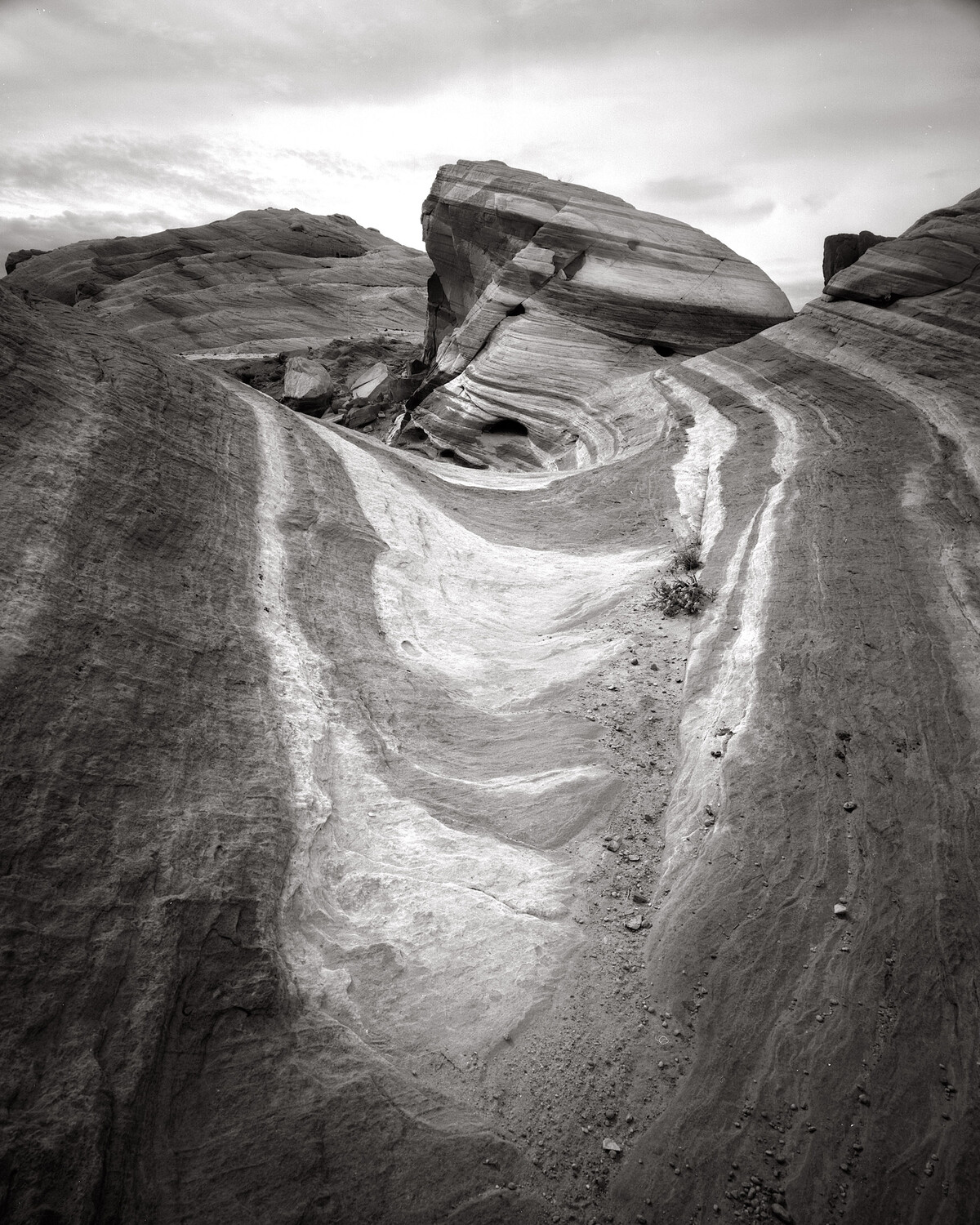
The Back of the Dragon
A place out in the desert of Southern Nevada. This place is smoking hot. I had been here one time before this one. On this trip I found a short cut to it and it was a lot easier. When I got to it there was a large group of people sitting on their rear ends just above it. I made a couple of images below it, which were kind of nothing burgers and when I got to the place to set up for this they began screaming at me to get out of their photograph, but there were no cameras out. They were just sitting there, so I ignored them and went about my business, which I am glad I did since I don't know if I will ever be back in this place again. I used a Toyo 45A camera, a 90mm Sinaron lens with a #61 filter attached. Kodak T-Max 100 film rated at ASA 50 to insure good shadow detail.






9 Comments
Location in a well known State Park known for long lines and great photographs?
There are many time I have to wait, wait and wait for the scene to clear of tourist hanging around in my composition. We all have a right to be there.
I like you use of lines shapes, and tonality of the rocks to frame your composition. I don't think I have ever shot T-Max at ASA 50. Does your #61 filter work better in this case than a #25? I only ask because #25 is the only one I currently have.
Thank you for the question, and it's a good one. The reason is that I use large format film, so I can customize any exposure for any situation. My default with T-Max of any stripe is to expose at 1/2 the box rated speed. That causes the shadow portions of the negative to get a lot of exposure, which means my shadows will always be filled with light. As you may know, the shadow portions of the negative develop completely in a very short amount of time, and once they have developed they will never gain much more density. Whatever density they might gain by more development will be very, very negligible. So we control shadow density by exposure only. As long as the development time is within normal range, the shadow areas are baked in by exposure. Highlights continue to develop as long as the film is in contact with an active developer solution. So we can control the image contrast, to a very great degree by controlling the film's development. The reason to use a dark green filter is that the material here, as you probably know, is red rock sandstone, for the most part. Since red and green are complementary colors, a green filter will block more of the red frequencies of light than it does yellow or white, so a dark green filter, in this case will increase image contrast between the red of the sandstone and the portions that are yellow, gray or white. A red filter, like a #25 or 29, would have the opposite effect by decreasing the difference between the red of the sand stone and the portions that are yellow, gray or white. The adventage of the green filter too is that it contains both yellow and cyan so it will help to increase apparent contrast in the sky. The ideal filter to increase apparent contrast in this case would be a cyan, or even a dark blue filter. However those two filters would cause there to be no apparent contrast in the sky.
PS on this. This development phenomena is why it is that there is no true "push processing" of film. All that does is to increase image contrast, sometimes so severely that the negative is unprintable. I use to so called "push process Tri-X to 1600 and more, not realizing what was happening. The negatives had better sharpness since the exposure was four time faster. But they were very grainy and the shadows were empty.
As to the other part about them having as much right to be there, that is true. And if they had cameras out and were actively making images I would not have stepped in. But, as I said they were all just sitting there.
This, BTW, is my short tutorial on film exposure and processing. T-Max films are less vulnerable to under exposure of the negatives than the older emulsions like Tr-X. However, I do want my negatives to have a lot of detail down into the very darkest shadows. Hope that helps.
Another PS. If you look up under the lip of the capstone there is a lot of detail. That's why I rate the film at a lower ASA. A digital photographer does much the same thing by checking the histogram and moving it to the right until there is no black clipping.
It took 25 minutes for the tourist to move far enough out of the scene to take this shot.
Panatomic-X and Minolta SR-T201
I have stood on that very corner. There was a "Flatbed Ford, but no girls were coming down to take a look at me, which is good. My wife would not have been amused.
Nice shapes, flow of all the lines, and details/textures, Nathan. I'm enjoying your posts!
Thank you. I enjoy them as well.
Good choice of filter to bring out that wonderful contrast and texture Nathan. Of course with digital we have the luxury of simulating that in post, but I do remember those days where we really had to think BEFORE taking the shot.
Kudos to you for remembering those skills.
Thanks for posting this wonderful shot.
Thank you.