

try something new: Deepscape
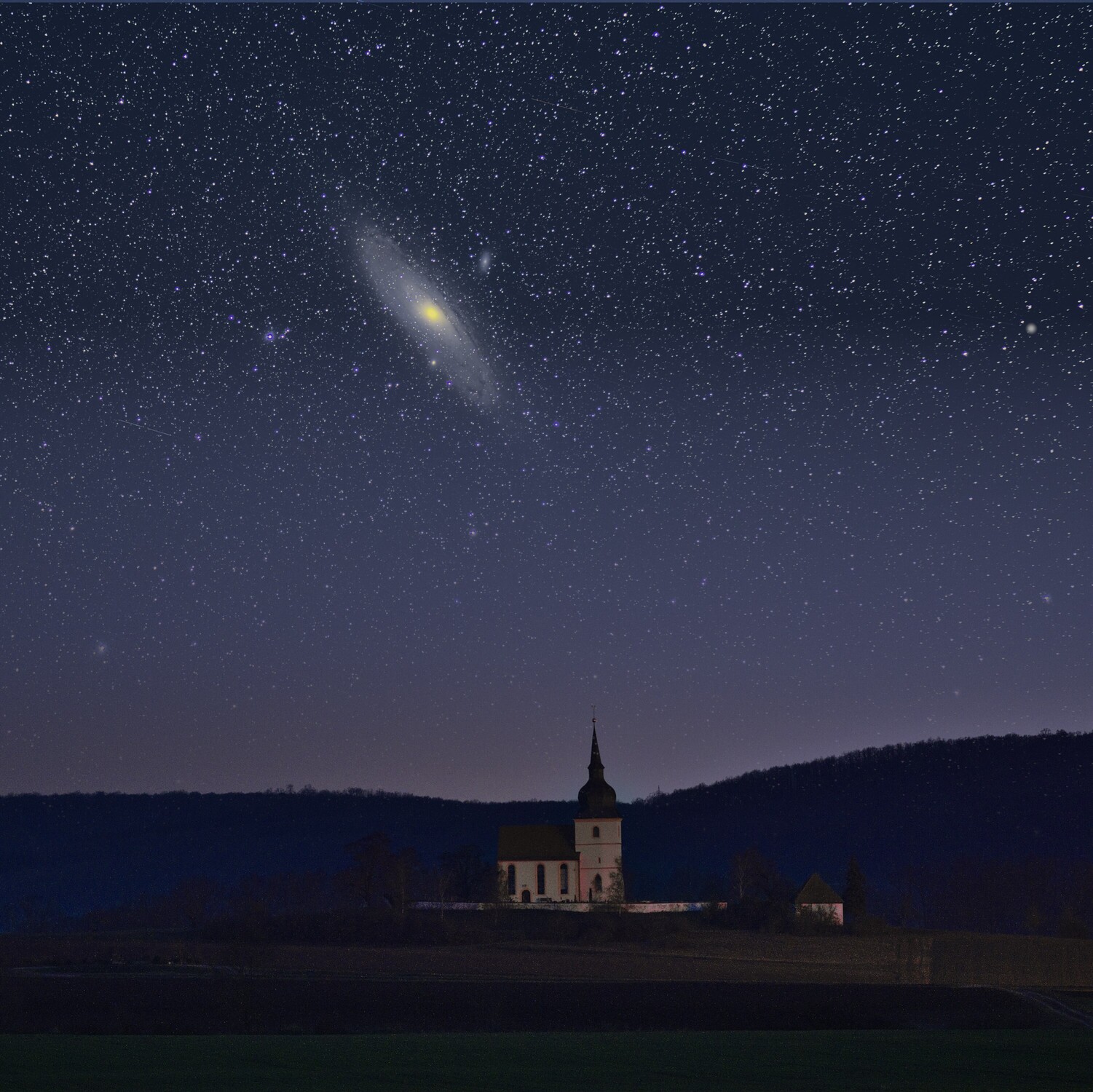
...was the challenge some weeks / months ago. I did: approaching the topic "deepscape". That means combining a deep sky object like the Andromeda galaxy, Plejades, or similar things with a real object on earth. By using the same focal length and settings. That results into the key question where does a dedicated object rise or set? Plus considering the light pollution in our environment. That makes the stars fading. Here is a result wher I'm good with. It's my beloved tiny church at village Kaubenheim with the Andromeda galaxy. The Andromeda never sets here, it just scratches the horizon. Which makes photographing difficult: It takes a long time until it rises again and the light has to pass a lot of air compared to the stars vertically above us. That dimms the light. Plus lightpollution. Here is a Bortle 4 area. A very good condition in Germany & many parts of the world.
Finally: about 10000 sec exposure, f2.8, iso 200, 100mm focal length. 2 min exposue each star image
Stacked with Sequator, blended with Gimp & processed with Darktable.









7 Comments
Awe is what it makes me feel. Super shot.
Thank you! Seeing the stars makes me humble - I realize we are sitting on a big space ship feed us and we are just a tiny spot in the universe. There is no escape. We are obliged to deal with each other & we need to find compromises to survive.
I think you captured it. Especially in today's society with light pollution. I remember, growing up in Los Angeles many moons ago, the sky would light up, you were able to see the Milky Way, but later in the same area, the stars disappeared which made me wonder why the stars disappeared.
I live deep in agricultural land in a very small town that produces little light at night. I do see very clear skies at night, but just with the odd twinkle here and there. I don't think anywhere sees skies like that apart from maybe up in Scotland.
Countryside in a tiny village appears often as good to see the stars! To judge on I normally consult the light pollutionmap.info. And then: take a picture: how huge is the glow at the horizon? That helps you to judge about the question 'what you can do?'
Enjoy the clear nights!
Thank you for that map link. It seems the small town I live in does produce a of light pollution. I would not have to drive far though to a much less polluted area. My house faces south. At night, if it's clear, there is always one bright light in the sky, over to the west usually, but that might be to do when when I see it and perhaps it moves around like we do? Anyway, I have no idea if this light is a star or a satellite. It is bright and does not appear to move. I have no idea where I got this bit of information from, but that bright light could be Venus?
Hi Colin!
To get an idea what is in front of you and get an orientation, check stellarium.com or .org. first on the PC to see the power of it. Then you can decide if you want to load the app. It can show you many satellites (no clue how up to date it is) and, more important, where is which star constellation, planet, what ever. One of my 1st tools I consult.
Where to move for being in a dark(er) area you need to find out yourself, having no clue where you are. A quick check I want to suggest: set the cam with a fast wide angle lens on a tripod, focus manually on a bright spot far away and take a photo. And check it: how tall / high is the band of light pollution? When does the MW fade into the light pollution? And, most important: is it OK for you?