
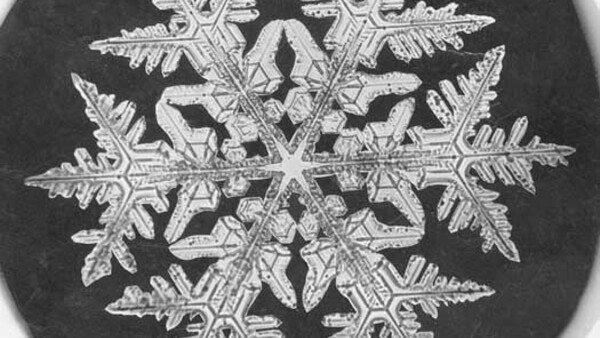
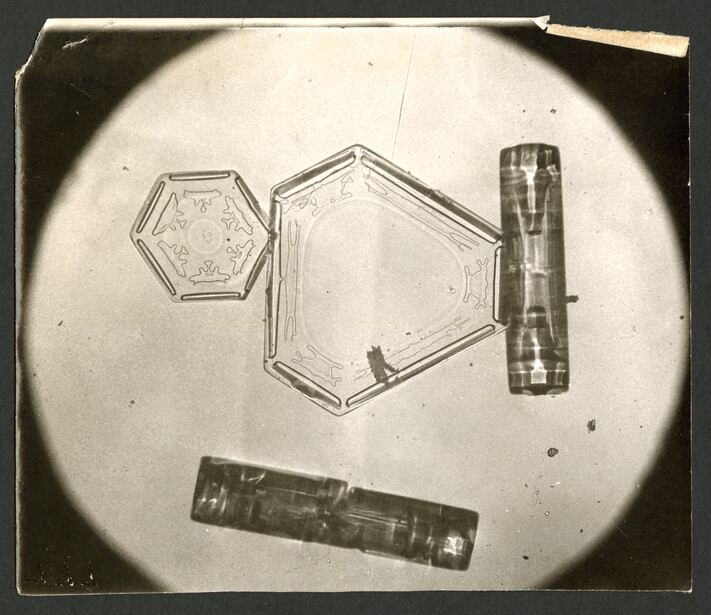
Wilson Alwyn Bentley made the first photograph of a single snow crystal on January 15, 1885, in an unheated shed behind his family's farmhouse in Jericho, Vermont. He was nineteen, a few weeks short of his twentieth birthday, working a bellows camera bolted to a microscope on a frame he had built himself. He held the exposure long enough for the crystal to keep its shape in the cold, and when he developed the plate he had something no one had managed before: a real photograph of a snowflake.
That single plate was not the achievement. It was the down payment. Over the next 46 years, through every winter until the last one he lived to see, Bentley went back out into the storms and did it again, and again, more than 5,000 times. He is the reason you grew up believing that no two snowflakes are alike. The book that made the case reached print just weeks before he died, at the close of 1931, a strangely fitting way to close a project that had eaten his entire adult life.
Three Centuries of Drawings, and Not One Photograph
People had been staring at snow crystals for a very long time before Bentley. Johannes Kepler puzzled over why they always arrived with six sides in a short 1611 essay, "On the Six-Cornered Snowflake." Rene Descartes sketched them in 1637. In 1665, Robert Hooke aimed one of the first microscopes at fresh snow and filled pages of his "Micrographia" with crystal drawings that revealed, for the first time, how intricate the things really were. For close to three centuries the entire record of snowflakes was made by hand.
That is the gap Bentley closed. A drawing, however careful, is one person's account, and Hooke himself admitted the crystals were never as tidy on the slide as an artist might wish. A photograph made a stronger promise. It claimed the crystal had actually sat under a lens and printed its own portrait onto the plate, which is exactly why the retouching question that later dogged him mattered so much.
A Microscope, a Camera, and Two Winters of Failure
Bentley grew up on a dairy farm with almost no formal schooling. His mother, a former schoolteacher, taught him at home and gave him an old microscope for his fifteenth birthday. Most boys would have pointed it at pond water and insects. He pointed it at snow. He tried to draw the crystals he saw before they melted and kept losing the race, because a snow crystal under a warm eye in a warm room lasts only seconds.
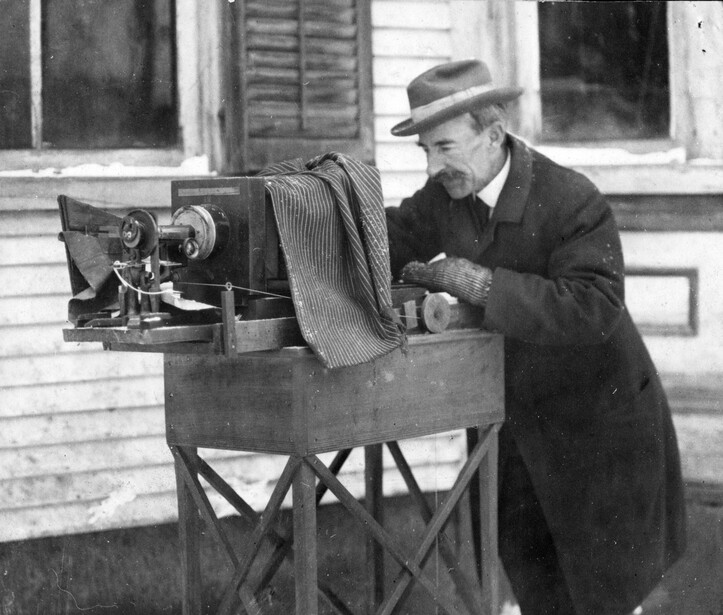
When he was seventeen, his mother talked his father into an expensive gamble. They bought a bellows camera and a microscope objective that together cost about $100, a serious sum for a Vermont farm family in the early 1880s, and his father made no secret of thinking the whole idea was nonsense unfit for a farmer. Bentley built a wooden frame to marry the camera to the microscope, then spent two full winters failing. He overexposed. He underexposed. Crystals melted, sublimated, or shattered before he could get them in front of the lens. It took close to two years of ruined plates before anything worked at all.
What It Took to Catch One
The method he worked out is essentially the one snowflake photographers still use. He worked in the cold on purpose, in an unheated shed, so his own body heat would not destroy the subject. When snow fell he caught crystals on a black-painted tray or a piece of black velvet, studied them fast, and picked out a single unbroken one. He moved it with a thin wooden splint and the fine tip of a turkey feather onto a chilled glass slide, careful not to breathe on it, then slid it under the lens and made the exposure before it could vanish. Handling took seconds. A warm finger, a sigh, a clumsy move, and the subject was gone for good.
He described the pull of it plainly in his later years. "Under the microscope, I found that snowflakes were miracles of beauty; and it seemed a shame that this beauty should not be seen and appreciated by others," Bentley said in 1925. "Every crystal was a masterpiece of design and no one design was ever repeated. When a snowflake melted, that design was forever lost. Just that much beauty was gone, without leaving any record behind."
The Retouching Fight
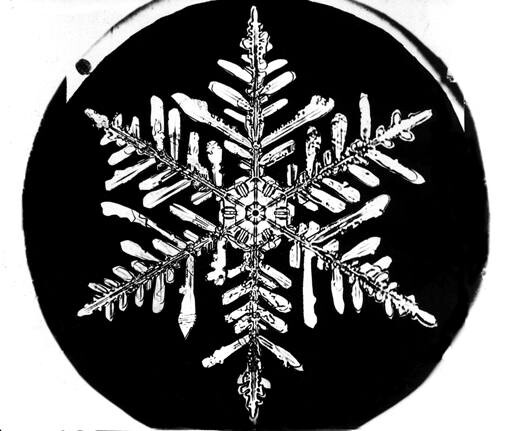
A snow crystal is white ice on a white world, and Bentley's early plates showed pale flakes swimming in gray. To make them read, he darkened the background by hand. On a duplicate of each negative he scraped the emulsion away from the crystal's outline with a knife, leaving the flake bright against solid black. His own account of the method is careful on one point: the original negative is best left alone, and the blocking out is done on a copy, so an untouched plate survives.
What the method does not settle is whether the knife ever crossed the outline into the crystal, and that is exactly what he was accused of. The German meteorologist Gustav Hellmann had his own photographer, Richard Neuhauss, shoot snow crystals, got lumpier and less tidy results, and accused Bentley of having "mutilated the outlines" to make his flakes look more perfect than nature allowed. Bentley's reply doubled down rather than backing away, and it is worth noticing that it was not a denial. "A true scientist wishes above all to have his photographs as true to nature as possible," he said, "and if retouching will help in this respect, then it is fully justified." The charge has never been fully settled either way. The kinder reading, and the likelier one, is that Bentley's flakes look impossibly perfect because he threw away almost everything he caught. He picked single unbroken crystals out of thousands and discarded anything chipped or lopsided, which on its own explains why his plates look unlike anyone else's. That is a strong case and it fits everything known about how he worked. It is still not the same thing as proof that the knife never crossed the line. Whether you find his answer reassuring probably depends on how you feel about the same argument in the age of the healing brush. The tension it names, where faithful printing ends and manipulation begins, has not aged a day.
No Two Alike
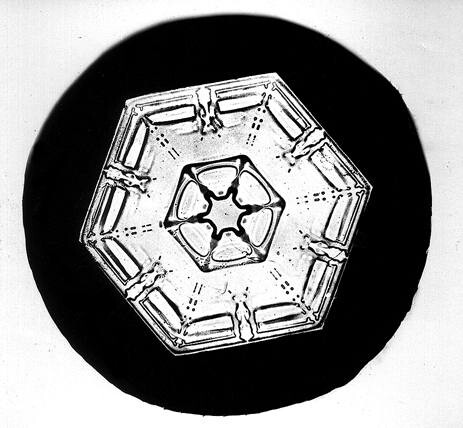
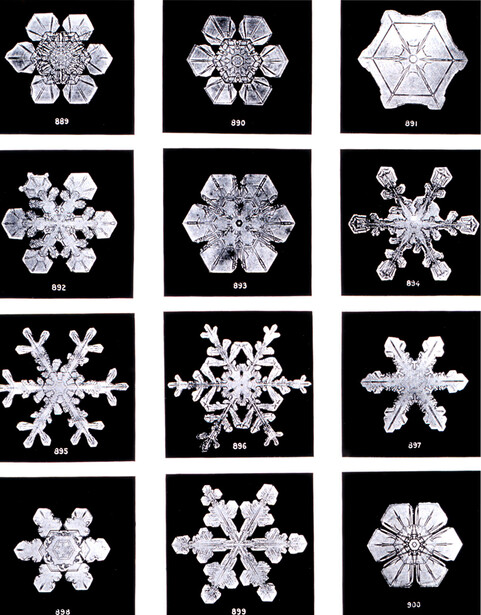
The idea Bentley is remembered for came straight out of the growing pile of plates. He kept photographing, kept comparing, and kept failing to find a match. In 1898 he co-wrote his first article, "A Study of Snow Crystals," with George Henry Perkins, a University of Vermont professor, and the claim that no two snow crystals are the same began working its way into the culture until it became one of those facts everyone repeats without checking.
The science mostly backs him, with a caveat worth keeping straight. Very small, simple crystals really can look identical, and under a microscope you can find convincing twins. A large, branched crystal is another matter. Kenneth Libbrecht, a Caltech physicist and the modern authority on the subject, has calculated that the number of ways to assemble a complex snow crystal exceeds the number of atoms in the universe, which makes the odds of two elaborate flakes matching, arm for arm and branch for branch, effectively zero. The Library of Congress puts the working answer the same way, that no two snow crystals of any complexity are ever truly identical. Bentley was right about exactly the crystals he chose to shoot.
The Book, and the Last Storm
For most of his life the photographs did not pay. Bentley sold prints and lantern slides for small money, gave lectures, and supplied images to National Geographic, Scientific American, and Nature while he was still milking cows. Near the end, colleagues gathered his life's work into a single volume. "Snow Crystals," published by McGraw-Hill in 1931 with the Weather Bureau physicist William J. Humphreys, reproduced 2,453 of his photographs across 204 plates, about a hundred of them frost and dew rather than snow, the definitive record he had spent decades building. The Smithsonian Institution Archives holds a set of his original prints today.
The book reached shelves in November 1931. The next month, Bentley walked six miles home through a snowstorm, the exact weather that had been his whole subject. He fell ill afterward and died of pneumonia on December 23, 1931, at sixty-six, in the farmhouse where he was born. His masterwork was barely out.
Why He Still Matters to Anyone With a Camera
Libbrecht put Bentley's standard bluntly: he "did it so well that hardly anybody bothered to photograph snowflakes for almost 100 years." Sit with that. A self-taught farmer with homemade gear and a $100 camera set a bar that professional science left largely untouched for a century. The plates hold up because the craft under them was real: patience, cold hands, and an obsessive refusal to accept a flawed frame, none of which any camera can supply for you.
You can chase the same subject now with far less suffering. A modern macro lens, a cold sheet of dark glass or wool, and focus stacking will pull a sharper single crystal than Bentley ever got off a glass plate, and the fundamentals of working that close are exactly what a course like mastering macro technique exists to teach. What none of it changes is the part he actually solved. Get to the crystal before it dies, and be ready. He lost that race for two winters, won it once on a January morning in 1885, and then spent the rest of his life making sure he never lost it again.
Lead image by Wilson Bentley, public domain. Source.







Join the Fstoppers community for free
-
Post comments and join in the discussions
-
Browse the site ad-free
-
Share your work and get featured in the community
-
Compete in the photo contests for fun and prizes
1 Comment