

On October 5, 1986, the New York Times published the closest thing to an honest tally the milk carton campaign produced. The National Center for Missing & Exploited Children knew of 107 children located because somebody recognized a picture of them, at least four of those from a milk carton. The National Child Safety Council's own estimate of cartons then in circulation was two billion to three and a half billion, down from a peak it put at three to five billion.
The First Cartons Came From a Des Moines Dairy
Johnny Gosch was 12 when he left his house in West Des Moines, Iowa, shortly before 6 a.m. on Sunday, September 5, 1982, pulling a red wagon toward the drop point for his Des Moines Register route. Customers called about papers that never arrived, and his father found the wagon two blocks away, still loaded. Twenty-three months later, on Sunday, August 12, 1984, 13-year-old Eugene Wade Martin left home around 5 a.m. for his own bundle of Sunday Registers. Neither boy has been found, and neither case has been solved.
Des Moines answered with printing. The Register ran full-page ads carrying both faces, a trucking company put poster-size images of the boys on its trailers, and a grocery store printed their pictures and reward information on paper bags. In September 1984, a month after Martin vanished, Anderson Erickson Dairy began running photographs and short biographies of both boys on the side panels of its half-gallon cartons, after an employee connected to the Martin family asked for help. A second Des Moines dairy, Prairie Farms, followed within a week, according to a later popular account. What the dairy added was reach into the kitchen, at breakfast, in front of an audience that had not chosen to look, which is why the carton became the memory, not the trailers.

The Anderson Erickson claim is well attested, and the record behind it is thinner than its repetition suggests. NCMEC credits the dairy, and historian Paul Renfro calls Gosch and Martin the first missing children featured on the sides of milk cartons. The best witness is Barbara Huggett, the National Child Safety Council artist who later laid out the national cartons by hand, who says her organization's founder saw those Iowa cartons and decided the idea should go national. No news item from 1984 documenting the launch has surfaced, and the dairy's own history page does not mention it.
The serious competing claim belongs to Chicago. On January 3, 1985, Hawthorn Mellody cartons appeared carrying Tricia Kellet, who was 9 when she vanished from the front of her home in May 1982, and Gary Antonio Feltman, who was 2 when he vanished that August. The cartons were a joint project with the police department, and they reached more than two million families. The wire story announcing it claimed no priority. California came third, not first: Alta Dena Dairy launched on January 21, 1985, promoted by a state assemblyman named Gray Davis, who would not become governor for another 14 years. In December 1984, by its own account, the National Child Safety Council in Jackson, Michigan started the first nationally coordinated program, though the Times dated the national cartons' appearance to January 1985. By March 1985, roughly 700 independent dairies had joined it.
What the Printing Process Did to a Child's Face
Huggett described the national layout to 99% Invisible in plain terms. MISSING ran in black block letters across the top. Two children sat side by side in black and white, with date of birth, height, weight, and last-seen location in type below. Half-pint school cartons fit one child. The council supplied every layout free, and International Paper made the plates free. The first national list ran to 77 children, and roughly 200 were featured over the program's life.
The usual explanation for how bad those faces looked is that ink soaked into porous paperboard. Gable-top stock is extruded with polyethylene on both sides before it reaches a press, so the ink sits on plastic film and soaks into nothing. The damage came from the press. Cartons are printed flexographically, with rubber plates on steel cylinders, up to seven colors in a single pass, at hundreds of blanks a minute. Flexography began as the coarsest major process, restricted for years to line and type work on boxes and wrappers, and it still runs coarse screens with heavy dot gain.

Stack those conditions and you get the object people remember. A single-color halftone, screened coarse, gaining dot on press, printed an inch and a half wide on a panel that curves away from you, then left in a refrigerator to get damp and creased. The separations that carry identity in a portrait collapse into two or three tones.
The crop fought the task too. The cartons used head-and-shoulders portraits, still NCMEC's standard: a recent picture in which the face is clearly seen. That framing suits recognition performed up close with time to study, the opposite of what a carton asked for. A stranger glancing across a parking lot works from height, build, posture, and gait. The cartons carried height and weight as text, in a form nobody converts back into a silhouette. Nothing quantifies where the pictures came from, though the surviving record looks like school portraits and snapshots.
Then there was currency. NCMEC tells parents to update a child's photograph every six months until age 6 and annually after that, because faces move fast. The carton children were long gone by the time they were printed. Gosch had been missing two years, and Chicago police required that a child be missing more than two months to qualify, building staleness into the rule.
Etan Patz and the One Picture Made by a Professional
If you grew up in that decade, the face you remember is probably Etan Patz, who was 6 when he disappeared on May 25, 1979, walking two blocks to his school bus stop in SoHo. His father, Stanley Patz, was a commercial photographer whose loft doubled as his studio, and Etan had often stood in for lighting tests. After the disappearance, Patz pulled his contact sheets and made copies, and printers donated fliers in five languages. The portrait reads as a photograph rather than a record, because someone who knew that face lit it on purpose.
Patz understood what that was worth. Speaking to Vanity Fair, in a passage Renfro quotes, he said: "If I hadn't been a photographer with those pictures, if we had been a poor, black family with blurry Polaroids, this case would have come and gone with the rest of them." Every other carton child got whatever picture the family happened to own.
Patz is also the source of the campaign's most durable myth. He is routinely called the first milk carton kid, which cannot be true, because no missing-child milk carton existed in the United States before September 1984, five years after he vanished. NCMEC's own 2024 account places him after Gosch and Martin. The softer version, that he was first on nationally distributed cartons, traces to one uncited sentence in a 2017 magazine piece that most later retellings are recycling.
The photographic evidence people cite for it does not say what they think it says. Search for proof and you land on three items from the Bernard Gotfryd collection at the Library of Congress, each titled "Etan Patz, first missing kid on a milk carton." None shows a milk carton. All three are studio frames of Julie and Stanley Patz holding a black-and-white print of their son. The catalog note states that the title came from caption information the photographer supplied, making it Gotfryd's shorthand for who Etan was rather than a description of the frame. One mount is dated 3/84 and one lists Newsweek as the agency, which would put the sitting before any missing-child milk carton existed anywhere in the country, though the Library catalogs the group as 1985.
Patz's remains have never been found. Pedro Hernandez was convicted of his murder in 2017, the Second Circuit vacated that conviction in July 2025, and the Supreme Court reinstated it on June 22, 2026.
The Recoveries, and How They Actually Happened
Every account of the yield disagrees with every other, and the reason is not that nobody counted. It is that the counting was done by the organizations running the program, against definitions that were never the same twice, and nobody audited any of it. NCMEC knew of at least four carton recoveries by October 1986, and by 1987 it was reporting six. At the far end sits a claim of 122, reported in October 1988 and measured against a file of 19,739 children on record since 1984. It was disputed as soon as it appeared, and it is hard to square with the council's own internal figure, reported by 99% Invisible, that of roughly 200 children in its national program two were ever found alive. A 2012 Slate explainer took the defensible position: no data exists on how many children the cartons saved.
The individual stories are stranger than the totals. Bobby Smith Jr., the recovery the council celebrated, turned up because his abductor's car was in a traffic accident and police traced the owner. Doria Yarbrough, one of the first two children on California cartons, came home on January 22, 1985, and the wire report filed at the time credits a televised news conference at which Davis said her mother wanted her home.
The best-documented carton recovery is Bonnie Lohman, taken at about age 3 by her mother and stepfather. Two versions exist, and neither has been reconciled. In her own account, her stepfather spotted her face on a carton, told her to hush, bought it, and let her cut the panel out. She put the scrap in her toy case, left the case at a neighbor's house, and the neighbors called police. In a contemporaneous newspaper account, she was eating cereal in Salida, Colorado, in October 1985, saw herself, and told a friend whose parents phoned police. She was about 7 and could not read the word MISSING above her own name.
Both versions agree on the part that matters. No adult recognized Bonnie Lohman from a carton. She recognized herself, and the identification traveled on a scrap of paperboard carried between houses. She was also a family abduction, ineligible for the national program, because the council took only what were then called dangerous stranger abductions. The campaign's most famous success was a case its own rules excluded.
That rule produced the campaign's central irony, and the numbers come from NCMEC's own director. Of the 107 children located through pictures by 1986, Jay Howell said about 85 percent had been taken by a parent without custody, about six were runaways, and about six had been seized by strangers. The cartons advertised the rarest category while the mechanism only ever worked, barely, on the most common one.
The Number the Campaign Was Built On
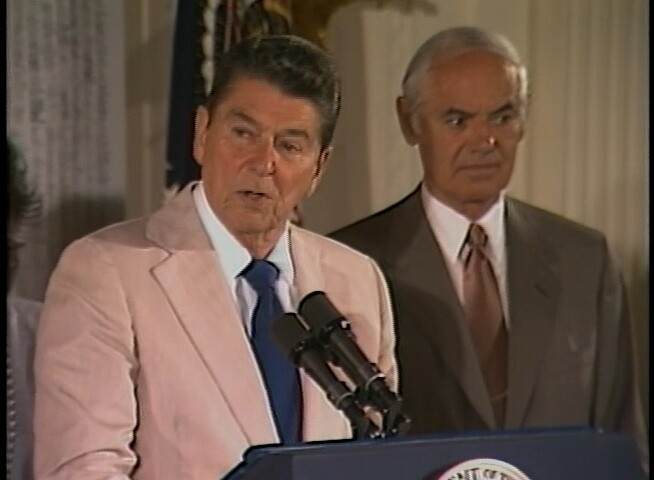
At the White House ceremony opening NCMEC on June 13, 1984, President Reagan referred to "the estimated 1.8 million children missing from their homes each year." Child Find was circulating 1.5 million, and the Missing Children's Help Center used 2 million. Estimates for stranger abductions ran from 4,000 to 50,000 a year, and 50,000 is the one that stuck to television, fundraising letters, and carton coverage.
The inflation was definitional. Advocates used an elastic definition of missing that folded runaways and custody cases into one enormous number, then illustrated it with stranger abduction horror stories, and the public concluded the 1.5 million were all Adam Walshes. In August 1985, while dairies were still printing, the Times traced that figure to a 1983 federal study that extrapolated police data from Louisville and Jefferson County, Kentucky, across the country, then multiplied again for unreported cases. The Denver Post had published its own dismantling that May, by Diana Griego and Louis Kilzer, and won the 1986 Pulitzer Gold Medal for Public Service for work that "helped mitigate national fears stirred by exaggerated statistics."
Real measurement arrived only because the 1984 statute that built the federal missing-children apparatus also ordered somebody to count. That mandate produced NISMART, whose first report measured 1988 and appeared in 1990, after the national campaign had largely faded. It found 354,100 family abductions under its broad definition, 450,700 runaways, and 200 to 300 stereotypical kidnappings, the category everyone pictured when they read the word abduction. The second study, measuring 1999, put stereotypical kidnappings at 115, and a later count found 105 in 2011. The campaign-era claim of 50,000 was off by more than two orders of magnitude.
Who ended up on the cartons followed the same distortion. The faces that became national symbols were overwhelmingly young white children from the Midwest and Northeast, while the at least 28 Black children and young adults murdered in Atlanta between 1979 and 1981 got nothing comparable.
What Photography Built to Replace It
The campaign was designed to expire, which almost no modern retelling includes. In that October 1986 Times piece, Howell at NCMEC and Gaylord Walker at the safety council both said the wind-down had been expected from the start, with Howell noting the effect would fade as people got used to the pictures. The side panel was also advertising inventory, and in February 1985 the president of Johanna Farms said that if nobody was found within a year, the company would probably drop the program. Dairies swapped photographs for safety tips through 1987, and the national program faded across the late 1980s. It did not stop cleanly. By NCMEC's own account the campaign was "gone almost entirely" by 1996, and a few individual companies were still printing children on cartons into the late 1990s. AMBER Alert did not end it either. Amber Hagerman was abducted in 1996, by which point the national campaign had been over for years and only stragglers were left.
One widely repeated cause deserves a warning label. Nearly every account says Dr. Benjamin Spock condemned the cartons for frightening children at the breakfast table. That claim traces to one uncited sentence in an Associated Press retrospective from April 20, 2012, and to a Slate piece three days later whose links on the pediatricians' names point to their Wikipedia biographies. Complaints about scaring children are real and were reported at the time. A verified Spock quote is not.
What replaced the carton was better printing and better targeting. ADVO's "Have You Seen Me?" card first mailed on May 25, 1985, National Missing Children's Day, carrying 8-year-old Cherrie Ann Mahan of Pennsylvania, who has never been found. Offset printed, geographically targeted, and eventually full color, it outlived the cartons by decades.
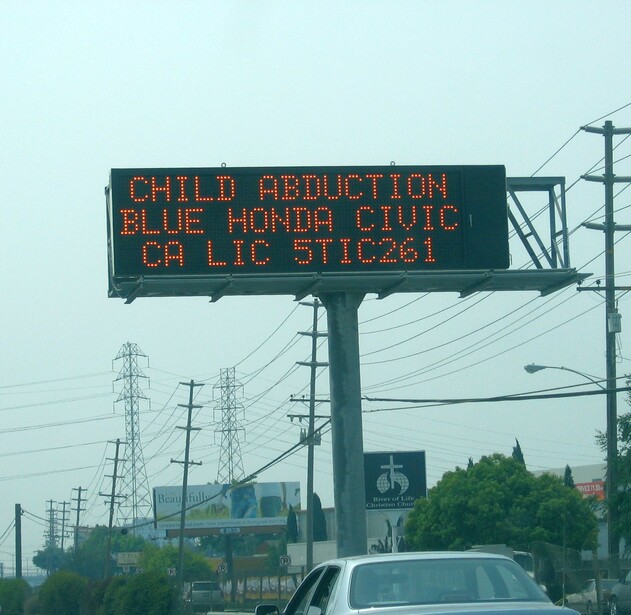
AMBER Alert inverted the economics, replacing a fixed image printed months in advance with descriptive text pushed out in minutes. Amber Hagerman was 9 when she was taken from a parking lot in Arlington, Texas, on January 13, 1996, and found dead four days later; her killer has never been identified. Diana Simone of Fort Worth wrote to a Dallas-Fort Worth radio station that month proposing a broadcast alert modeled on weather warnings, asking only that it carry Amber's name. More than 25 area stations launched the plan in October 1996, and the first activation came on July 5, 1997. National coverage came slowly: four states had statewide plans at the end of 2001, the PROTECT Act built the national network on April 30, 2003, and Hawaii became the fiftieth state in February 2005. The channel decided what could travel. Television and cable carried the child's face from the beginning, running a crawl with a picture of the child alongside the description of the abductor and the vehicle. The highway sign and, later, the phone in your pocket could not. The first wireless emergency AMBER Alert went out on December 18, 2012, sixteen years after Amber Hagerman was killed, and it was text only.
The other response was to rebuild the photograph itself. In 1985, medical illustrator Scott Barrows and his colleague Lewis Sadler developed a method they called projected aging, working from a 45-page manual charting average growth rates across 60 facial features, drawn from surgical, dental, and anthropological data. Barrows spent 8 to 20 hours per drawing and told the Christian Science Monitor in 1988 that soft tissue in the nose and lips was the hardest to predict. NCMEC began distributing age-progressed images widely in 1989 and now composites a child's photograph against pictures of parents and siblings in Photoshop, about eight hours per image.
The research on whether it works is not kind. Five peer-reviewed studies published between 2012 and 2020 tested the technique, and the ones that measured recognition against the outdated photographs it was meant to improve on found no advantage. One found that progressions can hurt by widening the pool of plausible matches. A 2017 study had eight artists age the same eight faces and found they agreed most when hair, ears, and face outline were concealed, exactly the features that dominate a small printed portrait. A 2020 study found that progressions built with parental reference photographs, the core of NCMEC's method, scored worse over long ranges than those built without, and its authors wrote that age progressions gave no benefit over outdated photographs. What the technique reliably delivers is a fresh image, and a fresh news cycle, for a cold case.
The field's showcase case shows what it takes. Aric Austin was taken by his non-custodial father on December 20, 1981, at about six weeks old, in Vancouver, Washington, and aging an infant photograph is the hardest version of the job. In 2003, Special Agent Colleen Maher, working a student loan fraud case, found irregularities in a birth certificate, cross-checked dates of birth, heights, and weights against NCMEC's database, and matched a driver's license photograph to Austin's age-progressed image. He was recovered that November, just before his 22nd birthday. No stranger glanced at the picture and remembered a face. An investigator ran the numbers first, then checked the photograph against a document. That is not the only way it has ever worked. NCMEC documents recoveries that turned on exactly the recognition the research doubts: a customer in an auto parts store saw Joseph Carson's age progression on a television monitor and recognized both the boy and the man who had taken him, the two of them standing in the store at that moment, and Daniel Markus came home after his progression aired on television. What the Austin case shows is the version that does not ask a stranger's memory to hold for twenty years, which is the version the studies suggest you should plan around.
Lead image: a quart gable-top paper milk carton photographed in 1994, its side panel given over to an advertisement, the same panel the missing-children portraits occupied a decade earlier. Photo by Renee Comet for the National Cancer Institute, public domain. Source.





.jpg)


Join the Fstoppers community for free
-
Post comments and join in the discussions
-
Browse the site ad-free
-
Share your work and get featured in the community
-
Compete in the photo contests for fun and prizes
No comments yet