
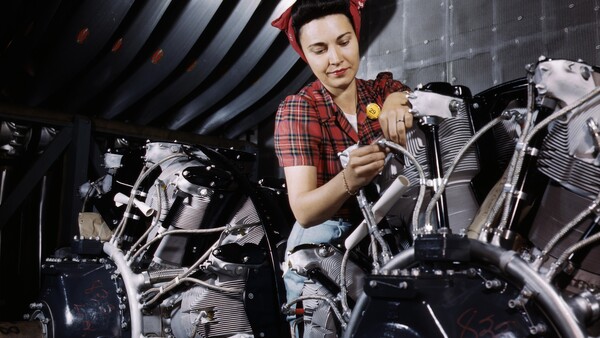
In March 1942, the Acme photo agency sent a photographer to Naval Air Station Alameda for a story about what women should and should not wear around machinery. On March 24, he made a frame of a 20-year-old machine shop worker bent over a lathe, her hair tied back in a polka-dot bandanna. Somebody then typed a caption with her name in it, glued the slip to the back of the print, and shipped it out to newspapers.
The Caption Was a Physical Object
A wire-service print was a piece of hardware. Acme Newspictures, which operated from 1923 to 1952 under the Scripps-Howard-owned Newspaper Enterprise Association before United Press absorbed it, shipped glossy prints to subscribing papers with the identifying information pasted onto the verso: a typed caption slip, an agency credit stamp, and usually a received-date stamp added by whichever picture desk handled it. Everything a photograph cannot say about itself lived on the back of the paper.
The slip on the Alameda frame gave the date, March 24, 1942, gave the place, and gave the name. The line that James J. Kimble eventually read on a surviving copy runs, "Pretty Naomi Parker looks like she might catch her nose in the turret lathe she is operating." It is a wire caption in the full 1942 register, condescending and specific in the same breath, and the specific half is what mattered seventy years later. Some later accounts identify the machine as a horizontal shaper rather than a turret lathe, which would make the slip authoritative about the woman and loose about the tool.
The photographer shot a series at Alameda that March, and the set included Parker's younger sister Ada alongside a coworker, Frances Johnson, posed to show what did and did not count as acceptable factory clothing. That frame quoted Lieutenant Commander R.R. Darron of the station to the effect that glamor and safety do not mix. Each frame went out with its own slip, and at least one of the others leaned on a joke about overtime pay rather than on the machine. Those slips were the only place either sister's name existed in connection with the pictures. Nothing in the emulsion said Parker, and nothing on the front of the print said Alameda.
That arrangement worked beautifully for exactly one physical object. The caption was bound to the print, not to the picture, and a picture is what everyone downstream received.
How the Name Came Off the Photograph
The Alameda images ran in papers and magazines through the spring and summer of 1942, including in The Pittsburgh Press on July 5. Each of those reproductions was a halftone of the front of the print. The back did not come along. A caption survived a reprint only if an editor bothered to retype it, and editors frequently did not bother, or trimmed it, or replaced it with something generic about women in war work.
By the time the lathe photograph resurfaced in Modern Maturity in 1984, it was a picture of an unnamed young woman at a machine. Geraldine Hoff Doyle saw it and recognized herself, and her belief was reasonable on its face. She had graduated from high school in Ann Arbor, Michigan, in 1942 and taken a job as a metal presser at the American Broach and Machine Company, and she looked a great deal like the woman in the frame. She quit that job after about two weeks, because she played cello and did not want to lose a hand to a press.
Ten years later, Smithsonian magazine put J. Howard Miller's "We Can Do It!" poster on its March 1994 cover. Doyle saw the yellow background and the bandanna and concluded that the photograph she believed was of her had been the source for the painting. She never tried to make money from the claim. She did not need to. Michigan institutions honored her, reporters repeated the story, and when she died in December 2010, the national obituaries described her as the inspiration behind the poster.
Six Years of Walking Backward
Kimble, then an associate professor of communication at Seton Hall University, read those obituaries and wanted to know what any of them were actually resting on. He told Smithsonian magazine that his question was how we really know it was Geraldine, and, if it was not, who it was. The answer took six years.
His 2016 paper in Rhetoric and Public Affairs carries a title that names the problem: Rosie's Secret Identity, or, How to Debunk a Woozle by Walking Backward through the Forest of Visual Rhetoric. A woozle, borrowed from Winnie-the-Pooh, is what you get when you track your own footprints in a circle. A claim gets published, a second writer cites the first, a third cites the second, and the accumulated citations start functioning as evidence for a thing nobody ever verified. Walking backward means following each citation to its predecessor until you reach the bottom, and the bottom of this one was a woman in Michigan looking at an uncaptioned reprint and saying, that is me.
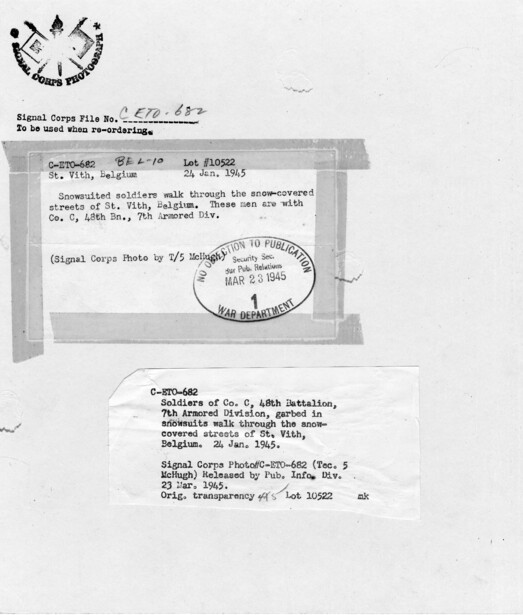
So Kimble went hunting for a copy of the photograph that still had its back. He worked through books, magazines, and the internet looking for a captioned version, and eventually bought a print from a vintage photo dealer with the slip intact. The name on it was Naomi Parker. The date on it was March 24, 1942, three months before Doyle graduated from high school in Michigan, and before she had worked a day in a factory.
Assuming Parker was long dead, Kimble asked a genealogical society to trace her descendants. The society wrote back that it could not continue, because it does not research living people, and it had every reason to believe she was one. In February 2015, he interviewed Naomi Parker Fraley, 93, and her sister Ada, 91, at the home they shared in Cottonwood, California. Fraley had kept her own clipping of the photograph for seven decades.
She had also already tried. In 2011, the sisters attended a reunion of women war workers at Rosie the Riveter/World War II Home Front National Historical Park in Richmond, California, and found the wire photo on display with Doyle's name beneath it. Fraley wrote to the Park Service. Nothing changed. She was holding a captioned clipping and could not outweigh thirty years of accumulated citations, because everyone else's copy of the picture said something different, and there were vastly more of those.
After Kimble published, the Omaha World-Herald asked Fraley in 2016 how it felt to be known publicly as Rosie the Riveter. "Victory!" she cried. "Victory! Victory!" Kimble has framed the stakes in terms of what the mistake took from her rather than what the correction gave her. For years, a photograph of her circulated with another woman's name attached, and she had no mechanism to get her own name back onto it.
The Correction Inside the Correction
The version that has replaced the Doyle story says that Naomi Parker Fraley was the model for "We Can Do It!" That goes further than the evidence does, and Kimble has been consistent about saying so. He described the connection to Smithsonian as circumstantial, noting that the two women look alike, that the polka-dot bandanna is there, that the timing works, and that the photo ran in Miller's home city seven months before the poster went up. His summary of it was, "It's a good guess."
Miller left no record of what he worked from. Charles A. Ruch, a Westinghouse historian who knew him, said Miller preferred live models to photographs. No document ties the Alameda frame to the drawing board, and unless one turns up, none is likely to.
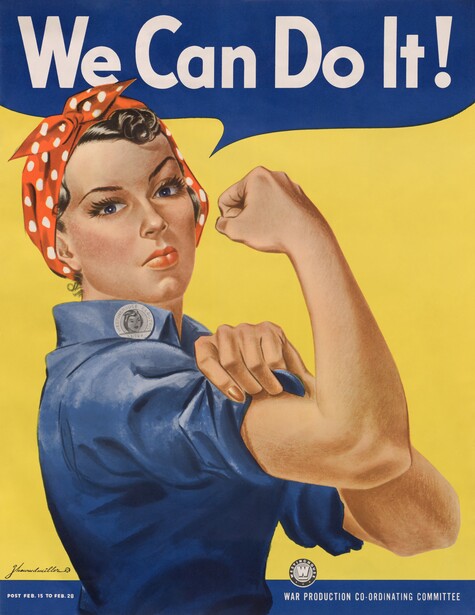
The poster itself is misremembered in nearly every direction. Kimble and Lester C. Olson established in 2006 that it was not a government recruiting poster and had nothing to do with the Ad Council. Miller made a series of images for the Westinghouse War Production Co-Ordinating Committee, and this one hung for roughly two weeks in February 1943 in plants where a mostly female workforce pressed Micarta helmet liners, some 13 million of them across the war. The "we" was Westinghouse employees, addressed by their management, and the message was closer to keep production up than to join us. It is also not Rosie the Riveter, who belongs to a 1942 song and to Norman Rockwell's Saturday Evening Post cover of May 29, 1943. The poster then disappeared for about four decades and came back in the 1980s as something else entirely.
Two separate claims are tangled together here. Who is in the 1942 photograph is settled, and the answer is Naomi Parker. Whether that photograph has anything to do with the poster is unresolved, and the woman who spent thirty years being congratulated for it was not the one in the photograph at all.
Your Caption Slip Is an IPTC Field Now
The pasted slip has a direct descendant. IPTC fields, written into the file itself and editable in any serious cataloging tool, carry creator, credit line, copyright notice, description, and location. EXIF carries what the camera knew: capture time, body, lens, exposure, and sometimes coordinates. Fill those in properly, and your photograph travels with its own caption slip, permanently attached, no glue involved.
A caption does more than assign credit. The Alameda slip carried a date, a place, and a name, and those three items are what turned a picture of an anonymous woman at a machine into a document capable of settling an argument seventy-four years later. Strip them, and you have an image rather than a record, and an image with no record attached belongs to whoever tells the most convincing story about it. In 1984, entirely without malice, that turned out to be a cellist from Michigan.
Except that it does not travel. IPTC has been testing this for years, and its round of social platform tests across fifteen major sites found that only Behance both preserved and displayed the rights information in uploaded files. Facebook, Twitter, and Instagram stripped nearly everything. Much of the loss was incidental rather than malicious, a byproduct of resizing: the platform generates a new derivative at a new dimension, and the new file simply does not inherit the fields. Those results date from the middle of the last decade and behavior varies by platform, by feature, and by whether a viewer saves or downloads, but nothing since has reversed the direction. A screenshot, meanwhile, carries none of the original's fields at all.
Content Credentials, the C2PA provenance standard, is an attempt to solve this with cryptographic signatures rather than good manners, and Meta announced in February 2024 that it would use the IPTC Digital Source Type property to flag AI-generated images on its platforms. Both approaches are still fighting the same physics that beat the Acme caption. Provenance survives a crop or a re-encode when the software handling the file is built to carry it forward, and C2PA also allows manifests to live outside the file. The current specification goes further than that. It defines a durable content credential as one carrying a soft binding, a perceptual fingerprint or an invisible watermark computed from the picture itself, so that a manifest stripped out of a file can still be matched back to it from a provenance store elsewhere. The recovery does not depend on the file keeping anything, which is the clever part. It depends on somebody having built the matching into the path the picture travels, which is the same dependency that beat the Acme caption. Run the image through software that carries none of it and the embedded assertion is gone; whether the name can be put back afterward is a question about infrastructure rather than about the file.
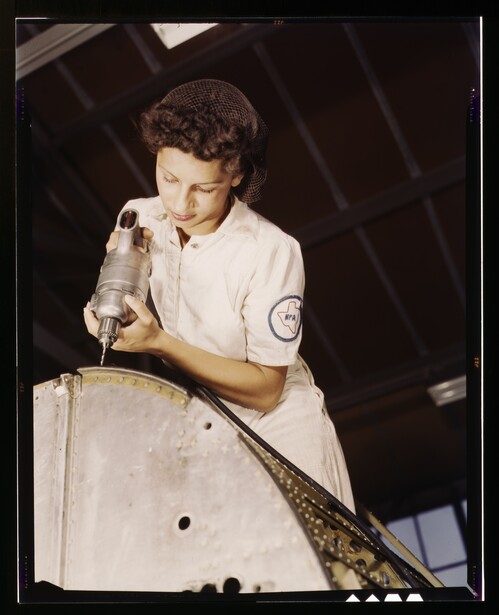
Which is the practical lesson from a woman who spent seven decades holding a clipping nobody would accept. Keep the original file, the one with the fields still in it, and assume that a copy sent out through a platform may come back stripped and assignable to anyone. Fraley's own evidence was never enough. What finally settled it was a print that some dealer had left alone, with a yellowed slip of paper still glued to the back.
Lead image by Alfred T. Palmer, Office of War Information, public domain (US government work). Source.



_(15729291533).jpg)

Join the Fstoppers community for free
-
Post comments and join in the discussions
-
Browse the site ad-free
-
Share your work and get featured in the community
-
Compete in the photo contests for fun and prizes
1 Comment
Great article, It brings back fond memories of my mother who worked on aircraft a the Curtiss Wright
plant in Columbus, Ohio. I have her socket set that she used, which I still use today.
David Dennis