
There is a particular kind of psychological illness that affects photographers after enough years behind a camera.
At first, you are happy simply because you captured something.
A face. A gesture. A decent exposure. A dog crossing the street with good timing.
You feel alive. Photography feels infinite.
Then one day your brain quietly mutates into a small authoritarian regime.
Now you zoom to 200%.
You inspect eyelashes like a forensic investigator.
You reject photographs because the focus landed on the wrong knuckle.
Welcome to adulthood.
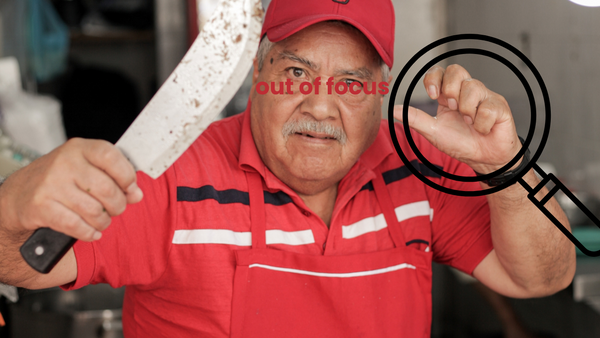
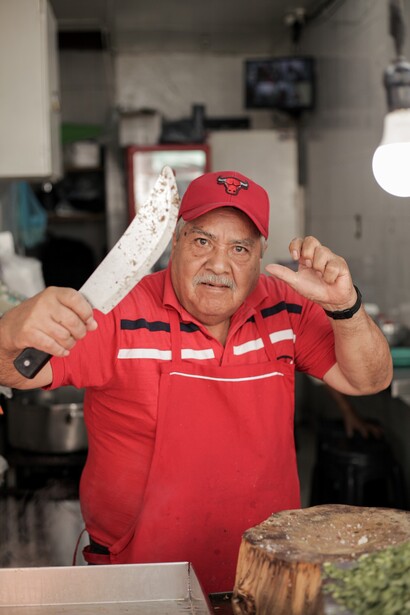
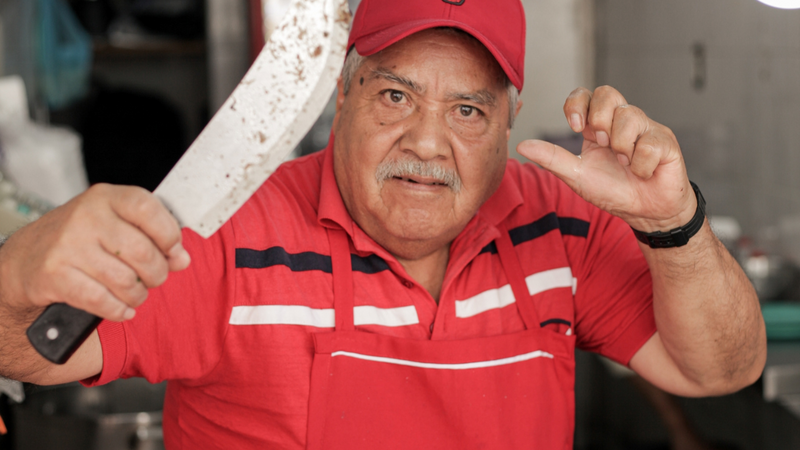
A few days ago I made a photograph in Mexico that I genuinely liked. A butcher looking directly at me, knife in hand, red tones everywhere, expression full of life. The kind of frame that immediately feels cinematic when it appears on the back screen.
For about twelve seconds, I thought:
"This one works."
Then I zoomed in.
Fatal mistake.
The focus had landed on the wrong hand.
Not disastrously wrong. The image still breathes. The energy is still there. In fact, many photographers would publish it without hesitation. Some viewers would probably even call it "raw" or "visceral."
Meanwhile, I stared at it like a disappointed football coach reviewing VAR footage.
Because photographers are strange creatures. We spend years trying to become free, instinctive, emotional, alive in the moment… only to later destroy ourselves over three centimeters of missed focus.
And the worst part?
I understand perfectly well that this obsession can become ridiculous.
One of my heroes is Nan Goldin. Her photographs often feel fragile, immediate, imperfect in the most human sense possible. They survive because of emotional truth, not optical perfection. And yes, a lot of them are out of focus, with the wrong focus spot.
And yet there I was, rejecting a photograph because my autofocus decided the wrong plane was more important than the face.
Technically speaking, this is also where the choice of aperture becomes part of the story.
At f/4, the image would probably have survived. There would have been enough depth of field to keep both gesture and expression inside a usable sharp zone. At f/2.8, on the other hand, everything becomes a gamble. And sometimes the gamble simply fails.
That is the part nobody likes to admit. Not because f/2.8 is "bad," but because it demands absolute precision in a world that rarely gives you perfect alignment.
But photography is full of contradictions like this.
We romanticize imperfection until it appears in our own files.
Then suddenly we become executioners.
The truth is that focus only matters where focus actually matters. Not every image needs surgical precision. Not every photograph lives or dies by technical purity. Sometimes atmosphere is enough. Sometimes emotion carries the frame beyond its flaws.
But sometimes you know, deep down, that the photograph missed the exact thing you wanted it to become.
And that feeling is difficult to negotiate with.
People often assume experienced photographers become more confident over time. In reality, many of us become harsher editors. Not because we hate photography more, but because we understand more clearly the distance between a good frame and a lasting one.
That distance is often microscopic.
I still feel like a beginner almost every time I photograph. I still miss frames. I still hesitate. I still review images wondering whether I truly saw what I thought I saw. Some days I feel less like a professional photographer and more like a man endlessly arguing with autofocus systems and his own expectations.
Maybe that feeling never disappears.
Maybe it shouldn't.
Because the moment you stop being severe with your own work, you also risk stopping your evolution. The danger is not imperfection. The danger is becoming satisfied too early.
So no, I probably will not publish that photograph, but I am doing it here, because here I feel free to share the bad moments in my photography journey too. Because I am not here to say, "Look at me, I am the best photographer out there."
I am a photographer and a writer who always argues for the great power of imperfection, and yet I can't recognize this photograph as something to show as a good photograph.
This is me. But this can also be you.
I think that in a world where everyone is going to show only the best things, we need to save ourselves with the normality of making errors.

Join the Fstoppers community for free
-
Post comments and join in the discussions
-
Browse the site ad-free
-
Share your work and get featured in the community
-
Compete in the photo contests for fun and prizes
5 Comments
I am a hobbyist photographer, on just about every event photo shoot I miss focus on people moving around. I've come to the conclusion I don't have to toss all those misses out when the moment being captured shows meaningful emotion or significant moment at the event. It can be a compromise, but with current post processing tools you can improve the result. For instance, I will usually stamp a layer in PS, try Topaz Photo AI plugin in PS using their Focus models, dial down the strength in the plugin, and put a black layer mask on and reveal only the small portions on the photo I want more focus, i.e., eye brows, eyes, mouth, teeth, and facial lines, then further reduce opacity of the layer to achieve a more natural look. I usually don't AI focus the skin on the face. I usually only add a little extra re-focusing this way. The photo often still does not look perfectly in focus but it improves the overall look and appears reasonably natural. the plugin also has a Face Recovery set of models that I sometimes use. I find most non-photographers are not bothered by slightly out-of-focus pictures since so many of the camera-phone pics they are taking have focus, white balance, and lens distortion issues. Also, for older people (like me) who have grown-up with 35mm Film photos, focus or sharpness problems were issues with cheaper cameras and lenses and shooting technique.
I think that's a perfectly valid approach, especially when the photograph has personal, documentary, or client value. We all make compromises depending on the purpose of the image.
My article was coming from a different perspective. I wasn't discussing whether an out-of-focus image can be improved, rescued, or appreciated by viewers. I was discussing my own editing standards when selecting photographs for my portfolio or long-term body of work.
For me, technical perfection is not the goal, but focus is part of the visual language of a photograph. If the image is intentionally soft, that's one thing. If it is unintentionally out of focus, then I have to decide whether the moment is strong enough to overcome that limitation. Sometimes it is. In the case I wrote about, it wasn't.
I also agree that many viewers are far less concerned with sharpness than photographers tend to be. Some of the most memorable photographs ever made would probably fail today's pixel-level scrutiny. But when I'm editing my own work, I try to judge the photograph against the standards I want to maintain, not against what software can recover afterward.
That's not a universal rule. It's simply where I draw the line for my own photography.
Why would a street photographer shoot at F/2.8? Seems to me that's an appropriate aperture for portraits where backgrounds sometimes are best blurred as much as possible. But I would think street photos need at least some background context to assist telling the story, so that F/5.8 to F/8 would be your priority, which also eliminates the slight depth of field problems that happened here.
That's a fair observation. Looking back at the image, as I said in the article I think f/4 would probably have been a better choice. The decision was made very quickly because what immediately caught my attention was the challenging backlight behind the subject, and in the moment I opted for f/2.8 to give myself a little more flexibility.
That said, I tend not to think in terms of being a "street photographer" and therefore using settings that are supposedly appropriate for street photography. I simply make photographs, and each situation asks for its own solution. Sometimes that means working at f/8, sometimes at f/2.8, and sometimes somewhere in between.
In this particular case, I agree that a little more depth of field would have helped. The image wasn't unsuccessful because f/2.8 is inherently wrong for this kind of photograph, but because my quick assessment of the scene led me to a choice that, in hindsight, could have been improved. That's precisely why I thought it was worth sharing the image and discussing it openly.
Photographers make errors. I do errors. That is the main topic here, and to reply also to someone: no, I don't feel myself special because I reject this photo. It is quite the opposite what I would share here: the idea that by being a professional photographer doesn't save me exactly as everyone. And this despite I am used to work often in a condition of under pressure and obtaining in few minutes the required work. This time I was surprised by the man asking me for a photograph: I repeat, my error. Also because as a portrait photographer, usually I don't go so wide with my lenses, not even when is a portrait shoot.