
Most likely, this won't matter to many people, but I'm writing it and proposing it anyway, also because I'm convinced that there's only one person who will be interested in this piece about an antiquated setup that, in my opinion, still works great today. At least it works for me.
So I finally bought a lens that I really wanted: the Canon EF 40mm f/2.8 STM.
Yes, this pancake, the one everybody on forums calls a "perfect walkaround for your mirrorless kit." I don't have a mirrorless kit (I have one, but it is the Canon M dead system), and I don't need an adapter to mount it on my camera, because I mounted it on my Canon 5D Mark II, a camera that is, by any modern definition, a fossil. Big mirror box, loud shutter, no flip screen, no silent mode, nothing quiet or discreet about it at all. I put a lens designed for people who want to disappear on a body that makes disappearing impossible.
I did it on purpose, and a few weeks in, I think I need to talk about it.
First of all, I consider myself a pancake lens photographer. I love them. I love the pancake lens. I became a professional photographer with the 17mm pancake lens on the first Olympus Pen. I loved seeing a Bessa R in Los Angeles with a tiny lens mounted on it. That is my way. As a photographer, I don't like proboscises coming out from a camera.
Here's the thing about 40mm that took me way too long to admit: it's the focal length I actually see in. Not 35, which I shot for years and always felt like I was dragging one extra motorcycle or one extra market stall into the frame that didn't need to be there. Not 50, which flattens the street into a series of isolated portraits when what I want is the whole mess of it, held together. 40 sits right in the middle and just... works for my kind of vision, in a way that's hard to explain. It's close to how a human actually scans a scene. Wide enough to hold context, tight enough that you have to commit to a subject instead of hiding behind everything around it. Respectful of people, who even at close range appear beautiful!
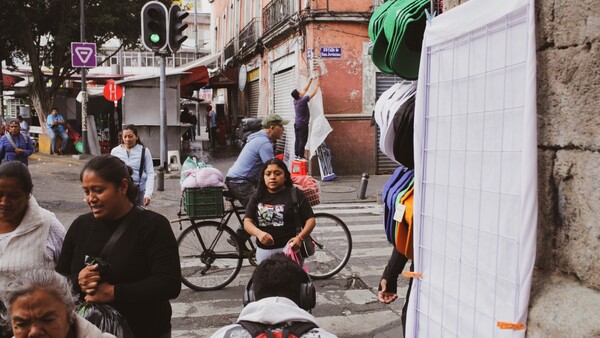
Everyone in street photography right now is chasing invisibility. Small mirrorless bodies, electronic shutters, the whole "nobody even knew I was there" school of thought, and look, I get it, I've been tempted by it plenty of times myself. But a 5D Mark II will never let you disappear. This camera requires a photographer to accept that presence is part of the game. It's a black, heavy brick with a grip and a prism hump and a shutter that sounds like a door slamming three feet from someone's face. In Centro, in Mexico City, on a corner like 5ª Calle de San Jerónimo where I made the photo I want to talk about, that sound carries down the block. People clock you. Vendors look up before you've even brought the camera to your eye. And yet... I was able to make this photograph:
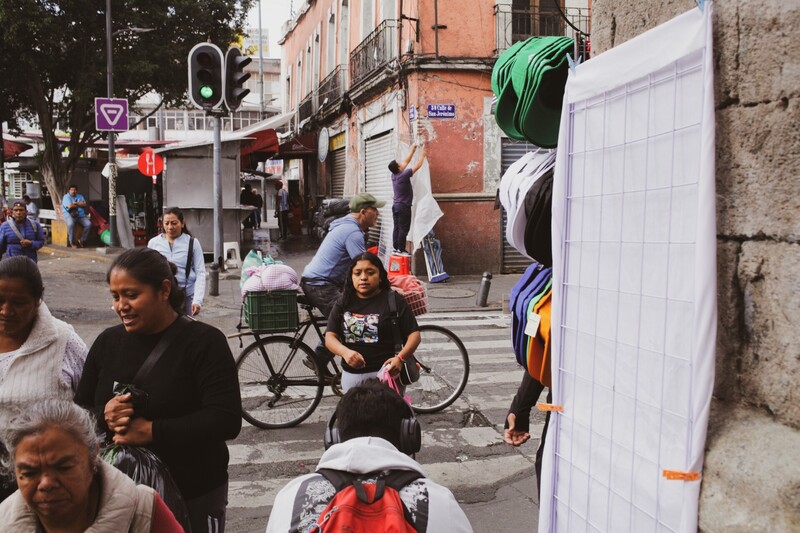
OK, now you see the photograph, and I could stop writing here, because this is exactly what street photography is. It is a keeper. It is a photograph I can show to explain what street photography is. Foreground, middle ground, background. In some way, everything is connected.
Back to the 5D issue... instead of fighting that bulky camera, I've started leaning into it. Guys, you can't steal a moment with a camera like this, not really, so you stop trying. You start negotiating instead: a look, a half-beat of eye contact, the simple confidence of not flinching when somebody stares straight down your lens. It's slower. It's more exposed. It also feels, gloriously, honest. I'm not pretending to be invisible in someone's neighborhood. I'm a guy with an obvious camera, and the street knows it, and somehow that's fine.
The photo that made me want to write this piece is here for all of you. Four, maybe five depths of information in one 40mm frame, and none of it turns into mush, because the lens doesn't compress or distort any of it into two flat planes the way a longer lens would. Foreground stall, midground crossing, background facade. My idea of the 40mm focal length is that I wanted a lens that could hold all of it without flattening it, and this magical pancake does it.
So how is the Canon EF 40mm f/2.8 STM doing on the 5D? It's not making me faster. Quite the opposite, indeed.
What it's actually doing is giving me a frame that matches how close I want to stand to people, mounted on a body that won't let me pretend I'm not standing there. That combination shouldn't work, according to the tutorials, manuals, and workshops out there, but here I am with a photo I am proud of. On the street, it looks like it is working better than almost anything else I've shot with in years.
So, how is this Canon EF 40mm f/2.8 STM doing on my Canon 5D? Ask me again in three months. I might feel completely different and maybe embrace, like almost all street photographers, the 28mm glory. But right now, I'm not going back. If you want to try the setup yourself, the Canon EF 40mm f/2.8 STM pairs beautifully with the Canon 5D Mark II.


Join the Fstoppers community for free
-
Post comments and join in the discussions
-
Browse the site ad-free
-
Share your work and get featured in the community
-
Compete in the photo contests for fun and prizes
31 Comments
I don't know how to get this email directly to the people who control this website so I hope you would pass this on to them. The advertisement that keeps shooting out from the right hand side of the website is so annoying that I will not visit this website for a month. At my next visit, if the same advertisement is still in place, I will delete your URL from my list. Enough is enough.
It's probably something with whatever browser you're using. On Chrome oriented Brave, I get nothing. On Microsoft Edge, I get a 10cm square of a photography oriented store. Nothing "shooting out."
I'm on Firefox and get nothing.
You wrote:
"[T]his is exactly what street photography is. It is a keeper. It is a photograph I can show to explain what street photography is. Foreground, middle ground, background. In some way, everything is connected."
I notice what you said about the photo:
- It has a foreground, midground, and background (a mundane quality shared with trillions of other photographs)
- "everything is connected" (which is meaningless)
I also notice what you did NOT say about the photo:
- It is beautiful
- It shows an interesting perspective
- It shows an interesting location
- It has a definite composition
- It is not cluttered
- There is not some ugly white piece of garbage dominating the foreground
- The people who were photographed gave their express consent to you photographing their faces and posting them on this website
Thanks for showing me EXACTLY what street trash snapshots ("street photography") is, and what it isn't!
Nice lens, by the way.
Thank you. Your comment actually illustrates my point better than you intended: we aren't looking at the same photograph. PLEASE NOTE: I'll also take this opportunity to say that this will be my last reply to anonymous accounts with no real identity and no portfolio to show. I'm always happy to discuss photography, but I prefer doing so with people willing to stand behind their work.
In the U.S., at least, the First Amendment protects our freedom to photograph anything that’s visible to the naked eye in public and publish those images. No consent required. There are some limitations, which include that one cannot thwart people’s efforts to maintain privacy or hold people up for public ridicule.
Also, who says street photos have to be “beautiful”, and what’s up with the snotty attitude?
Thank, Jacques. Mexico is pretty similar with the laws protecting the right to photograph in public places.
Are you sure. This site says something else:
https://commons.wikimedia.org/wiki/Commons:Country_specific_consent_req…
I don't know what you're inferring with this comment:
"The people who were photographed gave their express consent to you photographing their faces and posting them on this website."
In the USA you do not need any consent whatsoever; I would think the same for Mexico and most other countries. The logic is simple: an individual who is plainly visible from a lawful public vantage point generally possesses no reasonable expectation of privacy as to matters openly observable, including their capture by photography.
It seems to be different in Mexico and in most other countries:
https://commons.wikimedia.org/wiki/Commons:Country_specific_consent_req…
If you like that combo, you really ought to try a Panasonic GX7, GX8 or GX9 with Panasonic’s 20mm f1.7. I really wish I’d hung onto this lens and one of my GX7s when I migrated to Sony FE six years ago.
Yes, that can be a set-up i can consider in future for sure. I owned in the past some Olympus micro 4/3 cameras.
There's plenty of depth and context in your photo. But why did you take the picture? What's the subject? Where is my eye supposed to land as a destination within the frame, or does that matter?
That's a fair question, because not every photograph asks the viewer to arrive at a single destination. As a street photographer I am very sensitive to the energy on the streets. And I eneter in a flow that helps me to capture a certain energy. In this sense we need to consider the layering. I took it because I saw a temporary choreography unfolding in front of me: the man reaching up to hang the sheet, the cyclist crossing behind him, the young girl walking toward me, the street vendor's display on the right, and the flow of pedestrians all sharing the same space for a fraction of a second. For me, the subject isn't one person, it's the relationship between all those elements. If your eye keeps moving through the frame instead of settling on one focal point, that's intentional. Not every street photograph is built around a single protagonist. Some are about how life briefly organizes itself before dissolving again. Inside this frame in particular there is a connection between the foreground and the background represented by the white sheet (in the background it is the man to hang it) and when i photograph layering I tend to see an element calling my attention and depending on that I let the flow making the rest. It is getting into the rhythm. Sometimes is not sufficient to shoot just one time. I wait. I shoot. Another time. again. Street & Repeat formula.
From the viewers perspective, a busy photo without a clearly defined subject and story risks being forgettable rather than memorable. Interesting for maybe a quick moment, at best, but nothing to hold on to. It's like being exposed to too much information at once ensures we'll remember none of it. If you don't care about the audience, that's fine. You certainly don't need to take pictures to please me. I'm just saying the photographer and viewer often see things differently in terms of emotional response, much of which you have no control, some of which you can. Mood and energy are difficult things to communicate in a photograph.
Alternately, a simple photo with a clearly defined subject and story risks being trite, simplistic, or just uninteresting, holding attention only briefly.
Personally, I found the example image interesting enough that my gaze wandered all around the frame. I stopped, though, when I reached the large white rectangle on the right side.
I would guess that you find this photo interesting because it presents the same type of challenges you have in your event photography.... carving a compelling picture out of a chaotic environment. Looking for some sort of connection between people that puts them in the same frame. The degree to which we find an image to be interesting probably depends a lot on the subject.
You make valid points about risking a boring picture from simplistic composition. However, the collection of people in this photo doesn't particularly interest me. I'm not sure why it should. There's nothing unusual, and virtually no interaction among the people. It's simply a busy street scene. It doesn't raise any questions in my mind, but isn't that a main objective of street photography?
I agree with you Ed. It's just a hodge podge of ordinary people doing ordinary things. If he would have concentrated on the dude hanging up the sheet (?) at least there'd the tension of 'will this guy fall over?'
I find the composition engaging on the level of shapes, colors, planes of focus, and movement. One of Cartier-Bresson’s most famous images is of an “ordinary person doing ordinary things” - a boy walking with a bottle in his hand.
Regarding Cartier-Bresson's photo, I would say it's an ordinary kid doing something out of the ordinary. A child carrying two large wine bottles? That doesn't happen every day... probably not even in Paris in 1954. Where is he headed and who are the children right behind him? Even the adult woman in the background appears to be engaged in the drama. Something is clearly happening here that connects each of the people in the photo. The composition gives you a main subject and supporting cast which simply asks (to your point), "What is going on here?" In my opinion, it's the simplicity that makes it work.
No intention to defend at all my photograph. I just read your comments. Again, as always, someone appreciates, someones doesn't. There are people photographing all the time...flowers...ordinary flowers...and putting the reason to photograph them on how much sharp is the photograph, so no pretending everyone gets street photography, especially those not into street photography.
You enjoy writing about philosophical subjects; other people are more interested in camera gear. Personally, I like talking about photos: why I like them, or what doesn't work for me, how I respond to them, composition, and yes, those awful technical details. I would love to see more of that here in Fstoppers. After all, this is a photography site, but we dance around talking about photos themselves like it's a disease. Anytime someone expresses a photo critique, the conversation either turns dead silent, or it deteriorates into insults. That's unfortunate.
It's not an issue of appreciating street photography. You might be assuming that since the viewer is not "into" street photography that their opinion is not credible. But I don't think I have to call myself a street photographer to comment on street photography. I'm a photographer and there are many things that those from all genres share in common. You mentioned foreground, middle ground and background... that's one concept landscape photographers understand perfectly well. As we do composition and how one element in a picture relates to another.
I think it's good to listen objectively to other people, not just those who are experts in our particular genre. It doesn't always feel very good, but we can learn new perspectives that might influence the way we shoot in the future. Last of all... defending one's position is the most natural thing in the world. It's what makes for a good discussion rather than just a lecture.
Hey, Ed, you know I actually agree with much of what you're saying. I'd also like to see more discussions centered on photographs themselves rather than endless gear debates. The irony is that when those conversations do happen, they often become requests for the photographer to justify every decision, as if an image were successful only if its author could explain it analytically. It happened when I said about the energy, that you said is complicated to define. But at the point everything can be not valid. I think photography, outr photography is fueled by emotion and the direct experience. And while I canm agree that we should be not attached to the emotion we felt in order to decide and making the editing of photos, yet I feel a room for that. I receive different reactions for this èphoto and my photos in general. That is perfectly fine. That depends also by the background of the person.
I don't think criticism should come only from people within the same genre. Good photography isn't divided by walls, and fresh perspectives can be valuable. My point was different. Every genre develops its own visual language, conventions, and intentions, so understanding those makes criticism more informed, not more exclusive. The difficult to photograph in a place like that: I didn't share that. It is not considered a safe place at all. And of course even worse if you go with a stranger face and with a bulky camera as I did. Many times we tend to consider only what is in the image but that is an error, because sometimes it is deeply connected with the culture of a place, something I tend to consider and respecting a lot, because I work a lot with the sense of the place.
As for defending one's position, absolutely. That's what makes discussion interesting. What I find less productive is when the conversation immediately shifts from what the photograph is doing to whether the photographer is competent enough to have made it. Those are two very different discussions, and unfortunately the second one is often the easier one to have online. With that said, maybe I am wrong, but I noticecd a change in your behaviour under my articles after you known we are paid to make articles. Apologizes in advance if this is just a bad impression I have.
Photos themselves and discussions about photos can be rooted in details or emotions. We can't always steer a discussion in a direction that we prefer. And there's certainly nothing wrong with taking a picture solely for the reason that it feels good. You're not being asked to analytically defend your photo. I am merely talking about the photo as I see and interpret it. You can respond or ignore however you like. Other readers can agree or disagree. I am definitely not accusing you of being incompetent.
The manner in which you are compensated for your articles makes no difference to me, and has not to the best of my conscious awareness, affected anything I've written. My thoughts on that issue were an observation, not a criticism.
Thanks for the clarification, Ed. I hope this can get us forward and we keep to discuss about photography because that is the important here.
“I would guess that you find this photo interesting because it presents the same type of challenges you have in your event photography.... carving a compelling picture out of a chaotic environment.”
That is an astute observation. Early in my career, I worked hard to simplify my images, but I found I was over-thinking and making trite or obvious images. I still naturally gravitate toward simplicity, but my best images include multiple elements that lead my eye around the frame. And, I love a busy image that makes me ask, “What is going on here?”
I have the Canon 24mm f/2.8, which on my 90D gives me a similar setup to what you've used here. I haven't used that lens much, but now I'm a little curious to give it more of a try in city/street situations.
That makes me happy. If I achieve to have photographers trying something because read on my articles, it is great. Yes, the 24mm on the APS-C crop factor of Canon corresponds to a 38.4mm focal lenght. It is the lens I use most of the time withmy Rebel T7. The lenght is important but most of all our position respect to the subject and when we decide to shoot.
I used the Canon EF 40mm f/2.8 STM on my 6D a lot - a lovely lens. Fast, good IQ and tiny. And like the writer - it's a really nice/usful focal length.
If there was an RF 40 pancake I would buy it tomorrow for my R6.
Yes, this comment shows the problem with Canon because they keep to discontinue lens mounts and proposing new systems.
You have been very patient and measured in responding to criticism of your photo. I consider myself a "street photographer", yet I rarely photograph people on the street. I photograph objects and architectural details that I encounter walking about. Most photographers would not call that street photography.
Back to gear! I like using my 45mm f2.8 P on Nikon Df. Not 40mm, but but I do like the perspective and simplicity of using this tiny lens. And I am definitely pro-Nikon for the reason you stated about Canon. My Df can use every lens Nikon ever made in F-mount. Except the 21mm f4 from the early 1960s, and the first 35mm PC-Nikkor.