
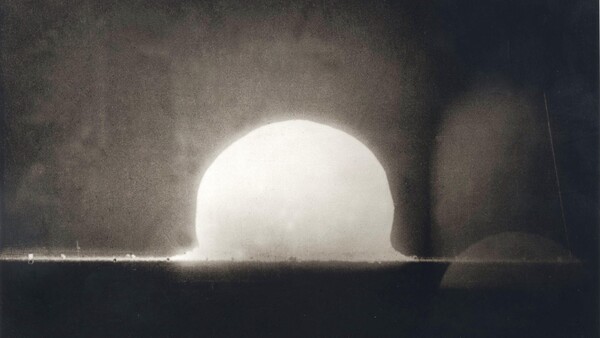
At 5:29:45 in the morning on July 16, 1945, in a stretch of New Mexico desert the Spanish called the Jornada del Muerto, the sky turned brighter than the noon sun. Aimed at that flash, tucked into steel-and-lead bunkers and buried instrument boxes ringing a 100-foot tower, sat roughly fifty cameras. Most of the cameras were unmanned and triggered automatically, although Brixner personally occupied a tracking-camera position at North 10,000. Every one had been focused, loaded, and left in the dark hours earlier, wired to fire on a countdown, because no human eye could be trusted to catch what was about to happen and no photographer could survive standing close enough to try. The world has entered the nuclear age.
Those cameras had a job no camera had ever been asked to do. They had to record an event that had never been photographed, that was calculated to outshine the sun many times over, and that would be finished, in its most important moments, in a few thousandths of a second. The team that built the rig had no exposure to copy, no reference frame to trust, and exactly one chance. What they captured became some of the most reproduced photographs of the twentieth century, and, in a twist almost no one expects, the raw material a British physicist would later use to reverse-engineer the bomb's secret yield from published pictures alone.
A Subject No One Had Ever Metered
Start with the problem that kept the photographers up at night. Nobody knew how bright the thing would be. The theorists at Los Alamos estimated the flash would reach something on the order of ten times the brightness of the sun, but that was a prediction, not a measurement, and the whole point of the test was that the physics had never been run at full scale. You cannot bracket around a number you are only guessing at, and there was no second take.
The reasoning the team fell back on was almost comically simple, which is what makes it brilliant. If the flash was going to be roughly ten suns, then point a camera as if you were photographing the sun, get a workable exposure for that, and then stop the lens down another ten times or so past it. Spread cameras across every plausible speed, aperture, distance, and angle, because if you blanket the possibilities widely enough, some fraction of them will land near correct even when you cannot say in advance which fraction. It was educated guessing at industrial scale, and the team accepted from the start that most of the frames would be ruined.
The scale of the light was not an abstraction. When it went off, the flash was seen more than 150 miles away, and reflected glow reached as far as Amarillo, Texas, roughly 280 miles distant, across a mountain range. A nuclear fireball, as the later reference literature would put it, appears to an observer fifty miles off as many times more brilliant than the noonday sun. This was the subject. The cameras were being asked to hold detail in it.
Julian Mack, Berlyn Brixner, and an Array of Fifty Cameras
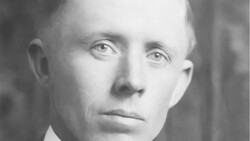
Two men ran the photography. Julian Ellis Mack, a physics professor from the University of Wisconsin, led the optics and photographic-measurements group. Mack was an instrument builder by temperament; he had invented a rotating-mirror streak camera, later called the Mack streak camera, capable of resolving events down to about a ten-millionth of a second, and that instrument had already helped perfect the implosion lens design before Trinity. Under him, running the motion-picture side, was Berlyn Brixner, a former landscape photographer who described the arrangement plainly. Mack, he said, "put me in charge of the motion picture part of the photography" while Mack "was naturally taking care of other photographic operations."
Brixner's task was to get the cameras built, placed, hardened, and firing on cue. By his own count he "finally got as many as nearly fifty motion picture cameras in operation or ready to operate by the time of the explosion." Mack's official report itemized the full inventory, and it came to fifty-two: three Fastax 8mm, three Fastax 16mm, three slow Fastax 16mm, three Fastax Primacord 16mm, four Mitchell 35mm, twenty-four Kodak Cine "E" 16mm, a pair of standard Fairchild aerial cameras and four more rigged for stereo, two pinhole cameras, one still camera, and three shock-switch units. Los Alamos, hedging between the two accounts, says more than fifty-two cameras were used. Whichever number you take, the cameras together exposed on the order of 100,000 individual frames.
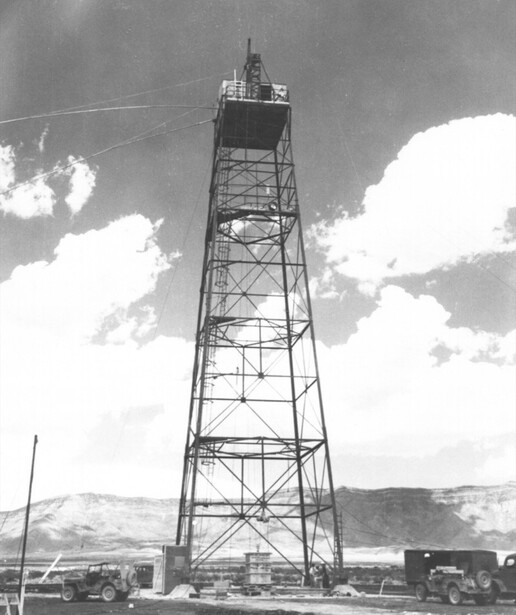
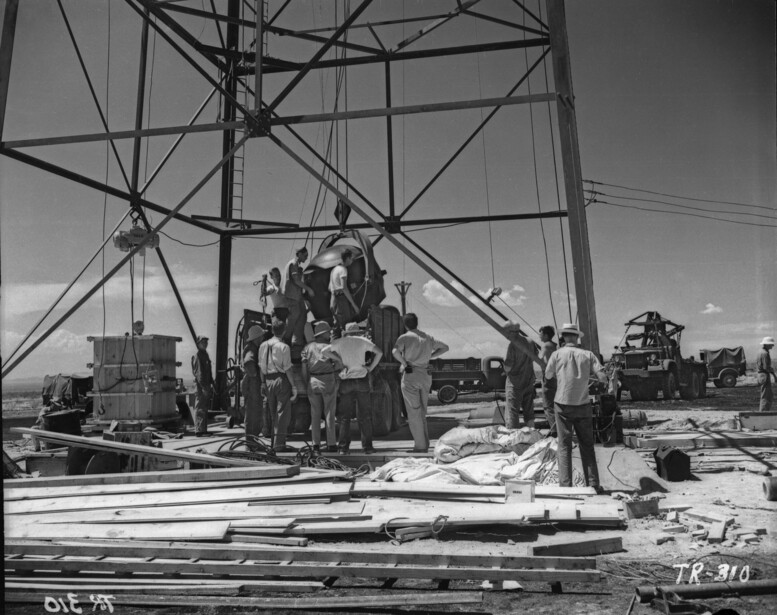
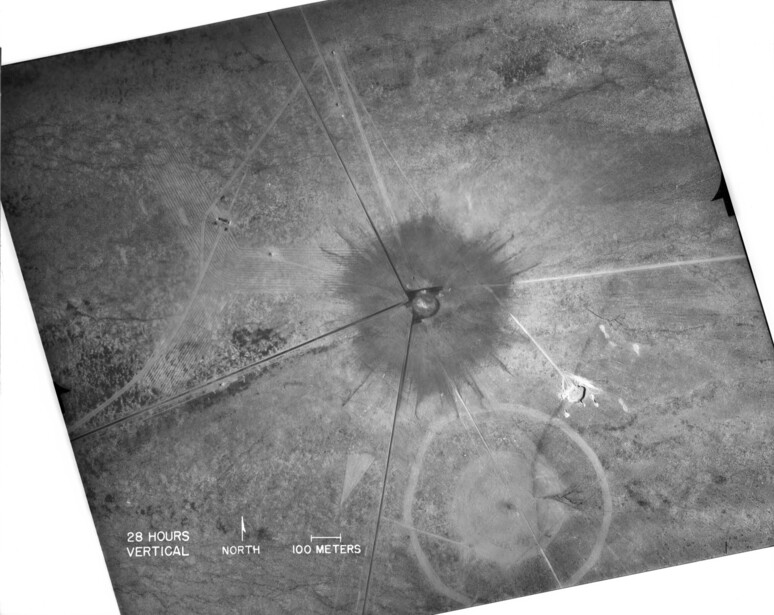
It helps to picture the ground. The gadget, as the device was called, sat atop a 100-foot steel tower designated Zero, its four legs sunk twenty feet into concrete footings, topped by an oak platform and a corrugated-iron shack open to the west. The height was partly a photographic decision. Lifting the device improved the imaging geometry, reduced the fallout scooped off the ground, and approximated the airburst the weapon was actually designed to deliver. The device had been raised to the platform by electric winch over a stack of mattresses, in case the cable let go. When it fired, at a yield of roughly twenty-one kilotons (the long-standing official figure, though a 2021 reanalysis of surviving trinitite put it closer to twenty-five, or 24.8 kilotons), the tower vaporized completely.
Steel-and-Lead Bunkers and a Camera That Fires Itself
You cannot put a camera near a nuclear detonation the way you would set up for a landscape. Brixner had to reinvent the shelters. The standard concrete-and-earth bunkers on offer would not do for what he needed at the close stations, so he built his own. "I had to make a completely new type of shelter," he recalled. "I built a steel and lead shelter, two of them actually, in place of those concrete ones and dirt." Cameras at the near positions did not look at the blast directly; they viewed it through mirrors, shooting through thick glass portholes so the blast, heat, and radiation would ruin the glass and the mirror rather than the lens and the film behind them.
The geography of the array was deliberate. "We had two sites north of the Zero and two sites west of the Zero, one at 800 and one at 10,000 yards," Brixner said. Ten thousand yards is 5.68 miles, and three reinforced, earth-covered shelters stood at that radius to the north, west, and south, sheltering scientists, soldiers, and instruments. Closer in, unmanned camera boxes sat at 800 yards and beyond, where the crews fully expected the gear to be destroyed or the film fogged by radiation before the shutter ever mattered. Farther out, human observers watched from Base Camp about ten miles to the southwest and from Compania Hill roughly twenty miles to the northwest. Keep those distances straight: the instrumented camera ring sat at 5.68 miles, not ten, and the ten- and twenty-mile figures belong to the observation posts.
Brixner ran the North 10,000 station himself. What is striking about shot morning is how little he did. Everything fired from the central control shelter at South 10,000. "Everything was operated from the central control station," he said. "I didn't have to do anything at the time but just sit there. The camera started running. I had a loudspeaker and was listening to the countdown." Joe McKibben ran the sequence timer in that bunker, starting the automatic run at twenty minutes and throwing the switch to the precise automatic timer at forty-five seconds, while physicist Samuel Allison called the count. A separate circuit designed by Ernest Titterton sent electronically timed pulses out to synchronize the many special instruments and cameras, so that a rig at North 10,000 and a rig at West 800 would trip in known relation to zero. The countdown was not just drama. It was the shutter release for fifty cameras at once.
Fastax, Mitchell, and the Cameras That Froze a Fireball
The workhorses were the Fastax cameras. A Fastax has no conventional shutter and no intermittent claw yanking film frame by frame; instead the film runs continuously past a rotating prism that steers the image to keep pace with it, which is how the design reaches speeds a mechanical shutter never could. Sourced figures for the Trinity Fastax cameras range from about 8,000 frames per second at the well-documented end up to the round 10,000 frames per second widely repeated in popular accounts, on 100-foot rolls of 8mm and 16mm film. Brixner leaned on them because the fireball's most important growth happened in the ten-thousandth-of-a-second range, and a camera running several thousand frames a second is what turns that blur into a measurable sequence.
Two Mitchell 35mm movie cameras at his North 10,000 station, running near 100 frames per second, produced what many consider the best footage of the test, the material Los Alamos later used to make some of the first measurements of a nuclear explosion's behavior. Mack's own instruments filled in the extremes of time resolution. His rotating-drum streak camera used a moving slit to smear the event across the film and reach roughly ten-microsecond resolution; electro-optical shutters pushed toward a microsecond; oscilloscope-trace photography, capturing electrical signals rather than the fireball, reached down toward the hundred-nanosecond range. Rounding out the set were spectrograph cameras that spread the fireball's light into its component wavelengths, so its temperature could be inferred from its spectrum, and pinhole cameras aimed not at visible light but at the gamma and high-energy flux pouring off the reaction.
One camera that could have gone even faster stayed home. A British framing camera, sometimes called the Marley, could take up to about 100,000 frames in a single second, though only around fifty-nine images in that burst. It had been used in developmental work, but by July 1945 it was considered out of date and was not fielded for the Trinity shot. That detail matters mostly because of what it heads off. The famous microsecond stills of a spiked, warty fireball that circulate as "atomic bomb" images were made by Rapatronic cameras, Harold Edgerton's magneto-optic design, and those belong to the Nevada and Pacific tests of the early 1950s, not to Trinity. Confidently pin them to July 16, 1945, and you are wrong by the better part of a decade. Trinity's frozen fireball is high-speed film, Fastax and Mitchell and the Mack streak, not a Rapatronic.
The morning did not cooperate. Rain and lightning had pushed the shot from its original pre-dawn slot, and in the heat and damp Brixner and a technician were still wiping water and dust off lenses shortly before the count. When it was over, the failure rate was brutal and expected. IEEE Spectrum, reporting on a later restoration of the footage, notes that only about eleven of the fifty-two cameras returned fully satisfactory images. Brixner was blunter about the near stations: "Only about two of the Fastax cameras at the near stations ran and got pictures. All of the more distant cameras worked okay." The close-in rigs, the ones behind the steel and lead and the mirrors, were the ones the blast reached first.
Yet eleven good sets of frames were enough, because of how they were arranged. Cameras spanned from about a half mile to fourteen miles, staggered in distance, angle, frame rate, and focal length, so the fireball could be triangulated in space and pinned in time from several independent viewpoints at once. Redundancy was the design. Blanket the event thoroughly enough and a two-thirds loss still leaves you a complete record.
How the Photographs Measured the Bomb
Here is where the pictures stop being souvenirs and become science. Because Mack's cameras recorded the fireball against a known length scale and stamped each frame with a known time, the films were not just images of an explosion. They were a table of the fireball's radius against time, printed in light. And the rate at which a blast wave expands encodes the energy that drove it.
The British physicist Geoffrey Ingram Taylor had worked out the underlying relationship years earlier, in a classified 1941 report, and he published it openly in 1950. A point-source blast wave, he showed, expands so that its radius R grows in proportion to the energy E and time t according to R equals a constant times the fifth root of E over the surrounding air density, all multiplied by t to the two-fifths power. Rearranged, that means R to the five-halves power grows in lockstep with time. Taylor checked it against the fireball radii and found the relationship held from roughly twenty meters out to about 185 meters of growth.
The punchline is the part that reads like a magic trick. Taylor did not have access to the classified yield. He had the published photographs, the ones printed with a scale bar and a time stamp. From a single well-chosen frame, a fireball about 100 meters in radius at sixteen thousandths of a second after detonation, with air density near 1.1 kilograms per cubic meter, the arithmetic returns an energy of roughly forty trillion joules. Since a kiloton of TNT is about 4.2 trillion joules, that is on the order of ten kilotons from one frame; folding in the rest of the sequence tightens the estimate. Taylor's photograph-derived figure came in near 16.8 kilotons, within a few kilotons of the still-secret truth. Publishing it openly, drawn entirely from pictures anyone could buy, reportedly caused real embarrassment in official circles on both sides of the Atlantic, because the number was classified and he had pulled it out of the public record.
A couple of honest caveats belong here. Taylor was not doing back-of-envelope dimensional analysis in the loose textbook sense; his 1950 papers derive the solution from the governing equations with careful physical simplifications and prove the point-source model applies. And he was not alone. John von Neumann in the United States and Leonid Sedov in the Soviet Union reached closely related solutions around the same time, which is why the result is now called the Taylor, von Neumann, Sedov blast wave. Still, the through-line holds. Careful, calibrated, time-stamped photographs of a fireball let outsiders measure a weapon they were never briefed on. Mack put the limit of his own work honestly when he cautioned that even the extensive imagery "give no idea of the brightness, or of time and space scales." The frames were a measurement, not an experience.
Jack Aeby and the Only Good Color Photograph
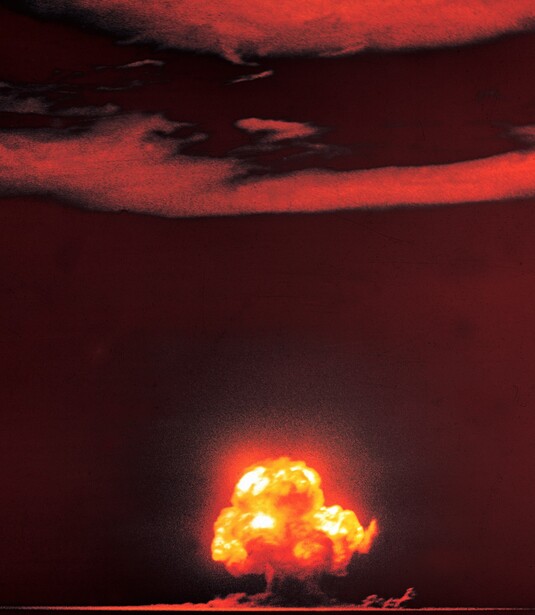
For all fifty-two of Mack's cameras, the single most reproduced still image of Trinity was shot by a man who was not assigned to photograph anything. Jack Aeby was a civilian working in Emilio Segre's physics group, measuring delayed gamma rays. He carried a personal 35mm camera, a Perfex, with permission Segre had secured for him, a rare privilege under Manhattan Project secrecy. Loaded in it was maybe three feet of leftover Anscochrome color movie film, the tail end of a roll, with only about four frames left. When the fireball rose, Aeby propped the camera on the back of a chair at Base Camp, about ten miles south of the tower, and shot it. "It was there so I shot it," he said later. "I wasn't a photographer, that wasn't my job, except I did carry a camera."
His method was bracketing by instinct. He opened up wide for the first frame, then, as he described it, "cranked the diaphragm down, changed the shutter speed and fired three times in succession," stopping down hard toward the small apertures. The correct exposure was partly luck, and partly a broken piece of safety gear: a crack in his issued dark welding goggles let a sliver of blast light leak through, and that leak seems to have cued him to keep stopping down rather than let the frame blow out. The middle exposure of the burst came out about right; the others were usable but not as clean. He developed the film himself that night through the long color process, and Segre noted that Aeby's pictures were ready before the official ones.
It remains the only well-exposed color still photograph of the Trinity detonation. Official color motion-picture footage existed, but the fireball's intensity overexposed, solarized, and blistered much of it, and time degraded the rest. A few points are worth getting right, because they are widely muddled. The camera model is genuinely disputed in the sources, between a Perfex 44 and a Perfex 33, so it is safest to call it a Perfex 35mm and leave the model open. The stock was 35mm movie film, not the "33mm film" that some accounts repeat, which is a transcription error, not a format. When the image first ran publicly, in the New York Sunday Mirror on October 7, 1945, after the Hiroshima and Nagasaki bombings had been announced, it was credited to the U.S. Army, which is a misattribution: Aeby was a civilian. And the photograph is almost always printed reversed left to right, done deliberately so the asymmetric cloud would match the official images shot from the north while Aeby had shot from the south. The original negative, handed to Los Alamos for safekeeping, was later lost.
One more name gets miscast in this story often enough to correct. William L. Laurence, the New York Times science reporter embedded with the Manhattan Project, was the only journalist to witness Trinity, and he is sometimes swept into accounts as if he made images. He did not. Laurence was a writer, hired to produce the prose and the pre-written press releases; he took no famous photographs. The pictures were the work of Mack's instrument team and, for the color still, of an amateur with a cracked pair of goggles.
What the Frames Became
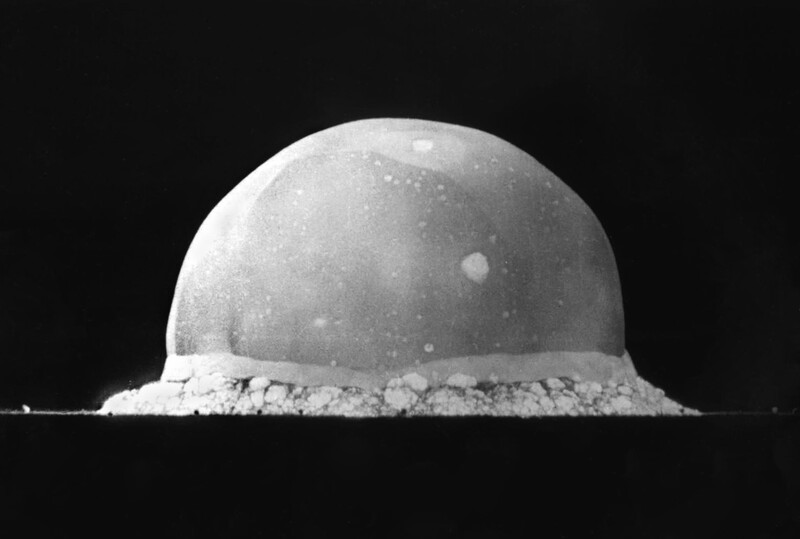
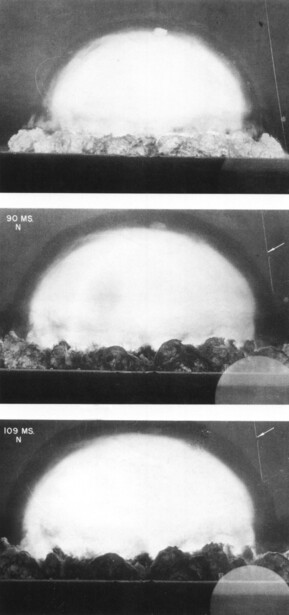
Most of the high-speed stills were stamped SECRET and stayed that way for a quarter century, though a single scaled fireball sequence had been released earlier, published in Life in 1947, the very frames Taylor worked from. When the rest were declassified in 1970, the prints came out with the security stamp struck through in blue ink, and because they were work products of the U.S. government they entered the public domain, free for anyone to reproduce. They have been reproduced ever since, the growing hemisphere with its flattened skirt of light along the desert floor, the frames labeled in milliseconds, an object lesson in what a camera is for when the thing in front of it has never been seen.
What strikes me, coming at this as a photographer, is how modern the whole approach feels. Faced with a subject they could not meter, in light they could not predict, with one exposure and no retries, Mack and Brixner did not chase a single perfect frame. They spread the bet. They ran the fastest instruments they had at every speed and distance at once, hardened the ones that mattered, accepted that most would fail, and trusted that redundancy and calibration would carry the day. They were right. Roughly four-fifths of the cameras failed to produce fully satisfactory images, yet the surviving footage still provided a remarkably complete record. The next time you see that fireball, the perfect glowing dome frozen sixteen thousandths of a second into the atomic age, remember it was not caught by a genius with a shutter finger. It was engineered, in the dark, by people who assumed they would mostly miss and built an array that could afford to.
Lead image: the Trinity fireball at roughly six milliseconds after detonation, a high-speed frame printed with the 100-meter scale bar and elapsed-time stamp that let physicists read the bomb's yield straight off the film. Photo courtesy Los Alamos National Laboratory, public domain (U.S. federal government). Source.



.jpg)


Join the Fstoppers community for free
-
Post comments and join in the discussions
-
Browse the site ad-free
-
Share your work and get featured in the community
-
Compete in the photo contests for fun and prizes
5 Comments
Best article I've read here in a while, fascinating.
A hell of a story. It reminds me, appropriately, of the firsthand account of from one of the airmen in the Hiroshima mission, published on the 50th anniversary in the wsj. Well worth your time.
i can’t be the only photographer wondering, “if I had been handed this chances with these limitations, would I have screwed it up?”
I was under the understanding that Doc Edgerton had a hand in these photos - Yes. Harold "Doc" Edgerton played a major role in photographing nuclear weapons tests. He invented the Rapatronic camera, which captured the first microseconds of atomic bomb detonations in the late 1940s and 1950s.Harold Edgerton and Atomic TestingThe Rapatronic Camera: Traditional mechanical shutters could not move fast enough to capture an explosion happening in a fraction of a millionth of a second. Edgerton designed a shutterless, rapid-action electronic camera using polarized filters that allowed exposures as brief as one-millionth of a second.EG&G Company: Edgerton and his associates formed the firm EG&G, which became a primary contractor for the U.S. Atomic Energy Commission.Documenting Blasts: His team provided the precision timing, firing systems, and specialized cameras used to record nuclear explosions during test series in Nevada and the Pacific.
Interesting article. I'm curious about the second image. It does not show on the Source link and looks more polished than the others. Has it been enhanced or edited?
This is an excellent well-researched article. Thanks so much!