
There is a kind of photography that pretends to be neutral. Flat surfaces, clean lines, ordinary spaces. Nothing dramatic, nothing loud, nothing that asks to be looked at twice. It's often dismissed as cold, detached, even empty. But that reading is too easy. What we call indifference is rarely indifference. It is a position.
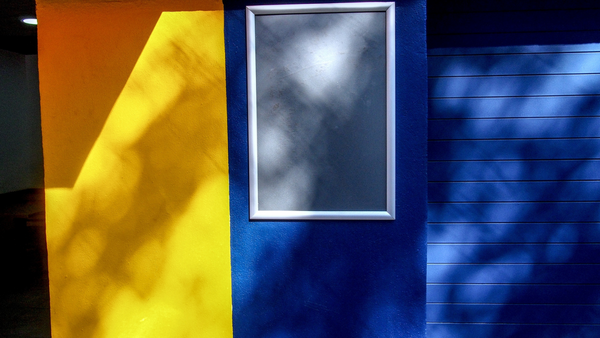
This photograph doesn't describe a place, doesn't narrate an event, doesn't offer a subject in the conventional sense. A yellow wall, a blue wall, a framed void, a shutter. Light cutting across surfaces like something accidental, almost careless. Nothing is happening, and yet everything is already decided. The geometry here is not decoration, it's structure. The vertical division is absolute. Yellow and blue don't blend, don't negotiate. They coexist without dialogue, holding a tension that never turns into conflict. The frame in the center suggests an image that isn't there, or maybe one that refuses to appear. That empty rectangle becomes the only possible subject, and even that feels withheld.
This is where indifference becomes interesting, because the photograph doesn't guide you. It doesn't tell you where to look, what to feel, what matters. It leaves you alone with the surface, and that can be unsettling. In a time where most images are designed to be immediately legible, this kind of work resists. Not loudly, not conceptually, just by standing there without offering resolution. There is a lineage behind this way of seeing. Luigi Ghirri understood that the ordinary is never just ordinary. Guido Guidi built entire bodies of work on the idea that attention itself is a form of construction. The photographers of New Topographics removed drama to reveal structure, while Stephen Shore and William Eggleston treated color not as expression but as fact. But referencing them is not enough, because this kind of image fails immediately when it becomes imitation.
The risk is always there. Geometry can become a refuge, a way to avoid complexity instead of confronting it. Lines can replace meaning, surfaces can replace thought, and what remains are images that are formally correct but fundamentally empty. That's not what's happening here. There is friction. The shadows are unstable; they break the rigidity of the walls, they introduce something organic, almost intrusive. The light is not neutral — it divides, emphasizes, interrupts. And that empty frame, placed with almost too much precision, becomes slightly uncomfortable. It feels intentional, but not resolved.
That tension is everything, because without it geometry is just design, and with it, it becomes language. What matters is not what the photograph shows, but what it refuses to resolve. There is no hierarchy, no clear entry point, no narrative progression. You look, and you stay there longer than expected, not because something happens, but because nothing fully settles. Indifference, in this sense, is not the absence of meaning — it is the refusal to simplify it. And maybe that's the real shift: not trying to make photographs that say more, but making photographs that reduce less. Most images today want to be understood immediately. This one doesn't. And that, precisely, is where it begins.


2 Comments
Reading this, I was reminded of the long tradition of the “nothing-as-art” movement of the last half century: Robert Rauschenberg exhibiting blank canvases and declaring the shadows cast by passing gallery viewers to be the true artwork; Salvatore Garau selling an “invisible sculpture” for $18,000 while providing the client with only a certificate of authenticity; and Jens Haaning submitting two empty frames to a museum under the title “Take the Money and Run.” In each case, absence itself was repackaged as profundity. Apparently, photographic “geometry of indifference” now proposes a new frontier for the same aesthetic philosophy that presents unresolved banality not as a lack of subject, but as evidence of artistic sophistication.
Thanks, Hoag, for this nice commet that is an opportunity for me to go more in depth here: what’s interesting is that all the examples you mention depend on the gallery system itself to survive. Rauschenberg, Garau, Haaning… their gestures only function once institutional validation enters the room. Photography is different because reality keeps resisting theory. A photograph, even at its most minimal, still carries the friction of lived life.
What you call “unresolved banality” has actually been part of photography since Walker Evans photographed roadside signs, or since Stephen Shore turned parking lots and motel rooms into reflections on modern existence. Even Lee Friedlander often built frames around visual ambiguity, fragments and what seemed, at first glance, like indifference. The point was never “nothingness.” The point was attention.
John Szarkowski once wrote that photography’s challenge was to recognize “the thing itself.” That includes ordinary moments, awkward spaces, accidental geometry and the anonymous poetry of everyday life. Not every image needs theatrical subject matter to justify its existence.
The danger today is not emptiness. It’s overstatement. In a culture obsessed with spectacle, subtle observation can easily be mistaken for absence.