
There are photographs that seem to exist entirely on their surface.
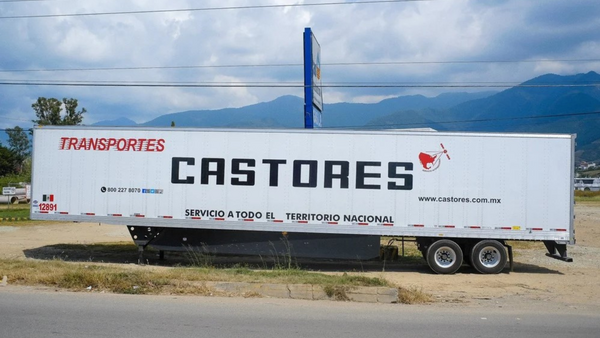
You look at them and everything is already there. A trailer, parked on a patch of dirt. A road cutting the foreground. Mountains in the distance. A sky that holds the whole thing together without insisting too much. And across the side of the trailer, a name stretched in bold letters, impossible to ignore.
And it feels immediate, legible, almost too clear, and yet the longer I stay with it the less it moves — not because it is static, but because it refuses to evolve into something else. There is no before, no after, no sense that anything is about to happen or has just happened. The trailer is not arriving, not leaving, not being used; it is simply there, detached from function, detached even from the idea of movement that it is supposed to represent. And that contradiction is what holds the image: a vehicle designed to move across territory, immobilized in a place that feels peripheral, almost provisional. The word "transportes" written on its side becomes strangely abstract, like a statement that no longer applies. Everything suggests circulation and yet nothing moves.
What interests me here is not the subject, but the condition, because this kind of photograph sits in an uncomfortable space between description and suspension. It shows clearly, almost insistently, and at the same time it doesn't open; it doesn't lead you anywhere beyond what is already visible. You are left in front of it with no real direction. And this is where my relationship with street photography has shifted the most. For a long time I was looking for images that carried a sense of progression, something unfolding, something that could be read as part of a larger flow. Even when subtle, there was always an expectation that the photograph would connect to something outside itself, but images like this resist that logic. They don't extend; they remain.
There is something in this that resonates with the work of Stephen Shore, where clarity doesn't translate into narrative but into a kind of stillness that feels almost disorienting, or in William Eggleston, where the ordinary holds its ground without needing to become symbolic, and more broadly in that shift introduced by New Topographics, where the landscape stopped being interpreted and started being presented. But this is not about placing the image within a tradition; it's about recognizing a behavior. Because what this photograph does, in a very quiet way, is interrupt the idea that an image needs to develop. It doesn't. It can remain closed, self-contained, almost indifferent to the viewer's need to extract meaning. And that indifference is not a weakness; it's a stance.
There is also something about scale that matters here. The trailer dominates the frame horizontally, almost excessively; it blocks the landscape instead of opening it. The mountains are there but they are secondary (that reminds me also of the research by Robert Adams), pushed back, reduced to a backdrop. Even the sky, which usually expands the image, feels contained. Everything is compressed into a kind of visual plateau; nothing escapes. And I didn't immediately trust this photograph. It felt too simple, too resolved on the surface, like it had already given everything it had to give. But that impression started to shift the longer I stayed with it — not because new elements emerged, but because the absence of development became the point. The image doesn't transform; it insists.
And maybe that's what I'm trying to understand more and more in my work — not how to make photographs that say more, but how to make photographs that don't need to move in order to exist. Images that hold their position even at the risk of being overlooked. Images that don't adapt to the viewer. Images that remain exactly where they are. Because sometimes what stays still long enough begins to feel unfamiliar, and that unfamiliarity is not produced; it's discovered.
Join the Fstoppers community for free
-
Post comments and join in the discussions
-
Browse the site ad-free
-
Share your work and get featured in the community
-
Compete in the photo contests for fun and prizes
No comments yet