
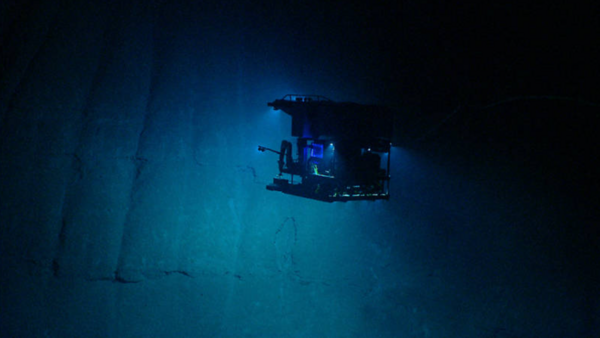
In 2022, a camera on the floor of the Izu-Ogasawara Trench off Japan, 8,336 meters down, filmed a small translucent snailfish drifting through its beam. No fish had ever been filmed so far down. No sunlight has ever reached that trench, and the light that does exist down there, the faint blue flicker of bioluminescence, is nothing like the broad-spectrum white the camera carries. When the lights came on, they almost certainly gave that fish a kind of light it had never seen. A great deal of deep-sea photography works this way: the scene has no sunlight of its own, so the camera has to bring it.
Where the Sunlight Runs Out
Water is a filter, and it eats light one color at a time. The long wavelengths go first. In clear open ocean, red is mostly gone within the first 15 meters or so, orange fades out somewhere around 40 meters, and yellow is largely finished before 100 meters, though the exact depths shift a lot with how clear or murky the water is. What is left by then is a bruised blue-green, and it keeps dimming until, below about 1,000 meters, no sunlight reaches at all.
Oceanographers split the water column by how much light survives. In the standard simplified scheme, the sunlit zone is the upper 200 meters or so, where there is enough light for photosynthesis. From roughly 200 to 1,000 meters is the twilight zone, dim and blue and not bright enough for photosynthesis. Everything below that is the aphotic zone, where no sunlight reaches at all, and that dark layer is most of the ocean by volume. It is the largest living space on the planet, and the sun has never touched it.
That single fact changes what a camera is for. On land or near the surface, light already exists and you are shaping it. Below 1,000 meters there is no ambient exposure to make. The frame is pure black until you add light yourself, which is the same problem that turns your own dives muddy and blue a few meters down and sends you reaching for a strobe like the Ikelite DS230 or a red correction filter. Take that problem to its absolute end and you have deep-sea photography, where the machine does not correct the light. It is the only light there is.
The Machines That Carry Their Own Sun
The workhorse for public deep exploration in the United States is a remotely operated vehicle called Deep Discoverer, or D2, flown from NOAA Ship Okeanos Explorer. It carries 28 LED lights and a high-definition camera that can zoom in tight enough to fill the frame with a 3-inch organism from 10 feet away, and it has been fitted on some expeditions with a specialized low-light camera to catch faint bioluminescence. It is rated to 6,000 meters and weighs about 9,700 pounds in air. A second lit platform called Seirios hangs on the tether above it, throwing down an overhead wash of light and, just as usefully, absorbing the ship's motion so the pictures below stay steady.
Power and data travel on an armored electro-optical cable that runs from the ship down to Seirios, with D2 flying beneath the lit platform on a short, neutrally buoyant tether about 33 meters long rather than hanging straight from the vessel. Optical fibers inside carry the video and data back up. The camera and its electronics ride inside pressure housings machined from titanium or built as thick glass spheres, with viewports of glass or sapphire, because the water is trying to crush them the entire time. At the bottom of the Mariana Trench the pressure is roughly 1,100 atmospheres, about 8 tons per square inch, and a housing that fails at that depth implodes in a fraction of a second. Consumer gear fights a gentler version of the same war, which is why a housing like the Nauticam NA-A1 is milled from a solid block of aluminum and pressure-tested before it ever gets wet.
Not every deep camera is tethered to a ship. Landers are simpler and often reach deeper. A lander is a frame with weights, lights, bait, and a camera that free-falls to the seabed, sits and films for hours while the smell of the bait draws animals in from the dark, then drops its ballast and floats back to the surface to be recovered. There is no cable and no pilot, which is exactly why landers, not ROVs, hold the deepest-fish records. The snailfish at 8,336 meters was filmed by baited landers deployed by Alan Jamieson of the Minderoo-UWA Deep Sea Research Centre in partnership with the Tokyo University of Marine Science and Technology. "The Japanese trenches were incredible places to explore; they are so rich in life, even all the way at the bottom," Jamieson said.
Why the Deep Is Painted Red and Black
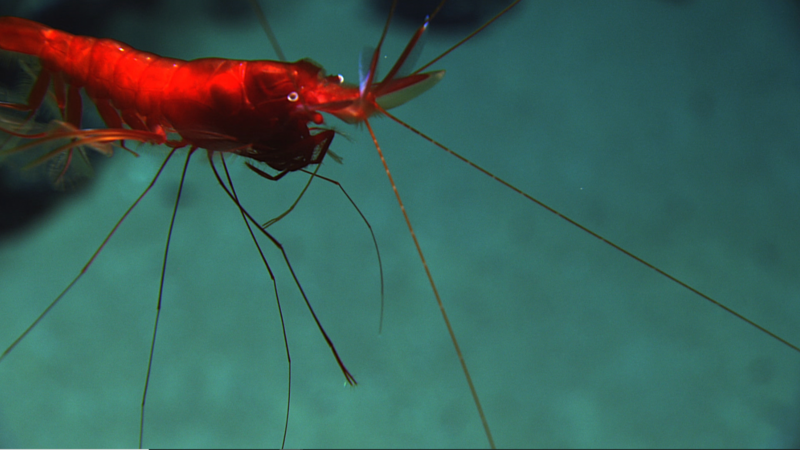
Many a deep-sea animal, pulled up in a photograph, turns out either jet black or blood red, though plenty of others are transparent, silver, or white. That is not decoration. In the blue twilight, red pigment has nothing to reflect, because there is no red light left in the water to bounce off it. A scarlet shrimp absorbs the available blue and gives back nothing, so to any predator relying on ambient light it simply reads as black and disappears. In the deep, red is camouflage, and so is black. The animals evolved their color for a world with no red in it.
Then the ROV arrives with broad-spectrum white light, and for the first time that shrimp is visibly, unmistakably red. The color in the photograph is real, but it is a color the animal has little occasion to show, because the broad-spectrum light that reveals it barely exists down there until the camera brings it. You are not quite documenting how the creature looks. You are seeing how it would look, under a sun it has never met.
A few animals have solved the darkness the other way. The loosejaw dragonfishes, including Malacosteus, produce their own far-red bioluminescence and can see it, when almost nothing else down there can. They shine a beam of red light that most other animals cannot detect and pick out red-colored targets that think they are hidden. It is close to a private night-vision system, a spotlight almost nothing else can see, evolved in the same darkness that photographers now flood with lamps.
Seeing Without Being Seen
Bright white light is a blunt instrument in a place that has never had any. It can dazzle animals whose eyes are built for single photons, and it scatters skittish creatures before you ever get a clean frame. So a lot of deep imaging now leans on red light, because most deep-sea species never evolved receptors for a color that does not reach them. In one study of sablefish, researchers counted an average of roughly 39 fish per short viewing window under red light against about 8 under white, simply because the red light did not frighten them off.
Red is quieter, not invisible. A 2021 study of pelagic communities found that the animals there still avoid white, blue, and red artificial light to some degree, which is part of why the field keeps pushing toward far-red wavelengths and ultra-low-light cameras that can work with almost nothing. The constraint has no equivalent on the surface. A landscape does not flee when you raise your exposure. Down here the photographer is trying to light a subject without letting the subject know it is being lit, and how well you manage that partly decides what behavior you are even allowed to see.
What the Lights Have Found
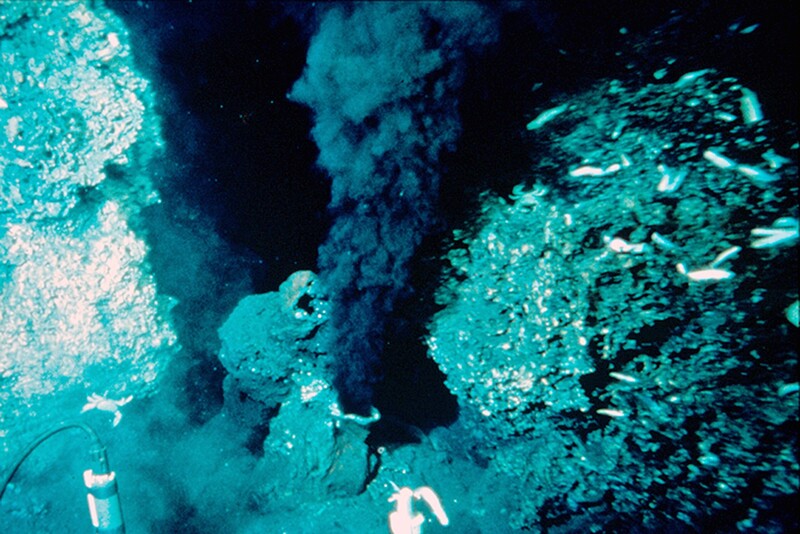
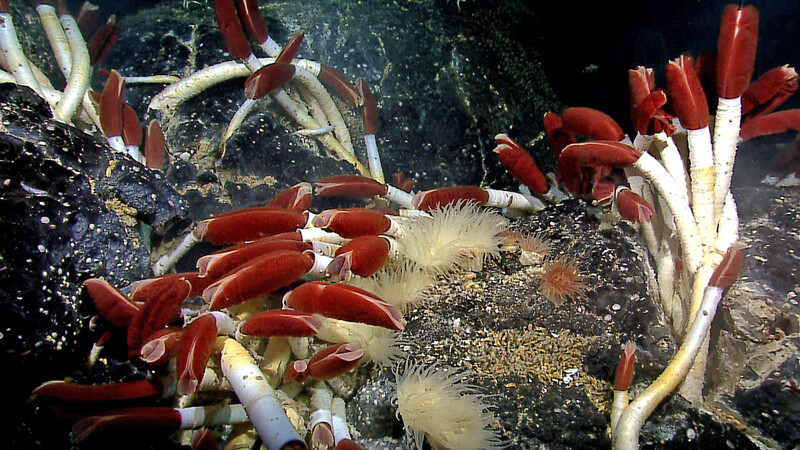
This way of seeing has rewritten biology more than once. On February 17, 1977, the submersible Alvin dropped about 2,500 meters to the Galapagos Rift, following a towed camera that had photographed a strange bed of clams in the dark. When Alvin's lights came up on the vents, the crew found clams the size of a ruler, mussels, pale crabs, and fields of giant tube worms tipped in red, all crowded around water shimmering with heat. It was the first rich animal ecosystem anyone had found with chemosynthetic microbes, rather than photosynthetic organisms, at the base of its food web, powered by chemistry welling up from inside the Earth. Chemosynthesis was already known in microbes, but no one had imagined it could feed animals this large and abundant. Nobody predicted it. A camera in the dark simply showed it to them on the 1977 dive.
The discoveries keep coming, and many of them exist only as pictures. On the first dive of its 2016 season, Okeanos Explorer settled onto a rock about 4,290 meters down near Necker Island in the Hawaiian chain and filmed a small, ghostly white octopus with no pigment cells and a single row of suckers on each arm. Nicknamed Casper, it is almost certainly a species science has never described. It still has no scientific name, because no specimen was ever collected, and video alone rarely provides enough anatomical and genetic evidence to formally describe a new species. It is known to the world entirely as light that a machine caught and sent back up a cable.
The record at 8,336 meters belongs to that translucent snailfish in the Japanese trench, filmed by a baited lander in 2022. On the same expedition the team caught two snailfish at 8,022 meters, the deepest fish ever physically brought up. These are not fish anyone was watching for. They were revealed by dropping a lit camera into some of the deepest water on Earth known to hold fish and waiting to see what swam into the glow.
Most of the deep seafloor has never been touched by sunlight, and much of it has never been lit by anything but the occasional spark of a living thing. The next camera lowered into it will bring the first broad-spectrum light some patch of the planet has ever received, hold it for a few minutes, and take it away again. The photograph that comes back is not a record of a scene that was already there to be seen in color. For one lit instant, the camera is the only reason the scene looks the way it looks at all.
Lead image — Remotely operated vehicle Deep Discoverer climbs a canyon wall off Puerto Rico, lighting the deep seafloor with its LED array in surrounding darkness. NOAA Office of Ocean Exploration and Research, Public domain. Source.







Join the Fstoppers community for free
-
Post comments and join in the discussions
-
Browse the site ad-free
-
Share your work and get featured in the community
-
Compete in the photo contests for fun and prizes
No comments yet