
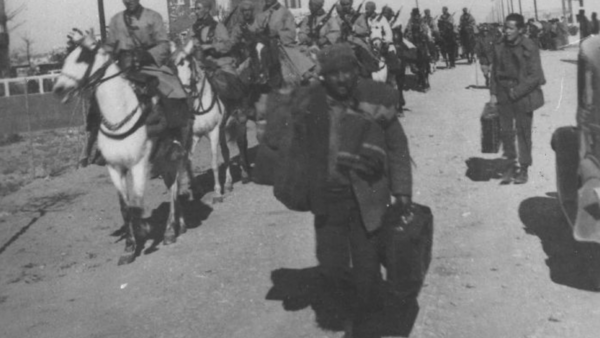
In December 2007, three small cardboard boxes reached the International Center of Photography in New York holding 126 rolls of 35mm film and roughly 4,500 negatives that had been missing since 1939. Inside was a visual record centered on the Spanish Civil War as seen by Robert Capa, Gerda Taro, and David "Chim" Seymour, three young photographers who helped invent modern war reporting before all three of them were killed on assignment. The cache also holds several rolls of portraits of Capa and Taro made in Paris by a fourth photographer, Fred Stein, along with a few frames shot before the fighting started. The film had disappeared from a Paris darkroom and resurfaced nearly seven decades later in a Mexico City apartment, after a journey whose middle stages remain uncertain, and almost no one believed it still existed.
The Boxes That Should Not Have Survived
The material now known as the Mexican Suitcase is not a suitcase at all. It is three flat boxes, each subdivided into small compartments, packed with rolls of film shot mostly between May 1936 and the spring of 1939, plus a few earlier frames, including Stein's rolls of Capa and Taro in Paris and Chim's photograph of a mother nursing a baby near Badajoz, both made months before the war began in July 1936. The rolls sat in numbered compartments with handwritten labels and diagrams identifying many of the assignments, the kind of production detail that lets an archivist reconstruct the sequence of surviving exposures and, in many cases, the assignment they belonged to.
That ordering is the reason the find mattered so much. A famous print tells you what the photographer chose. A full roll of film tells you what the photographer rejected, how close they stood, how many frames they burned before the one that made the magazine, and sometimes whether a scene was as spontaneous as it looked. For decades, scholars of the Spanish Civil War had the icons but not the rolls they came from. The boxes gave them the complete rolls, and with them the contact sheets and the fuller record of each assignment that could be reconstructed from the negatives.
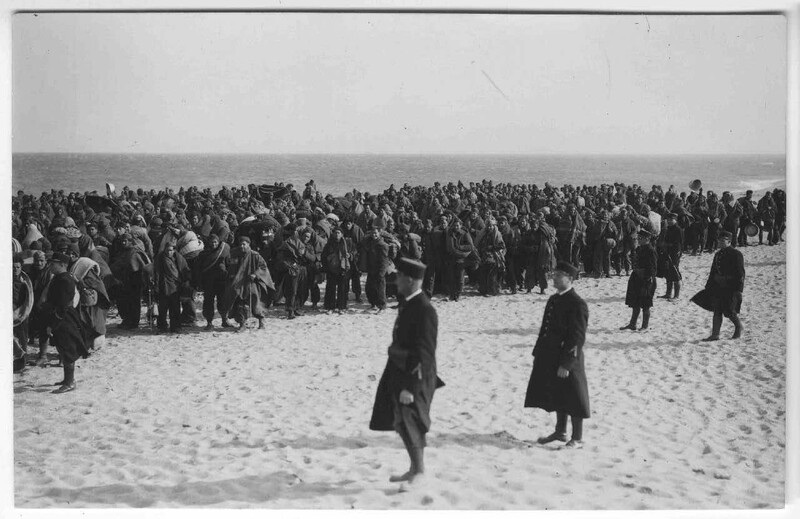
The International Center of Photography put the recovered work on public view from September 24, 2010, through May 8, 2011 and published a two-volume study of it. Among the frames were Capa's coverage of exhausted Republicans marched along the beach at the Le Barcarès internment camp in France in March 1939, Chim's quiet image of a mother nursing her baby at a land-reform meeting near Badajoz, and Capa's photographs of Ernest Hemingway and the correspondent Herbert Matthews at Teruel in late December 1937.
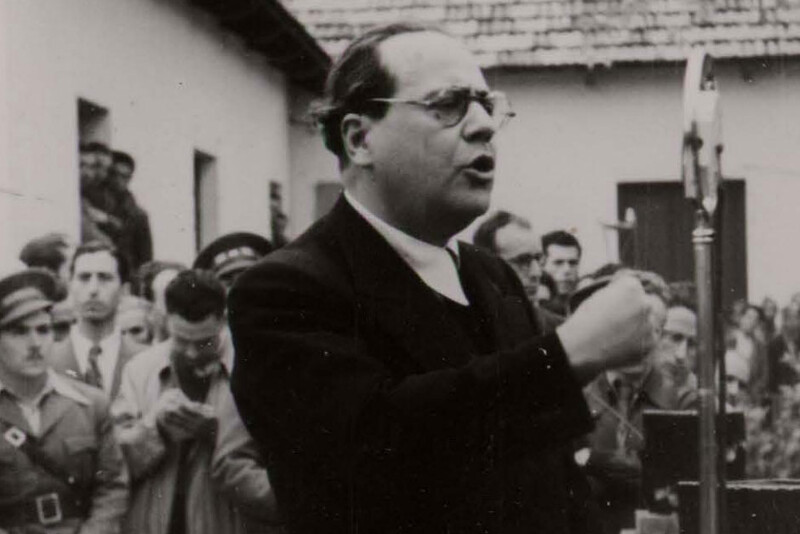
Three Photographers and One Invented Name
To understand why the boxes matter, you have to know who exposed the film. The man the world remembers as Robert Capa entered life in Budapest in 1913, christened Endre Friedmann. His partner had arrived three years earlier, in 1910, a Stuttgart child registered as Gerta Pohorylle before she reinvented herself as Gerda Taro. The two were a couple and a working partnership in Paris in the mid-1930s, and they were struggling to sell pictures under their own foreign-sounding names in a market growing more hostile to Jewish and left-leaning emigres. So they built a fiction. They invented a glamorous, successful American photographer called Robert Capa and sold Friedmann's work under that name, with Taro presenting herself as his agent. The persona sold better than either of them had alone, and eventually Friedmann became Capa for good.
The third figure, Chim, was born Dawid Szymin in Warsaw in 1911; he signed his Spanish Civil War photographs simply "Chim" and only adopted the name David Seymour in 1942, after reaching the United States. All three covered Republican Spain from 1936 onward, working in overlapping places and sharing the same professional and personal circles, and their approach was radical for the time. They worked close, on foot, with small cameras, in the middle of events rather than at a safe remove. Capa and Chim carried 35mm rangefinders, and Taro made much of her early Spanish work on a Rolleiflex. That intimacy is what made the pictures feel modern, and it kept all three of them in range of the wars they covered. All three were eventually killed on assignment.
Taro was the first to die. On July 25, 1937, covering the Republican retreat from the Battle of Brunete, she was riding on the running board of a car when an out-of-control tank collided with it, knocking her down and running over her, and she died of her injuries the next day. She is generally recognized as the first woman photojournalist killed while covering combat at the front, and she was 26. Capa survived Spain, went on to photograph the D-Day landings, and helped found the Magnum Photos cooperative in 1947 with Henri Cartier-Bresson, Chim, George Rodger, and others. He stepped on a landmine in Thai Binh, in what was then French Indochina, on May 25, 1954, while photographing for Life. Chim took over as Magnum's president after Capa's death and was killed by machine-gun fire near the Suez Canal on November 10, 1956. Of the three photographers whose film filled those boxes, only Taro did not outlive the war that made them; Capa and Chim both survived it, only to be killed years later covering other conflicts.
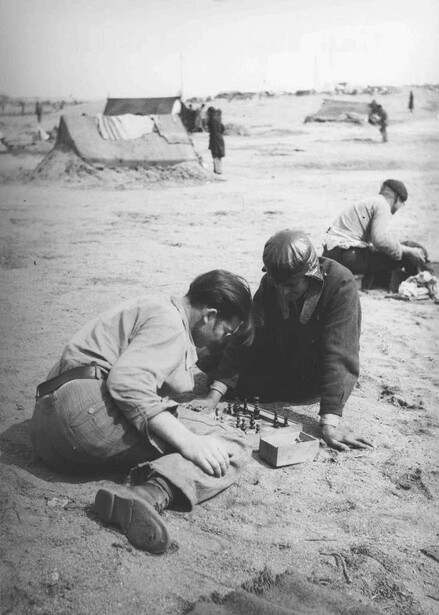
A Rucksack, a Chilean Consul, and a Mexican General
Capa had already sailed for the United States in October 1939, and the negatives stayed behind with his darkroom manager, a Hungarian named Imre Weisz, known to everyone as Csiki, who fled Paris the following spring as German forces closed in. What he did next is the human center of the whole story. Decades later, in a letter dated to 1975, Weisz recalled the moment plainly, misdating it by a year in the process. "In 1939, when the Germans approached Paris, I put all Bob's negatives in a rucksack and bicycled it to Bordeaux to try to get it on a ship to Mexico," he wrote. "I met a Chilean in the street and asked him to take my film packages to his consulate for safekeeping. He agreed."
Accounts of the exact route differ, with some placing the film's path through Marseille as well, and the middle stretch of the journey is genuinely murky. What is clearer is where it landed. At some point the boxes came into the hands of General Francisco Aguilar González, a Mexican diplomat who served as ambassador to the Vichy government around 1941 and 1942. He carried them to Mexico City, and there they sat, forgotten, for the better part of half a century.
Weisz himself ended up in Mexico too. He was interned in North Africa during the war, eventually reached Mexico, married the surrealist painter Leonora Carrington, and lived out his life there. He died in early 2007, months before the boxes he had tried to save finally reached New York. He never saw them come home.
The negatives resurfaced through a Mexican filmmaker named Benjamin Tarver, who had inherited them from an aunt whose family had ties to the general, and had known for years that he was holding something extraordinary. Tarver made contact with scholars and, eventually, with ICP, but the negotiations dragged. What broke the deadlock was the persistence of Trisha Ziff, a curator and filmmaker based in Mexico City who mediated between Tarver and the institution. She brought the boxes to New York, and on December 19, 2007, the material was handed to Cornell Capa, Robert's younger brother, who had founded ICP in 1974 to preserve exactly this kind of work. Ziff later told the full story in her 2011 documentary, also called The Mexican Suitcase.
What the Negatives Settled, and What They Didn't
The most quietly important thing the boxes did was sharpen attribution. Because Capa and Taro had shared a byline and a working life, and because Taro died young and was gradually written out of the story, a body of work that was genuinely hers had been folded into the Capa legend. The recovered rolls, read alongside the notebooks, let researchers separate her frames from his with a precision that had not been possible before. That work was already under way when the boxes landed. ICP opened the first major American retrospective of Taro's photographs on September 26, 2007, almost three months before the suitcase reached New York, so what arrived in December was a large new body of evidence rather than the moment her authorship was first recovered. Format had already done what it could elsewhere. In Taro's earliest Spanish work, held in other collections, her square Rolleiflex frames separate cleanly from Capa's rectangular 35mm, but that test does not apply here, because the suitcase is 35mm throughout and by 1937 both were shooting it. Inside these boxes the evidence is the notebooks, the assignment labels, and the order of frames along a roll. That is what let her coverage of the training of the new People's Army near Valencia in early 1937 be credited to her with far greater confidence. It is also why the boxes did not settle everything. Where two photographers worked the same ground on the same stock, some frames still rest on informed judgment rather than proof.
Then there is the photograph everyone wants the suitcase to explain. Capa's Falling Soldier, showing a Republican militiaman at the instant of death, ran in the French magazine Vu on September 23, 1936, and in Life on July 12, 1937, and it became the defining image of the war. It has also been argued over for half a century. Was the man really shot at that moment, or was the scene arranged during a lull? Was he really at Cerro Muriano on September 5, 1936, as long claimed?
Many people assumed the Mexican Suitcase would end the debate by producing the original negative. It did not. That specific frame is not in the boxes. The suitcase holds related Capa film from the same broader period, but the crucial exposure, and the run of frames immediately around it, is absent. Separately, the researcher José Manuel Susperregui analyzed the landscape in the background of associated pictures and concluded the location was actually near the town of Espejo, roughly 50 kilometers from Cerro Muriano, the site long claimed for the image, which would make an accidental combat death far less likely and a staged one more so. The late Richard Whelan, Capa's biographer, defended the picture's authenticity to the end. The honest position today is that the question remains open. The suitcase deepened the evidence without delivering the single frame that would have closed the case, and that absence is its own small drama.
Why a Box of Old Film Still Matters
You can treat this as a museum story, but the practical lesson sits closer to your own hard drive. These photographers shot on film, and film is a physical object that can be bicycled out of a war zone, handed to a stranger, and rediscovered in a drawer 68 years later. Film has its own ways of dying. It burns, floods, molds, and fades, and plenty of it has been thrown out by people who did not know what they had. These negatives survived because a few people at each stage chose to keep them and hand them on, not because film is inherently safer than a hard drive. A digital archive can outlive any single copy, but only with the same intent behind it: redundant copies in more than one place, backups you have actually restored from, metadata that still means something in twenty years, and files migrated forward before the format strands them.
The other lesson is about the difference between the picture and the record. For most of a century, the world knew Capa, Taro, and Chim through a handful of prints selected by editors and the photographers themselves. The negatives and notebooks turned that curated legend back into evidence, restored a woman to her own work, and forced a more careful conversation about one of the most reproduced images ever made. Keep your outtakes. Keep your metadata. Somewhere down the line, the frames you did not publish may be the ones that tell the truth.
Lead image: Spanish republican refugees crossing into France under escort by Moroccan spahis, February 1939. Photo by Albert Belloc, CC BY-SA 4.0, Archives départementales des Pyrénées-Orientales, cropped. Source.





Join the Fstoppers community for free
-
Post comments and join in the discussions
-
Browse the site ad-free
-
Share your work and get featured in the community
-
Compete in the photo contests for fun and prizes
No comments yet