
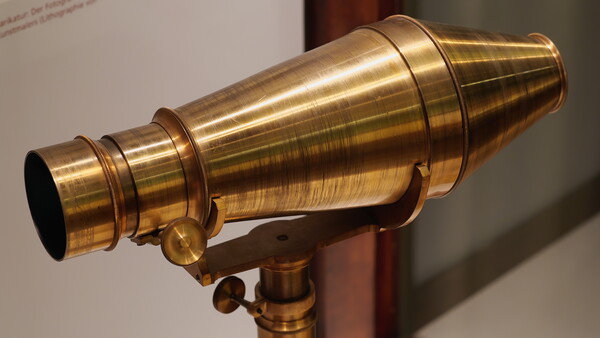
By May 1840, a mathematics professor in Vienna had finished a lens before a single piece of glass had been ground for it. Petzval worked the design out on paper, with a squad of army computers grinding through the arithmetic under his direction, and the result gathered roughly 20 times more light than the lens sitting on the front of a typical daguerreotype camera. A few portrait studios were open by then, working with mirror cameras and bromine chemistry. The industry that followed ran on Petzval's design for the next 40 years.
The Man Who Did the Math
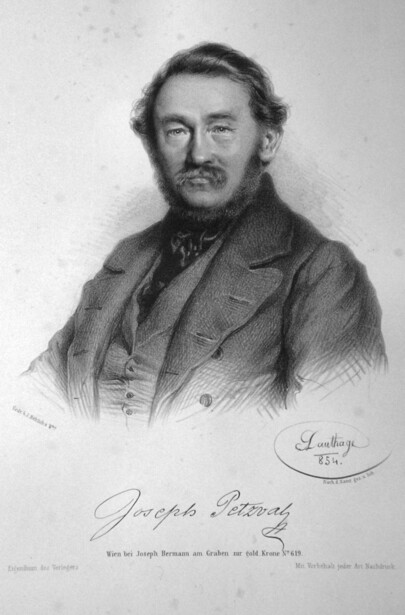
Jozef Maximilián Petzval was born on January 6, 1807 in Szepesbéla, a town in the Zips region of what was then the Kingdom of Hungary. German sources call it Zipser Bela, and it sits today in Slovakia as Spišská Belá, where his birth house has held a museum of photographic and cinematographic history since 1964. His first name appears as Jozef, Josef, and Joseph depending on which country's records you are reading, and all three refer to the same man.
He took an engineering diploma at the University of Pest in 1828, a doctorate in 1832, and a professorship in higher mathematics there in 1835. In 1837 he accepted a chair at the University of Vienna, where he stayed as a full professor of mathematics and mechanics until he retired in 1877 at the age of 70. He was a working mathematician first and an optical designer second, and his name still sits on the Petzval sum, the quantity that tells you how strongly a lens wants to bow its image into a bowl instead of laying it flat. Photography was a side quest that ate his life.
The Arithmetic Behind the Lens
Camera lenses before 1840 were made the way furniture is made. An optician ground a shape, looked through it, ground it again, and kept the versions that worked. Telescope optics were further along, because Joseph von Fraunhofer had been computing achromatic objectives from his own measurements of glass dispersion since the 1810s, and Petzval started from that work, using a well corrected telescope doublet as the front half of his lens. What nobody had done for a camera was carry the calculation through the whole design. He traced rays through a proposed four-element arrangement using the refraction math available to him, calculated where the aberrations landed, and adjusted curves and glass types on paper until the numbers came out. That is why the Petzval portrait objective is generally credited as the first photographic lens designed by computation rather than by trial and error, and the method matters more than the aperture number it produced.
The famous part of the story is the help. The accounts say the general director of artillery, Archduke Ludwig, ordered a group of soldiers from the imperial and royal bombardier corps to be placed at Petzval's disposal to run the calculations by hand, because artillery was one of the few military trades doing serious arithmetic every day. The specifics wobble between retellings. One version names two senior fireworkers, Löschner and Hain, plus eight bombardiers. Another counts eight gunners and three corporals. The roster details come down through biographical literature published long after the fact, starting with Ludwig Erményi's 1903 life of Petzval, rather than through a surviving order or payroll, so the specifics are thinner than the anecdote. What stays consistent is the shape of it: months of hand computation, finished by May 1840, done by men whose day job was ballistics tables.
Calling that team a human parallel computer is a modern flourish, and you will see it repeated everywhere. It is a fair description of what they were doing. It is not something Petzval or his contemporaries wrote down.
How Much Faster f/3.6 Really Was
The portrait objective is usually quoted at f/3.6, and Austrian sources often give f/3.7. The difference does not change the argument, so here is the arithmetic in plain terms. Light gathered scales with the square of the f-number ratio, not the ratio itself. A standard daguerreotype camera of 1839 carried a Chevalier achromatic landscape lens working somewhere around f/15 to f/16. Divide 16 by 3.6 and you get about 4.4. Square that and you get about 19.8, so call it 20 times the light. Run the conservative pairing, f/15 against f/3.7, and you get 4.05 squared, which is about 16 times. Push the reference lens to f/17 and the answer climbs to about 22 times.

That spread explains why published accounts confidently state 16 times, 20 times, and 22 times, sometimes within a single search result page. They are all doing the same multiplication against different assumptions about the old lens. In stops, which is the unit you actually think in, 20 times the light is a little over four and a quarter stops. One lens swap bought early photographers more speed than the entire jump from ISO 100 to ISO 1600.
What That Did to a Portrait Session
Early daguerreotype exposures ran from roughly three to fifteen minutes depending on light and plate, which is not a portrait session, it is an ordeal. The Library of Congress essay on the daguerreotype medium puts the practical result plainly: modifications to the sensitization process, coupled with improved lenses, soon cut the exposure to less than a minute. Austrian accounts of Petzval's lens describe the drop as roughly 15 minutes down to around 45 seconds, and camera histories often cite about 10 minutes down to 30 seconds. Nobody sober claims the 1840 lens by itself delivered a one-second exposure.
Two things happened at once, and the lens usually takes more credit than it earned alone. Bromine and chlorine accelerators applied to the sensitized plate raised its speed enormously across 1840 and 1841, and plate polishing improved alongside. Petzval's optics and the chemists' work together took portraiture from barely possible to merely uncomfortable.
Uncomfortable is the right word. Sitters were braced against headrests and posing stands so they would not drift during the exposure, faces were sometimes powdered, and studios worked in blinding direct sun or under skylights because nothing else fed the plate enough light. The old line about sitters being forbidden to blink is theater. A blink inside a 45-second exposure is invisible. Holding your head, hands, and shoulders still for that long while staring into hard light is the part that actually hurt, and you can read it in the stiff, faintly stunned faces in surviving portraits.
What Was and Was Not Patented
The popular version of this gets loose fast, so here is the exact sequence. Petzval handed the portrait design to the Viennese optician Peter Wilhelm Friedrich von Voigtländer, who built it into the all-metal camera that went into series production in 1841. Austrian accounts record a payment of about 2,000 gulden in 1840, made without a written contract and without any protection filed on the design beforehand. The MacTutor biography states the outcome bluntly: Voigtländer made a fortune, Petzval had not taken out patents, and he received no royalties.
So the 1840 portrait objective was not a patented invention that got infringed. It was an unprotected design, handed over once for a single payment, then copied by anyone with a glass shop, which is what happened across Europe and America for the next 40 years. Voigtländer made the lens by the thousand. The firm finished its 10,000th photographic objective at the end of 1861 and marked the milestone with a celebration in February 1862, and it had produced about 18,000 by 1865, an output no earlier optical shop had come close to.
Patents enter the story later, and on the other design. Petzval and Voigtländer broke permanently in 1845 over who had the right to produce what, and Petzval moved his work to other Viennese opticians, briefly toward Franz Xaver Waibl and then to Carl Dietzler. Dietzler took out an Austrian patent in October 1857, number 10570, on the second combination Petzval had derived back in 1840, the landscape and reproduction lens. Voigtländer, who believed his earlier payment had bought him everything Petzval calculated, built his own version and sold it as the Orthoskop. Litigation followed in 1857 and 1858, and none of it stopped him.
Geography finished the job. Voigtländer opened a factory in Braunschweig in 1849, then in a separate German state and outside the reach of any Austrian privilege, and ran the two plants side by side for nearly two decades before closing the Vienna works in 1868 and consolidating everything in Braunschweig. An Austrian patent protects you in Austria. Dietzler went bankrupt in 1862, and Petzval walked away from optics for good, spending his remaining working years on acoustics. He had already picked a public fight with Christian Doppler over wave theory in 1852, and he came out on the wrong side of it once Ernst Mach worked the problem through in 1860 and 1861.
The Burglary, the Monastery, and the Broke Question
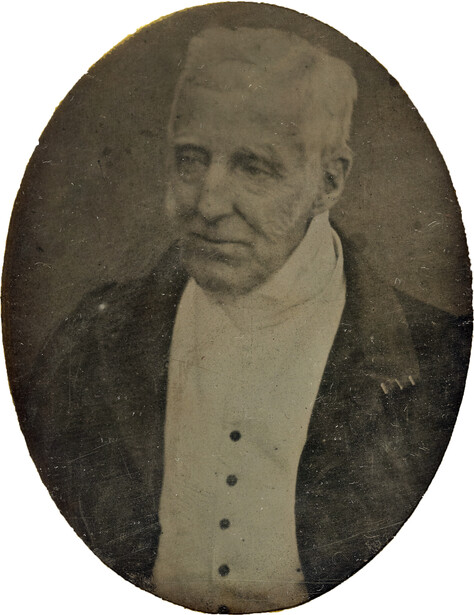
In 1859 Petzval's home was burgled and the manuscript of the treatise on optics he was writing was destroyed. He never returned to the subject. He had rented an abandoned monastery on the Kahlenberg above Vienna and rode down to the university to lecture, stopping his optics lectures in 1862 and giving up the rest in 1877. At 62 he married the woman who kept his house, Katarina Schlegl, in 1869, and was widowed within a few years. He spent his last stretch almost entirely alone on the hill with his horse, and died in Vienna on September 17, 1891, a date some photo-history pages give as the 19th.
Now the claim that ends every retelling, and probably the one you came here for: he died broke. Austrian photo-history sites say it flatly, "fast vergessen, verbittert und arm," almost forgotten, embittered, and poor, and that sentence has propagated everywhere without a citation under it. The contemporary paperwork says something narrower. The death notice his caretakers placed in September 1891, reprinted in the trade journal Photographische Correspondenz, styles him "k. k. Hofrath und Ritter des Franz Joseph-Ordens, o. ö. Universitätsprofessor in Pension." In Austrian officialese, in Pension is the formal status of a state official drawing a pension, not a polite way of saying he had stopped working. The same notice gives the house of mourning as Karlsgasse 2 in the fourth district, names Josef and Josefa Mayer as the couple who nursed him, and says he was to be buried at the Zentralfriedhof "im eigenen Grabe," in a plot he owned. The city moved him to an honored grave in the same cemetery in 1905.
Nobody has published an estate inventory, so what he actually had when he died is unknown, and anyone who quotes you a number is guessing. But a pensioned imperial professor buried in a grave he owned is not destitute, and destitute is the specific word the folklore uses. Forgotten survives the test easily. The same obituary records that no relatives wept at his coffin, that the chairs set aside for mourners stayed mostly empty, and that so little was known about his life that Wurzbach and Poggendorff could manage barely more than a list of his papers. Honors kept arriving, Hungary's academy listing him abroad in 1873 and the Czech mathematicians and physicists making him honorary in 1881, but they were the kind that arrives by mail. Embittered is harder to document, though the same notice calls him "stets ein Sonderling," always a solitary oddity, and the shape of the last decades fits: alone on the hill with his horse, the optics manuscript gone, the second design in a competitor's catalog. He lost the money the design should have made, he lost the manuscript, he lost the second design to a competitor, and he lost the recognition he believed he was owed. The sharpest way to state the injustice is this: the man who put the portrait industry's standard lens on paper took one lump sum of 2,000 gulden while that industry grew on top of his arithmetic.
The Look That Outlived the Argument
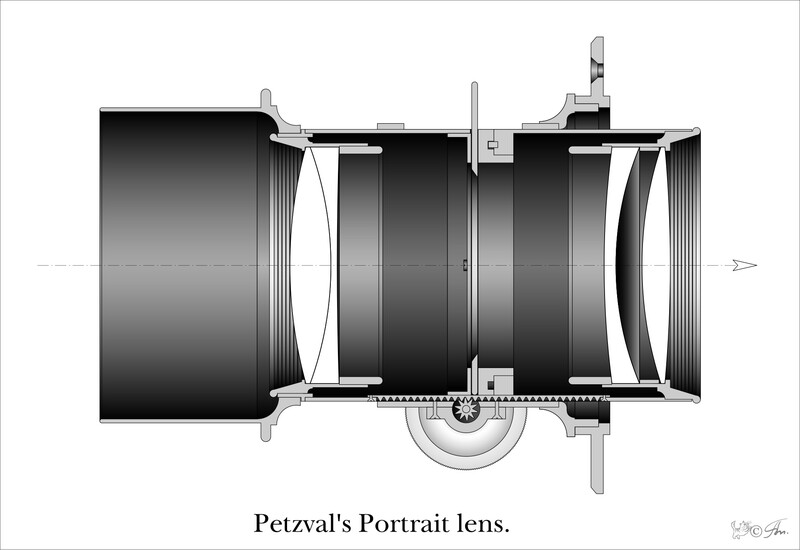
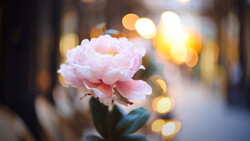
The optical compromise that made the lens fast is the reason people still buy the look. Petzval's four-element, three-group design corrected spherical aberration and coma well enough to shoot wide open, but it left field curvature and astigmatism largely intact. Its off-axis focus falls on curved sagittal and tangential surfaces rather than one flat image plane. In the middle of the frame you get a sharp, high-contrast subject. Toward the edges, out-of-focus highlights stretch into arcs that rotate around the center, which is the swirl, and the corners go soft and dim. Nothing out there is truly in focus either, because detail running out from the center and detail running around it come sharp at different distances, so no setting of the focus makes a corner clean. On a portrait plate, where the subject sat dead center, that read as flattering. On a landscape it read as broken, which is exactly why Petzval bothered to derive a second design.
Lomography rebuilt the formula for modern cameras with a Kickstarter campaign in 2013 that raised nearly $1.4 million, and the line has kept going. Current versions include the Lomography Petzval 55mm f/1.7 MKII and the Lomography Petzval 80.5mm f/1.9 MKII, sold in mirrorless and SLR mounts with control over how strong the swirl gets, which Petzval would have found funny. He spent months of hand arithmetic suppressing aberrations, and you now pay extra for a ring that dials them back in. Lensbaby sells the same instinct in a different formula with the Lensbaby Burnside 35, which pairs swirled edges with an adjustable vignette. Original brass Petzvals from the 1850s and 1860s still turn up at auction and still work on large format cameras, because a design that was right on paper stays right.
If you shoot portraits with one, the thing to internalize is that the swirl is a function of what sits behind your subject and how far back it is. Busy foliage six feet behind a head wide open spins hard. A clean wall does nothing at all. Aperture and a bokeh control ring decide how much of it you get, since stopping down pulls the swirl back and dialing the ring down pulls it back further, but no setting will spin a background that has nothing in it. That makes it a compositional decision as much as a lens setting, and it rewards the same deliberate approach to placement and expression that a good headshot course drills into you.
The next time you shoot a portrait at f/1.4 in a dim room and complain about the focus falloff, remember that you can do it at all because a professor in Vienna decided a lens was a math problem, and a room full of artillerymen did the sums.
Lead image: a brass Voigtländer Petzval portrait objective, dated 1840 in the source record, photographed on museum display. Photo by Wikimedia Commons user Bautsch, CC0. Source.





Join the Fstoppers community for free
-
Post comments and join in the discussions
-
Browse the site ad-free
-
Share your work and get featured in the community
-
Compete in the photo contests for fun and prizes
2 Comments
The Lensbaby Burnside 35 has not been available for purchase for some years now and doesn’t show up on their website The link in this article finds no such lens. Lensbaby do have the Twist 60 optic which gives a fairly extreme version of the Petzval swirl effect.
Beautifully crafted words, just like the lens Alex. Ta