
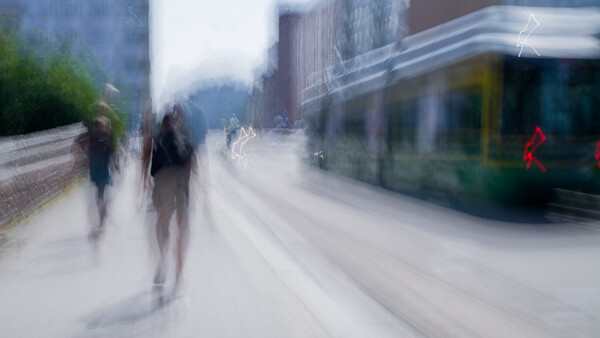
Street photography still speaks about people, encounter, and human communication in the moment. Much of the practice already uses people differently. People become form, scale, color, silhouette, and rhythm inside the frame. Has the photographer begun to use people as compositional material?
Some time ago, I wrote about how street photography is changing under the pressure of searchable faces and traceable images. The argument there was about the conditions of publication: once a face can be indexed, the act of publishing it is no longer the same gesture it used to be. What I want to look at now is what happens inside the frame, before publication, because the same pressure that changes how images circulate also changes how they are made.
There is a shift in contemporary street photography that the genre still describes with the wrong words. The image still speaks in the old language of people, encounter, and the human moment. The practice has moved elsewhere. Increasingly, the person in the frame is no longer the reason the photograph exists. They are the material through which the photograph is organized.
Once proximity becomes risky and the face becomes the most fragile element in the image, the practical response is distance. The photographer keeps shooting, but the relationship to the person changes. The encounter disappears; form remains.
From Encounter to Arrangement
To see the shift clearly, it helps to recall what the person used to be inside the street frame. In the canonical work of the genre — Winogrand, Meyerowitz, Levitt, Gilden — the human figure was the carrier of meaning. A face, a gesture, an exchange of glances was not decoration inside the frame. It was the reason the frame existed.
The street was treated as a place of encounter. The photograph followed that logic. Even without consent, even without awareness, the image was read as something that happened between two presences. The image carried evidence that two presences had briefly crossed.
This idea is still the language of street photography. It is the language used in workshops, captions, artist statements, and interviews. It is the language readers expect when they look at the work. It no longer describes much of what now circulates as street photography.
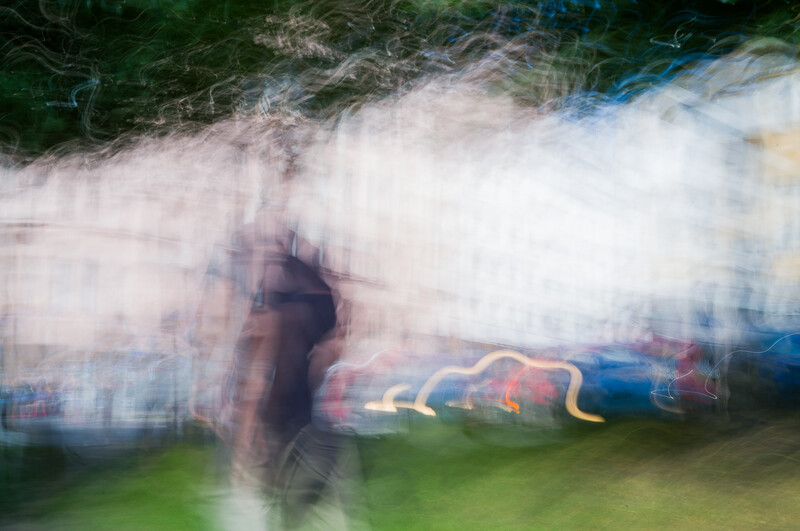
When direct contact carries risk — legal, social, reputational — photographers adjust. Some shoot from behind. Some shoot from above. Some use long focal lengths and stand far away. Some wait for the person to dissolve into motion blur or shadow. Some build images around silhouettes, reflections, or fragments of bodies cropped at the shoulders or knees. These choices often arrive as style, but they begin as adaptation. And they produce a different kind of image.
In this new image, the person is still present, but their function has changed. They are no longer the subject. They are a moving element within a designed surface — a shape moving through light, a color carrier, a unit of scale, a piece of rhythm. In some images, they are closer to a prop than to a presence.
The street is no longer a place of encounter. It functions more like a composition, where bodies pass through structures of line, geometry, and tone. The photograph no longer reads as an encounter. It reads as an arrangement. Some of this work is strong. The problem is not quality. The problem is description. The addition of "fine art" does not change what the image is doing: a different practice continues to operate under the old name.
This is why the shift is easy to miss. People have not disappeared from street photography; they have changed function. The body stays visible, while the person becomes less central to the meaning of the image.
The Mismatch Between Language and Practice
Even when the photographer reduces the person to form, color, silhouette, or scale, publication breaks that reduction. Once published, reverse-image search, facial recognition, contextual data, and location metadata reattach identity to the figure. The photographer sees a shape; the platform sees a profile. The viewer scrolls past both at once and rarely notices the contradiction.
This is the current condition of street photography: the practice moves away from the person, while publication pulls the person back into identification. Street photography is not ending. It is being described with a delay. The work has already changed; the language has not. It is built through the movement of bodies across light, geometry, and tone. Geometry, light, and rhythm were always there. What changed is the description: the genre still names one practice and shows another.
What the genre needs is a more accurate vocabulary. Not "decisive moment," not "the human encounter," not "bearing witness" — at least not by default. Those words still apply to some work. But for much of what now circulates under the name of street photography, a more accurate description would speak about composition, spatial order, and the movement of figures through designed space.
People are still in the frame, but no longer necessarily at the center of meaning. After publication, they enter another center, created by search, recognition, and circulation. The photographer did not choose it and cannot control it.
A person may enter the image as form. Algorithms return them as identity. That is the unease street photography has not yet learned to name.
Join the Fstoppers community for free
-
Post comments and join in the discussions
-
Browse the site ad-free
-
Share your work and get featured in the community
-
Compete in the photo contests for fun and prizes
No comments yet