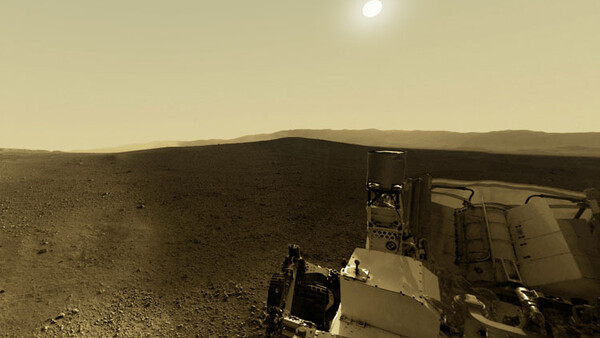
As the Curiosity rover slowly sets up shop on the red planet, we earthlings are getting our first look at never-before seen images of the unexplored landscape around the landing site. A number of panoramic images have been created and are beginning to pop up on the web. While NASA has yet to photograph the beautiful Mt. Sharp, a 3-mile high mountain not far from the landing site and one of the main objectives of the mission, the panoramas that have been put together are still quite impressive.
360pano.eu has put together a panoramic image showing almost all of what we have received from Curiosity. The only caveat here is that they have smoothed over missing pieces and taken artistic liberty to colorize and fill out the entire canvas. Take it with a grain of salt - however, I do think that this is the most impressive display so far.
NASA's panorama, as hosted by the Wall Street Journal, is similarly impressive, although no effort has been made to fill in missing information. While this is the most factual panorama, you don't get the seamless 360-degree view that the 360pano version provides.
While not from the Curiosity rover itself, the Opportunity Rover panorama, located at panoramas.dk, was created in January of 2012. Taken at a location known as Greeley Haven, this panorama gives you a great idea of what we can expect from a full-color Curiosity panorama once the rover is all set up and completes filling in the gaps left by the current images.
I will be sure to give an update when Curiosity has completed a few panoramas of the red planet, until then, enjoy, and check out the fantastic Wikipedia article on the program if you aren't up to speed.




Join the Fstoppers community for free
-
Post comments and join in the discussions
-
Browse the site ad-free
-
Share your work and get featured in the community
-
Compete in the photo contests for fun and prizes
10 Comments
too bad they have to land in such "boring" places. i know they have to because it makes landing easier. but imagine they would land closer to mount olympus or the mars canyons.
It's not to make landing easier, it's to make research easier. The locations are picked because they are of particular scientific interest.
The Gale Crater, where Curiosity landed was chosen because it contains geological information in the form of rock layers that can be more readily studied. It definitely wasn't chosen because it was easier to land; the landing was known as "seven minutes of terror" for a good reason.
Pretty weird, to be this close and yet so far.
mmmmm, could please someone explain where are the pictures taken from??? I rolled all over the image, the curiosity and all the different angles possible, and it seems that the camera is flying??? there is not even a shadow of the camera! they are great pictures but it just gets to my mind: 1.- a huge processing and elimination of the camera´s shadow and stem, or 2: is it really mars???
no it´s not mars it´s tau ceti.....
You can find it on wikipedia: http://en.wikipedia.org/wiki/Curiosity_rover and http://upload.wikimedia.org/wikipedia/commons/3/3f/Drawing-of-the-Mars-…
wait so im not understanding why theirs no camera or shadow in the img...
just to add, the comment is from the link 360pano.eu.
there is no shadow in the 360panu link because the images are simulate to what should be there when the pictures are complete with more information to fill in the gaps of the Wall Street Journal pictures (which are actual pictures that have been released thus far)
thanks for the conversation guys. regards