
If you have spent any time reading about photography, you have encountered the word "stop" used in a way that makes no apparent sense. A lens is "two stops faster." A photo is "one stop underexposed." Image stabilization gives you "five stops of compensation." Somebody on a forum says they "opened up a stop and a half" and everyone nods like that means something.
It does mean something. It means something specific, and once you understand it, you will have the single most useful unit of measurement in all of photography. Stops are the reason the exposure triangle actually works as a system instead of three disconnected settings you have to guess at independently.
A Stop Is a Doubling or Halving of Light
That is the entire definition. One stop more light means twice as much light. One stop less means half as much. Two stops more means four times as much (double it, then double it again). Three stops more means eight times as much.
The scale is logarithmic, which is a word that scares people but should not. All it means is that each step is multiplicative rather than additive. You are not adding a fixed amount of light each time. You are multiplying by two. Going up three stops from any starting point gives you eight times the light, whether you started at a whisper of illumination or a blazing floodlight.
This is the same way your ears perceive sound. The difference between a whisper and normal conversation feels similar to the difference between normal conversation and a shout, even though the second gap involves vastly more acoustic energy. Stops work the same way for light: each one feels like an equivalent perceptual step, even though the physical quantity doubles every time.
Why Photographers Use Stops Instead of Actual Numbers
Aperture is measured in f-numbers. Shutter speed is measured in fractions of a second. ISO is measured in, well, ISO. These three scales use completely different units, and the numbers on each scale do not move at the same rate or in the same direction. Aperture numbers get smaller as you let in more light. Shutter speed numbers get larger. ISO numbers get larger too, but on a different scale entirely.
Without a common unit, adjusting exposure means juggling three unrelated number systems at once. You change your aperture from f/5.6 to f/4 and now you need to figure out how to compensate with shutter speed, but 5.6 and 4 do not relate to fractions of a second in any obvious way.
Stops solve this by translating all three scales into the same language. Going from f/5.6 to f/4 is one stop more light. Going from 1/125 to 1/250 is one stop less light. Going from ISO 400 to ISO 800 is one stop more sensitivity. You do not need to think about the actual numbers on each dial. You just need to know how many stops you moved and in which direction.
This is why photographers talk in stops constantly. It is the universal currency that makes trades between aperture, shutter speed, and ISO intuitive. If you add one stop of light with your aperture, you can subtract one stop with your shutter speed, and the exposure stays identical. The numbers on your dials will be completely different, but the amount of light hitting the sensor will be the same.
The Stop Scale for Each Setting
Each of the three exposure controls has its own sequence of full-stop values. These are worth knowing, not because you need to memorize charts, but because recognizing the pattern makes it second nature to count stops when you adjust settings.
Aperture (full stops): f/1, f/1.4, f/2, f/2.8, f/4, f/5.6, f/8, f/11, f/16, f/22, f/32. Each step to the right halves the light. Each step to the left doubles it. The numbers look irregular because the f-number is a ratio (focal length divided by the diameter of the entrance pupil), and area scales with the square of the diameter. You do not need to understand the math. You just need to know that the sequence above is the full-stop scale, and each step is exactly one stop.
Shutter speed (full stops): 1 second, 1/2, 1/4, 1/8, 1/15, 1/30, 1/60, 1/125, 1/250, 1/500, 1/1,000, 1/2,000, 1/4,000, 1/8,000. Each step to the right halves the light (faster shutter, less time, less light). Each step to the left doubles it. The numbers are cleaner here: each one is roughly half the previous. (Some are rounded for mechanical convenience, which is why 1/15 appears instead of 1/16 and 1/125 instead of 1/128, but the light difference is negligible.)
ISO (full stops): 100, 200, 400, 800, 1,600, 3,200, 6,400, 12,800, 25,600. Each step to the right doubles the sensor's sensitivity, which has the same practical effect as doubling the light (though it comes with increasing noise). Each step to the left halves it.
Most modern cameras also offer third-stop and half-stop increments between these values. When you turn your aperture dial and see f/3.2 or f/3.5 between f/2.8 and f/4, those are third-stop steps. They give you finer control, but the full-stop values above are the skeleton of the system.
How Stops Make the Exposure Triangle Work
The exposure triangle is usually taught as a diagram: aperture, shutter speed, and ISO sitting at three corners, with arrows showing that changing one affects the others. That diagram is correct but unhelpful without stops, because it does not tell you how much to change each setting when you adjust another.
Stops make it mechanical. The rule is: if you change one setting by a certain number of stops in one direction, you can change any other setting by the same number of stops in the opposite direction, and the exposure stays the same.

Say you are shooting at f/5.6, 1/125, ISO 400, and the exposure is correct. You want a shallower depth of field, so you open your aperture to f/2.8. That is two stops more light (f/5.6 to f/4 is one stop, f/4 to f/2.8 is two). To keep the same exposure, you need to remove two stops somewhere else. You could increase your shutter speed by two stops: 1/125 to 1/250 (one stop), 1/250 to 1/500 (two stops). Or you could drop your ISO by two stops: 400 to 200 (one stop), 200 to 100 (two stops). Or you could split the difference: one stop faster shutter speed and one stop lower ISO.
All of these combinations produce the same exposure. The images will look different (different depth of field, different motion rendering, different noise levels), but the brightness will be identical. Stops are what make that equivalence visible and countable.
Where You Will Hear "Stops" Used
Once you know the unit, you will start hearing it everywhere, because photographers use it to describe far more than just exposure settings.
Dynamic range. When a camera review says a sensor has "14 stops of dynamic range," it means the sensor can distinguish brightness levels from the darkest shadow to the brightest highlight across a range where the brightest value is 2^14 (about 16,384) times brighter than the darkest. A camera like the Nikon Z8, known for its excellent dynamic range, gives you more room to recover detail in shadows and highlights during editing than a camera with fewer stops.
Image stabilization. When a lens or camera body is rated for "five stops of stabilization," it means the system can compensate for enough camera shake to let you use a shutter speed five doublings slower than you would normally need. A camera like the Sony a7 IV, rated for 5.5 stops of in-body stabilization, could theoretically let you shoot at 1/8 when your minimum handheld speed at a given focal length would otherwise be 1/250.
Flash power. Strobes and speedlights like the Godox V860III or the Canon Speedlite EL-1 adjust their output in stops. Going from full power to half power is one stop. Half to quarter is another stop. This is why flash power controls feel intuitive once you understand the system: they use the same unit as everything else.
Lens speed. When someone calls a lens "fast," they mean it has a wide maximum aperture that lets in more light. An f/1.4 lens is "one stop faster" than an f/2 lens. That one stop means twice as much light at maximum aperture, which translates to one stop more shutter speed in low light, which can be the difference between a sharp handheld shot and a blurry one. This is why lenses like the Canon RF 50mm f/1.4 L VCM, the Nikon Z 50mm f/1.4, or the Sony FE 50mm f/1.4 GM command a price premium over their f/1.8 counterparts: that extra 2/3 of a stop of light at the widest aperture has real practical value.
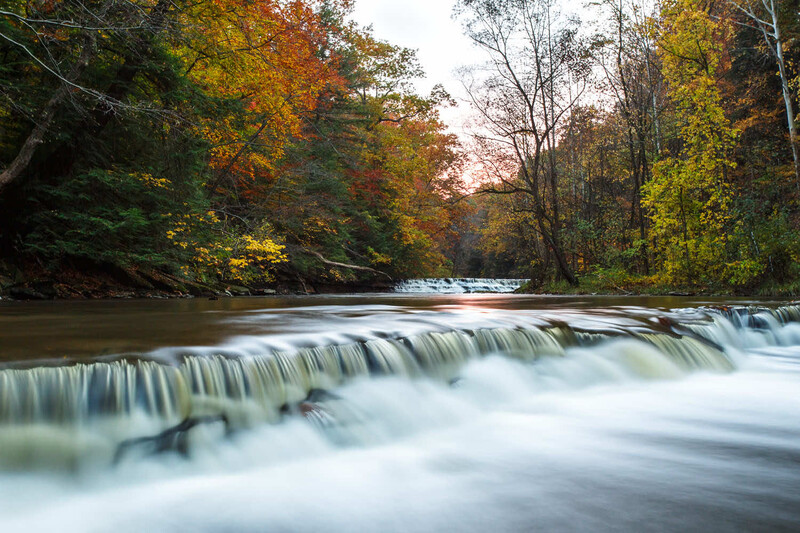
ND filters. Neutral density filters are described by how many stops of light they block. A 3-stop ND filter like the Hoya ProND 8 cuts the light to 1/8 of its original intensity. A 10-stop ND filter like the B+W 110 ND cuts it to roughly 1/1,000. This is how landscape photographers get those long-exposure effects with silky water and streaked clouds in broad daylight: they stack enough stops of ND filtration to bring their shutter speed down to several seconds even under a bright sun.
Why This Makes Everything Easier
Before you internalize stops, every exposure decision feels like a separate problem. You change the aperture and then have to figure out a new shutter speed from scratch, doing mental arithmetic with two unrelated number systems. You look at a photo that is too dark and wonder whether to change the aperture, the shutter speed, or the ISO, and by how much.
After you internalize stops, those same decisions become simple trades. The photo is one stop too dark. You can add one stop anywhere: open the aperture one stop, slow the shutter one stop, or raise the ISO one stop. Pick whichever one has the side effect you want (more blur, shallower depth of field, more noise) or the fewest consequences you do not want.
The word "stop" is not jargon for the sake of jargon. It is a genuine simplification. It takes three different measurement systems that have nothing obvious in common and unifies them into a single, consistent scale where one unit always means the same thing: a doubling or halving of light. That is why photographers will not stop talking about it. It is the single concept that makes the camera's controls feel like one system instead of three.
If you want to build these instincts through structured practice rather than trial and error, the Fstoppers Photography 101 tutorial walks through exposure, aperture, shutter speed, and ISO with the depth to make stops feel like second nature. And if you are ready to see how exposure decisions play out differently across multiple genres of photography, The Well-Rounded Photographer covers eight disciplines with eight instructors, each making the same fundamental trade-offs in different creative contexts.




Join the Fstoppers community for free
-
Post comments and join in the discussions
-
Browse the site ad-free
-
Share your work and get featured in the community
-
Compete in the photo contests for fun and prizes
No comments yet