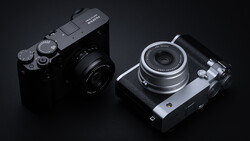
The fixed-lens compact that actually changes how you shoot day to day is under the microscope. If speed and color straight out of camera, you’ll see where the Fujifilm X100VI helps and where it gets in the way.
Coming to you from Teo Crawford, this helpful video looks at the Fujifilm X100VI digital camera in the places you’ll actually use it. You see how the 23mm lens (35mm equivalent) pushes you toward layered scenes and quick framing while the hybrid viewfinder nudges you to shoot more and chimp less. Crawford compares JPEG recipes to personal edits and shows where the in-camera look falls short if you like split toning or precise midtone control. There’s also a useful note on buffer behavior tied to certain recipe settings, which matters when you fire more than a couple of frames in a row.
The test flows through three lighting setups: a wet city loop, a bright morning with tricky dynamic range, and a late outing chasing soft evening color. You watch exposure compensation do most of the work in semi-auto while the optical finder keeps the experience fluid but makes exact exposure harder to judge at capture. That tradeoff is honest and practical, especially if you prefer to shoot fast and decide later whether a frame needs extra polish in raw. Crawford’s verdict on film simulations is measured: good starting points, not a finish line if you’re picky about color separation and tonal contrast.
Key Specs
-
40.2 megapixel APS-C (23.5 x 15.7 mm) CMOS sensor
-
In-body sensor-shift stabilization, 5-axis
-
Fixed 23mm f/2 lens (35mm full frame equivalent)
-
ISO for photos: 125–12,800 native (64–51,200 extended)
-
Internal video up to 6,240 x 3,510 at 23.98–29.97 fps, plus DCI 4K and 4K at up to 59.94 fps, 10-bit options
-
Single SD/SDHC/SDXC card slot
-
Wi-Fi 5 and Bluetooth 4.2
-
Tilting 3" touchscreen LCD and hybrid optical/electronic OLED viewfinder
-
1x NP-W126S battery, approx. 310 shots
-
Body size 5 x 2.9 x 2.2 in, 1.0 lb body only
What pushes this camera forward isn’t a spec bump on paper but how the dials, size, and viewfinder change how you move. You get shutter and ISO under one hand, aperture on the ring, and a finder that can be optical or electronic without breaking rhythm. That mix encourages quick experiments like slow shutter in shutter-priority with a recipe applied, which exposes whether your JPEG look holds up when motion and contrast start fighting.
The video also grounds the hype. Crawford nods to the craze that made earlier X100 models hard to find, then shows why demand happened without pretending the camera is magic. You’ll see where the camera handles exposure gracefully and where high-contrast scenes overexpose by a fraction, plus how a quick tweak or a raw safety net helps you get a keeper.
You also get a helpful reality check on recipes. If you like a warmer base with distinct greens and oranges, lifted midtones, and dense shadows, the camera tools get you partway there, but nuanced split toning and fine contrast often need an edit. That isn’t a flaw, just a sign that JPEG-first suits a certain style while color-obsessed work benefits from JPEG + raw as a default setting. Check out the video above for the full rundown from Crawford.

Join the Fstoppers community for free
-
Post comments and join in the discussions
-
Browse the site ad-free
-
Share your work and get featured in the community
-
Compete in the photo contests for fun and prizes
No comments yet