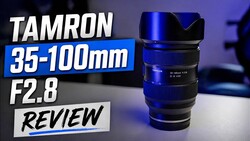
The Tamron 35-100mm f/2.8 is one of those lenses that makes you stop and reconsider what you actually need in a zoom. At $899, it sits in a range most manufacturers ignore entirely, and it does it at a constant f/2.8 aperture that won't break the bank the way a comparable prime kit would.
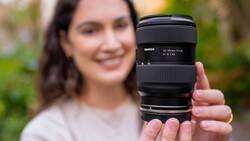
Coming to you from Lee Zavitz, this hands-on video puts the lens through a real portrait shoot with a single Nanlite Forza 60B and a projector attachment to simulate window light. Zavitz shoots wide open throughout, which tells you a lot about how the lens actually performs under real conditions rather than a controlled test chart. Center sharpness is strong at f/2.8, with corners softening slightly, and stopping down to f/4 brings everything into line. There's minimal chromatic aberration even in backlit situations, and the vignetting wide open is mild enough that Zavitz says he actually prefers it for portraits.
The weight difference between this and the Tamron 35-150mm f/2-2.8 is hard to ignore. The 35-150mm comes in at 1,165 grams. The 35-100mm is 565 grams. You're essentially cutting the weight in half, and the price drops significantly too. Zavitz points out that if you're shooting on a Sony a1 II and drop into APS-C crop mode, you can push this lens to an effective 150mm and still pull a 21-megapixel raw file. That's a real-world workaround worth knowing if you're on the fence about missing that extra 50mm of reach.
One of the more interesting features is the wireless customization through the Tamron Lens Utility app, which now works over a wireless dongle instead of requiring a USB cable tethered to a computer. The three-position switch and custom button are configurable directly from your iPhone, and the options go deeper than you might expect, including focus throw adjustment, focus direction, and even a wireless follow focus mode. Zavitz walks through exactly how he has his own unit set up, and it's worth seeing what's possible before you assume this is just a basic zoom. Autofocus uses Tamron's VXD linear motors and handles point-to-point eye tracking well, though burst shooting at 15 fps on the a1 II did produce a few misses during a fast hair-bounce sequence. Focus breathing is also addressed in the video, which matters if you're planning to use this for video work. Check out the video above for the full rundown from Zavitz.



No comments yet