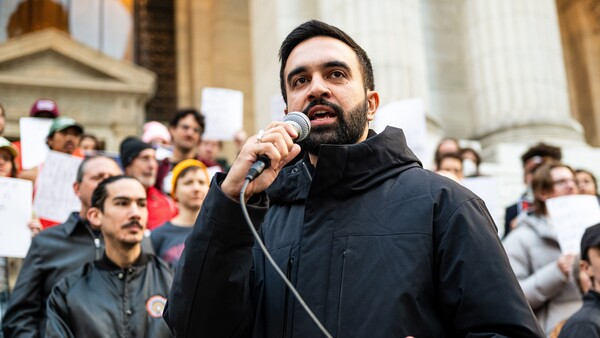
New York City wants landlords and brokers to tell you when the photos in a rental listing have been generated or retouched by AI. It arrived as one of 23 proposals in Mayor Zohran Mamdani's Rental Ripoff Report, and if it becomes a real rule, the people shooting those listings are the ones who will have to draw the line.
The complaint underneath it is one everybody recognizes. You scroll a listing, the room looks bright and generous, and then you turn up in person and it is a dim box with a window facing a brick wall. Photographers have always nudged that gap a little — a wide lens, a good afternoon, a tidy frame. What has changed is that AI does much more than nudge. It can relight a room, delete the radiator, furnish an empty apartment, or put a view outside a window that has never had one. The city's position is not that you cannot do any of it. It is that you have to say you did.
The genuinely hard part is where the line falls, and that is a real question rather than a rhetorical one. Nobody thinks straightening a vertical or fixing the color of a wall is fraud; that is just competent real estate photography, and it has been the job for decades. Somewhere between correcting the white balance and adding a sofa the picture stops describing the apartment, and a disclosure rule only works if it can say where that happens. This report does not answer it.
Nothing here is binding yet. The report came out of five borough hearings where more than 2,400 New Yorkers testified, and the city describes the work on a roughly three-year timeline, so this is a statement of intent rather than a rule anyone gets fined under next week. It still matters, because rules that start in the largest rental market in the country rarely stay there — and it will be real estate photographers, not landlords, who end up deciding in practice what counts as altered.
Lead image: Zohran Mamdani in 2024, photo by Bingjiefu He, CC BY-SA 4.0, via Wikimedia Commons.
Sources: PetaPixel, 6sqft, and the NYC Mayor's Office.






Join the Fstoppers community for free
-
Post comments and join in the discussions
-
Browse the site ad-free
-
Share your work and get featured in the community
-
Compete in the photo contests for fun and prizes
6 Comments
Following in California's footsteps. Surprised you didn't note CA's AB 723 law.
Probably every law regulating business behavior originated out of some real problem that needed to be addressed in behalf of the consumer. If left alone, there is no doubt corporations would continue to lie, cheat and deceive for their own advantage. New York apparently passed a law requiring corporations to make it as easy to cancel an online subscription as to sign up for one. Good for them... I think. Canceling stuff like that can be a nightmare. But why did we have to get to that stage requiring a law that should have been unnecessary with a little common sense? After all, virtually every small business complains that the weight of complying with government regulations is suffocating, including a huge tangible cost of compliance which raises prices.
But every day there's discussion of a new law. This one about AI in real estate advertising just seems like wandering into a lion's den. It was already illegal, I think, if not unethical for misrepresenting a property by removing tangible objects that really exist in a property from a picture... power lines and such. Every last realtor I ever designed a brochure told me not to remove physical objects by means of image editing that were fixed to the home or land. Changing a few clouds was okay, removing a loose trash can from the driveway was okay, but changing the structure of the house was never okay. AI has become the foundation of post-processing for most commercial photographers, so it's hard to image how this proposed law would do anything more than further bury small business in regulations and subsequent lawsuits.
I ran a business for 30 years, Complying with the laws pertaining to my business activities wasn't unduly difficult, expensive, or time consuming. We pay legislators to make law. Lots of laws? Behind each one is usually someone who got hurt/used/cheated. I appreciate the protections our laws provide — even if there are a lot of them.
What sort of business did you operate, John? There are some which are more affected by regulations than others. I worked 40+ years as a commercial printing broker, so while the paperwork to operate my own business was not terribly burdensome, many of my customers for whom I designed their business forms and marketing collateral faced a much different regulatory environment. Small independent banks, restaurants, home builders, energy companies (oil and natural gas), and others spoke constantly of the burden of complying with rules and regulations. Even the printing manufacturers themselves who I worked with complained about excessive environmental and safety compliance rules and regulations.
It’s become a highly contentious issue here in my state of Colorado. The Colorado Chamber of Commerce did some research recently and found over 205,000 state business regulations, ranking Colorado as the 6th highest regulated state in the country. How many business owners take their company and jobs somewhere else because of that, like to Texas? I agree with you that each law evolved out of a need for consumer protection. But the flip side of the argument is that regulations and affordability are linked hand-in-hand. At about $600,000, the median price for a home here in Colorado ranks in the top six highest in the nation. Homebuilders are constantly complaining about regulations, some of whom claim over $100,000 of the cost of building a home goes into regulation. I don’t verify or analyze those numbers… I’m merely citing what the industry claims and cited by newspapers.
Even if you’re not one of those highly impacted industries, take a look at the one bureaucracy that affects everyone. Consider the fact that the first income tax form in 1914 was a total of four pages, one of which was instructions. The tax in 1914 was a simple graduated rate from 1% on earnings from $3,000 to $20,000, to an upper limit of 6% on earnings over a half-million dollars. The IRS tax code today is comprised of about 7,000 pages, plus more than 60,000 pages of regulations and rulings. I’ve read estimates that put the cost of compliance at over $500 billion nationally… not actual taxes paid, but cost of filling out forms. That is absurd. I’m sure every one of those pages seemed like a good idea and initially solved some sort of problem, but those legislators whom we pay a handsome salary and benefits have made a colossal mess out of the government revenue and compliance system. And in the meantime, they can’t solve the larger problems of environment, healthcare, gun violence, and a Social Security system going broke. It all sincerely makes me question the integrity of legislators, and the new laws they're trying to pass every day.
So while I agree that laws are needed to protect humans from each other’s worse impulses, I disagree that regulating AI in advertising is going to accomplish anything more than just adding another layer of paperwork and litigation. Deception in advertising has always existed, long before Photoshop and AI made it so easy. I learned that firsthand as a kid in the 1960s. I remember one such time vividly… my dad had decided the Key Biscayne Hotel in Florida where we had stayed previously had become too expensive, so after looking at lots of brochures, booked a Christmas stay at another hotel in Miami. The pictures showed gorgeous views from the rooms and happy vacationers lounging on the beach. However, when we arrived, the view from the room was of the back alley of a restaurant, and the beach was across the other side of Collins Avenue. Being Christmas, the place was full so the hotel could not change rooms. Dad could make do with about anything that provided a TV, newspaper and golf course in the vicinity. Mom was livid, and determined not to spend one night in that hotel. It was one of those moments between your mom and dad that you never forget. After a short but heated argument, we landed at the Key Biscayne. It cost dad about a hundred bucks a night, but probably saved himself having to sleep on the floor for a week.
My point is that if realtors want to deceive a buyer regarding a listed property, it could be done just as easily without AI. After this law passes, another whole set of regulations will be required to determine what level of AI was indeed applied to a picture. In reality, I suspect that everything in the future will be created in whole or in part by AI, leading to more revised rules and regulations.
The problem being , that laws are never created due to people acting in an ethical manner , its always the opposite . If a law is needed for people to act in an ethical manner, don't blame the law , blame the people who acted in a manner that made the law necessary . Historically, people play a significant role in ruining things for themselves
My grandfather arrived in New York in 1910 from eastern Europe. As best I can tell, he was living on East 7th Street in Manhattan, a mere few blocks from the Triangle Shirtwaist Factory Fire that claimed the lives of 146 people in 1911. Without safety laws in place, doors to the stairwells and exits were locked, and there were no sprinklers in the building. I’m sure that event was a major factor leading to legislation of building codes and growth of labor unions. Too bad it took a disaster to force changes upon owners. A lot of things that government and labor unions did in 1911 made sense, and I don't disagree with you, but I question how many of the new laws being proposed today are of any help. Besides, we have a law defining nearly every criminal activity imaginable... enforcement is the problem.