Sony's problem, if you can call it that, is abundance. E-mount has been open to third parties longer than any other mirrorless system, and the result is a catalog so deep that two photographers shooting the same subject can arrive at completely different, completely defensible kits. A wedding shooter can spend the price of a used car on G Master glass or build a full frame kit from Sigma, Tamron, and Viltrox for less than one GM zoom costs. Both approaches work. That is the luxury and the trap.
Three things decide where you land. The first is autofocus, because Sony bodies are only as fast as the motors in front of them, and this is where the gap between a G Master and a budget prime is still real. The second is weight, which sounds like a soft consideration until you have shot a ten-hour wedding with a 24-70mm on the front of an a7 IV. The third is honesty about what you actually shoot, because the lens that transforms a portrait photographer is dead weight to a landscape shooter.
The picks below are spread deliberately: native Sony where nothing else touches it, third-party where the value gap is too large to ignore. Every spec was checked against current manufacturer and retailer sources at the time of writing, and every pick gets its real weakness stated rather than buried.
At a Glance
- Best Overall: Sony FE 24-70mm f/2.8 GM II
- Best Standard Zoom Value: Tamron 28-75mm f/2.8 Di III VXD G2
- Best Portrait Lens: Sony FE 85mm f/1.4 GM II
- Best Wide Angle and Landscape Lens: Sony FE 16-35mm f/2.8 GM II
- Best Telephoto Zoom: Sony FE 70-200mm f/2.8 GM OSS II
- Best Budget Prime: Viltrox AF 50mm f/2.0 Air
- Best Third-Party Value: Viltrox AF 135mm f/1.8 LAB
- Best Macro Lens: Sony FE 100mm f/2.8 Macro GM OSS
- Best APS-C Zoom: Sigma 18-50mm f/2.8 DC DN Contemporary
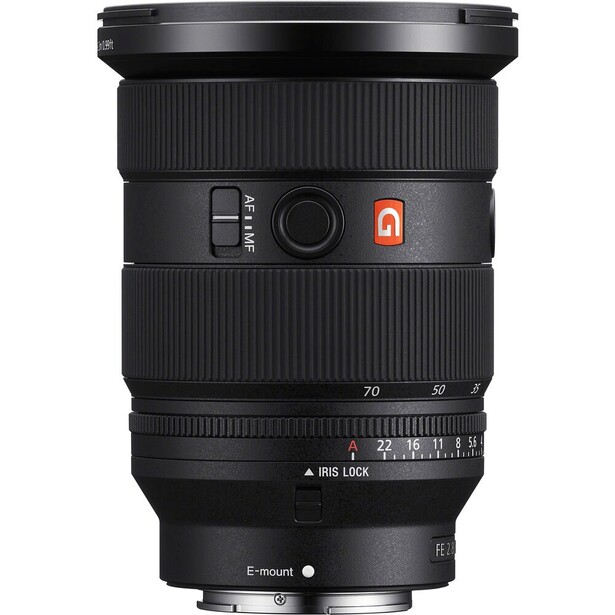
Best Overall: Sony FE 24-70mm f/2.8 GM II
- Format: full frame
- Aperture: f/2.8 to f/22
- Optical design: 20 elements in 15 groups
- Aperture blades: 11, circular
- Minimum focus distance: 0.21 m at 24mm, 0.30 m at 70mm
- Maximum magnification: 0.32x
- Filter thread: 82 mm
- Stabilization: none (relies on in-body stabilization)
- Weight: 695 g
- Price: $2,448 (B&H)
If you could own exactly one lens on this mount, the FE 24-70mm f/2.8 GM II is the one that would let you keep working. It covers the range most paid photography lives in, from a full-length environmental portrait at 24mm to a tight head-and-shoulders at 70mm, with an optical performance that no longer asks you to accept a zoom compromise. Four XD linear motors drive the focus group, which is why it tracks a moving subject on an a7 V or a1 II without the small hesitations that used to separate zooms from primes.
The number that matters most is 695 g. That is lighter than most rivals in this class and roughly 20% below the original 24-70mm GM, and you feel it in the way the lens sits on a smaller body like an a7C II rather than dragging the front down. Close focus of 0.21 m at the wide end is the underrated part of the design: you can get near enough to a plate, a ring, or a detail shot to fill the frame at 0.32x magnification, which quietly removes a lens swap at events. The de-clickable aperture ring and iris lock matter too, once you are shooting video and want silent aperture pulls.
The honest problem is price. This is one of the most expensive standard zooms Sony sells, and for a lot of photographers the difference between it and the Tamron below is better spent on a second body or a light kit. If you shoot professionally, that premium buys a lens that will outlast two camera bodies. If you shoot for yourself on weekends, it is more lens than your work needs. Check the current price of the Sony FE 24-70mm f/2.8 GM II at B&H.
Also consider the Sony FE 28-70mm f/2 GM if you want a full stop more light and will accept the extra bulk and the loss of 24mm at the wide end.
What We Like
- Prime-level sharpness across the whole zoom range
- 695 g, light enough to balance on compact a7C bodies
- 0.32x close focus covers detail shots without a lens change
- Fast, quiet XD linear motors that keep up with Sony's best tracking
What Could Be Better
- Among the priciest standard zooms on the mount
- No optical stabilization
- 82 mm filters are expensive to duplicate across a kit
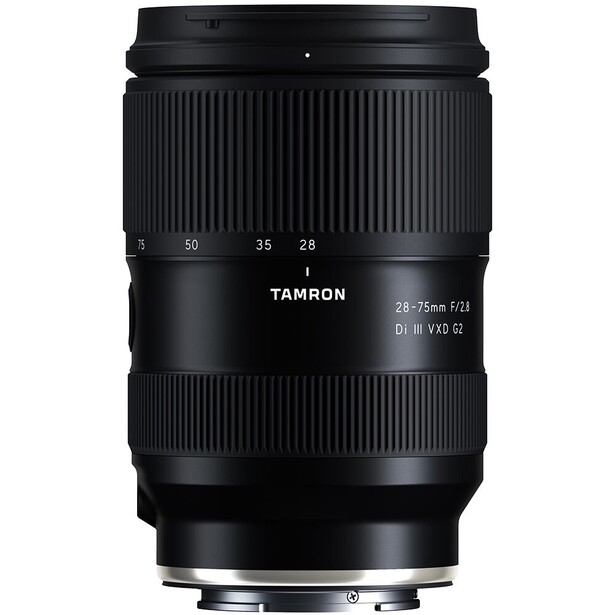
Best Standard Zoom Value: Tamron 28-75mm f/2.8 Di III VXD G2
- Format: full frame
- Aperture: f/2.8 to f/22
- Optical design: 17 elements in 15 groups
- Aperture blades: 9, circular
- Minimum focus distance: 0.18 m at 28mm, 0.38 m at 75mm
- Maximum magnification: 0.37x (1:2.7) at 28mm
- Filter thread: 67 mm
- Stabilization: none (relies on in-body stabilization)
- Weight: 540 g
- Price: $699 (B&H)
The Tamron 28-75mm f/2.8 Di III VXD G2 is the lens that quietly ended the argument about whether you really need a G Master zoom at all. At 540 g it is lighter than the GM II, it takes cheap 67 mm filters shared with the rest of Tamron's E-mount line, and its VXD linear motor is quick enough that autofocus is no longer the giveaway. The optics are good rather than merely acceptable, with contrast wide open that holds up in a side-by-side until you start pixel-peeping corners.
What you give up is spelled out in the name. It starts at 28mm, not 24mm, and on a full frame body that is a meaningful loss for interiors, tight rooms, and anything architectural. The 0.18 m close focus at the wide end partially compensates, letting you push in for near-macro detail work at a 1:2.7 reproduction ratio. Tamron's Lens Utility software also lets you remap the custom switch and focus ring behavior over the lens' USB-C port, which video shooters use to set a linear manual focus throw.
This is the lens we would hand to a photographer buying their first serious zoom, and to plenty of working photographers who would rather put the savings into lighting. Its weakness is corner performance at 28mm wide open, where the GM II is visibly cleaner, and the nine-blade aperture renders busier bokeh in cluttered backgrounds. Neither shows up in a portrait or a reception photo. Both show up in a landscape at f/2.8, which is not what this lens is for. Check the current price of the Tamron 28-75mm f/2.8 Di III VXD G2 at B&H.
Also consider the Sigma 28-70mm f/2.8 DG DN Contemporary if you want the same idea in an even smaller package.
What We Like
- Around half the price of the GM II with most of the performance
- 540 g and 67 mm filters keep the whole kit cheap and light
- Near-macro 0.18 m close focus at the wide end
- USB-C port and Lens Utility customization
What Could Be Better
- Starts at 28mm, a real loss for interiors and architecture
- Corners at 28mm and f/2.8 trail the G Master
- Nine-blade aperture renders busier bokeh in cluttered scenes
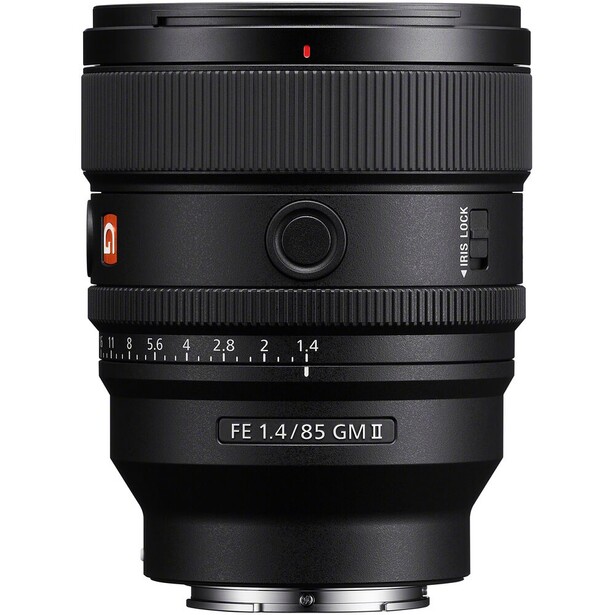
Best Portrait Lens: Sony FE 85mm f/1.4 GM II
- Format: full frame
- Aperture: f/1.4 to f/16
- Optical design: 14 elements in 11 groups
- Aperture blades: 11, circular
- Minimum focus distance: 0.85 m in autofocus, 0.8 m in manual focus
- Maximum magnification: 0.11x in autofocus
- Filter thread: 77 mm
- Stabilization: none (relies on in-body stabilization)
- Weight: 642 g
- Price: $1,948 (B&H)
Portrait lenses get judged on bokeh, and the 85mm f/1.4 GM II earns its reputation there, but the more interesting story is the weight. Sony cut roughly 20% off the original, down to 642 g, which is what turns an 85mm from a lens you bring for a scheduled session into one you keep on the camera for a whole wedding day. Two XA elements and two ED elements keep longitudinal chromatic aberration under control, so the green and magenta fringing that plagued fast 85mm lenses for years is essentially gone from the specular highlights behind your subject.
Sony rates autofocus at roughly three times faster than the original, with about seven times better tracking. That is fast enough to hold an eye at f/1.4 on a subject walking toward the camera, which the first-generation lens could not reliably do. The 11-blade aperture keeps out-of-focus highlights round rather than polygonal when you stop down to f/2 or f/2.8, which is where most portrait photographers actually shoot.
The weakness is close focus. At 0.85 m in autofocus you cannot get in tight for a beauty-style crop without cropping in post, and photographers coming from a 90mm macro will notice it immediately. The lens also does nothing at the wide end of a portrait session, so it works best as half of a two-lens kit. If you want one lens that flatters faces and separates them from a background with almost no effort, this is it, and our portrait lens guide covers the cross-mount alternatives. Check the current price of the Sony FE 85mm f/1.4 GM II at B&H.
Also consider the Sony FE 85mm f/1.8 if you want most of the look for a fraction of the money and can live with slower autofocus.
Read our full review of the Sony FE 85mm f/1.4 GM II.
What We Like
- 642 g makes an f/1.4 85mm genuinely carryable all day
- Longitudinal chromatic aberration is essentially eliminated
- Eleven-blade aperture keeps highlights round when stopped down
- Autofocus that holds an eye at f/1.4 on a moving subject
What Could Be Better
- 0.85 m minimum focus is limiting for tight beauty crops
- Expensive next to the excellent FE 85mm f/1.8
- Single-purpose focal length in a working kit
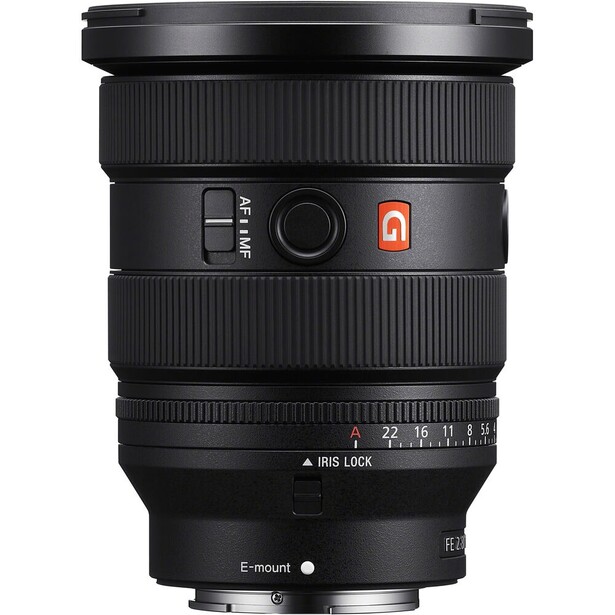
Best Wide Angle and Landscape Lens: Sony FE 16-35mm f/2.8 GM II
- Format: full frame
- Aperture: f/2.8 to f/22
- Optical design: 15 elements in 12 groups
- Aperture blades: 11, circular
- Minimum focus distance: 0.22 m
- Maximum magnification: 0.32x
- Filter thread: 82 mm
- Stabilization: none (relies on in-body stabilization)
- Weight: 547 g
- Price: $2,598 (B&H)
Landscape photographers spend a lot of energy arguing about primes, and then most of them buy a 16-35mm anyway, because a shoreline does not wait while you swap glass. Sony's FE 16-35mm f/2.8 GM II weighs 547 g, roughly a fifth less than the lens it replaced, and it is the one that lives on the camera for a sunrise hike. It accepts standard 82 mm screw-in filters, so a polarizer and a neutral density set go straight on without a bracket system.
The optical improvement over the first GM is concentrated exactly where landscape shooters look, which is the extreme corners at 16mm. Sharpness there is high enough that you can shoot at f/5.6 rather than stopping down to f/11 and fighting diffraction. Close focus of 0.22 m and 0.32x magnification let you plant the front element inches from a foreground rock or a bed of flowers, which is the most useful trick in wide angle landscape work.
Two caveats. Coma at 16mm and f/2.8 is well controlled but not perfect, so dedicated astrophotographers will still prefer a fast prime for stars in the corners of the frame. And you are paying a premium for a maximum aperture most landscape work never uses, since the majority of these frames are shot between f/8 and f/11 on a tripod. If you only shoot landscapes in daylight, a slower and cheaper wide zoom will produce identical files. If you also shoot interiors, events, and the occasional aurora, the constant f/2.8 earns its keep. Check the current price of the Sony FE 16-35mm f/2.8 GM II at B&H.
Also consider the Sony FE 16mm f/1.8 G if your wide work is mostly night skies and you want the extra stops.
Read our full review of the Sony FE 16-35mm f/2.8 GM II.
What We Like
- Corner sharpness at 16mm that holds up wide open
- 547 g, down from 680 g for the first-generation GM
- Takes normal 82 mm screw-in filters, no bracket needed
- 0.22 m close focus for dramatic foregrounds
What Could Be Better
- Coma at 16mm and f/2.8 still trails a dedicated astro prime
- You pay for an f/2.8 aperture most landscape work never uses
- The FE PZ 16-35mm f/4 G covers the same range for much less
Best Telephoto Zoom: Sony FE 70-200mm f/2.8 GM OSS II
- Format: full frame
- Aperture: f/2.8 to f/22
- Optical design: 17 elements in 14 groups
- Aperture blades: 11, circular
- Minimum focus distance: 0.40 m at 70mm, 0.82 m at 200mm
- Maximum magnification: 0.30x
- Filter thread: 77 mm
- Stabilization: Optical SteadyShot, three modes
- Weight: 1,045 g
- Price: $3,098 (B&H)
Every system has a 70-200mm f/2.8, and most of them ask you to hold a kilo and a half at eye level in the fourth hour of a ceremony. Sony's second-generation 70-200mm GM OSS II weighs 1,045 g, down from 1,480 g for the lens it replaced. The weight came out of the focus groups, which is why it also focuses faster: four XD linear motors move much less glass than the ring motors in the original, and the lens keeps pace with the 30 fps burst on an a1 II.
The optical highlight is close focus. At 0.40 m and 0.30x at the wide end, this zoom does detail work that used to require a separate lens: rings, invitations, and cake details without ever taking the 70-200mm off the body. Optical SteadyShot offers three modes, including a panning mode that ignores horizontal motion, and it works alongside a body's in-body stabilization rather than replacing it.
The limitation is the one every f/2.8 telephoto zoom shares: it is big, it is heavy, and it announces you. For a documentary shooter trying to be invisible, that is a real cost, and Sony's own FE 70-200mm f/4 Macro G OSS II is the sensible alternative. If you shoot events, sports, or portraits at distance for money, this is the lens the job is built around. Check the current price of the Sony FE 70-200mm f/2.8 GM OSS II at B&H.
Also consider the Sony FE 50-150mm f/2 GM if you want a full stop more light and can carry 1,340 g. For wildlife and sports, where 200mm runs out fast, the Sony FE 400-800mm f/6.3-8 G OSS reaches 800mm natively (1,600mm with a 2x teleconverter) at 2,475 g, and the lighter Sony FE 200-600mm f/5.6-6.3 G OSS is the cheaper way into that range.
Read our full review of the Sony FE 70-200mm f/2.8 GM OSS II.
What We Like
- 1,045 g, roughly 30% lighter than the first-generation GM
- 0.30x close focus makes it a genuine detail lens
- Internal zoom keeps balance constant on a gimbal
- Optical SteadyShot with a dedicated panning mode
What Could Be Better
- Still large and conspicuous for candid work
- Internal zoom means it never gets shorter for packing
- The f/4 Macro G OSS II covers most of the same jobs for far less
Best Budget Prime: Viltrox AF 50mm f/2.0 Air
- Format: full frame
- Aperture: f/2.0 to f/16
- Optical design: 13 elements in 9 groups
- Aperture blades: 9, circular
- Minimum focus distance: 0.51 m
- Maximum magnification: 0.11x
- Filter thread: 58 mm
- Stabilization: none (relies on in-body stabilization)
- Weight: 205 g
- Price: $199 (B&H)
Sony's own cheap 50mm has been a punchline for a decade, which left a hole that Viltrox walked straight into. The AF 50mm f/2.0 Air weighs 205 g and measures 56.5 mm long, so on an a7C II or an a7 IV it turns the camera back into something you will actually carry. Thirteen elements in nine groups, three of them ED, deliver center sharpness that our reviewer called excellent wide open and better still by f/2.8, and the stepping motor locked focus quickly and quietly in continuous autofocus and face tracking.
Buying this lens is an exercise in knowing what you are giving up. It is f/2, not f/1.4, so the background separation is good rather than spectacular. Flare is the real weakness we found: put a strong light source just outside the frame and ghosting and veiling flare show up quickly. The build is high-grade plastic on an aluminum mount, not the sealed brick of a G Master, and the 0.51 m minimum focus distance keeps you further from small details than you will sometimes want. There is no aperture ring, no focus hold button, no weather-sealing gasket you would trust in real rain. What you get instead is a sharp full frame prime for less than the cost of a decent camera bag.
That is the argument for it, and it is a strong one for anyone who has just bought a full frame body and discovered the kit zoom is the boring part of the kit. A fast, small 50mm remains the quickest way to learn light and distance, a point we make in our beginner camera guide too. Check the current price of the Viltrox AF 50mm f/2.0 Air at B&H.
Also consider the Viltrox AF 40mm f/2.5 Air at 167 g if you prefer a slightly wider everyday focal length.
Read our full review: We Review the Viltrox AF 50mm f/2.0 Air Lens for Sony FE Mount
What We Like
- 205 g and 56.5 mm long, effectively weightless on the camera
- Excellent center sharpness wide open, with minimal smearing at the edges
- Quiet, reliable stepping-motor focus that holds up in continuous AF and face tracking
- Costs less than a good filter for a G Master
What Could Be Better
- f/2 rather than f/1.4, so less background separation
- Ghosting and veiling flare are obvious with strong side lighting
- 0.51 m minimum focus distance limits close-up work
- No aperture ring, no focus hold button, no serious weather-sealing
Best Third-Party Value: Viltrox AF 135mm f/1.8 LAB
- Format: full frame
- Aperture: f/1.8 to f/16
- Optical design: 14 elements in 9 groups
- Aperture blades: 11, circular
- Minimum focus distance: 0.72 m
- Maximum magnification: 0.25x
- Filter thread: 82 mm
- Stabilization: none (relies on in-body stabilization)
- Weight: 1,235 g
- Price: $899 (B&H)
Viltrox spent years making cheap lenses that punched above their price. The LAB line is the company deciding to stop punching up and swing level, and the AF 135mm f/1.8 LAB is the clearest evidence: a metal barrel, weather-resistant construction, dual custom buttons, a multi-function ring, and an 11-blade aperture, at a price that undercuts Sony's own 135mm f/1.8 GM by a margin impossible to shrug off.
What a 135mm f/1.8 does that an 85mm cannot is compress. Shoot a subject at f/1.8 with a treeline 30 m behind them, and the background dissolves into a wash of color while the subject stays cut out and three-dimensional. When we reviewed the LAB (on the Z-mount version, which shares its optical design), we found sharpness virtually faultless, with corners holding up even at f/1.8, and bokeh from the 11-blade aperture rendering smooth, circular highlights between f/1.8 and f/2.8. Eye tracking held on in low light and backlight and against fast-moving subjects, matching what our reviewer got out of first-party glass. Close focus of 0.72 m and 0.25x magnification also makes it a capable detail lens for products and still life.
It is heavy. At 1,235 g it weighs nearly twice what the 85mm GM II does, and it takes 82 mm filters, so this is not a lens you carry on the off chance. The focal length is demanding too: at 135mm you need distance from your subject, which rules it out for tight studios and cramped venues. Firmware is the other irritation: updating the lens means going through Viltrox's phone or desktop app rather than a simple download, which our reviewer found needlessly fiddly, and third-party lenses on Sony bodies remain one autofocus update away from needing a patch. For portrait and editorial shooters who work outdoors and want maximum subject separation for the money, nothing on this mount is a better deal. Check the current price of the Viltrox AF 135mm f/1.8 LAB at B&H.
Also consider the Sony FE 135mm f/1.8 GM if you need first-party firmware certainty and a lighter body.
Read our full review: The Viltrox AF 135mm f/1.8 LAB Z Mount: Better Than Nikon's 135mm?
What We Like
- Sharpness we found virtually faultless, corners included, from f/1.8
- Smooth, circular bokeh from the 11-blade aperture at wide apertures
- Metal build, weather resistance, and real professional controls
- 0.25x close focus doubles it as a product lens
- Eye tracking that held up in low light, backlight, and on moving subjects
What Could Be Better
- 1,235 g is a commitment to carry
- 135mm needs working distance most studios do not have
- Firmware updates run through Viltrox's app rather than a simple download
- Third-party autofocus depends on Viltrox firmware keeping pace with Sony
Best Macro Lens: Sony FE 100mm f/2.8 Macro GM OSS
- Format: full frame
- Aperture: f/2.8 to f/22
- Optical design: 17 elements in 13 groups
- Aperture blades: 11, circular
- Minimum focus distance: 0.26 m
- Maximum magnification: 1.4x, up to 2.8x with a 2x teleconverter
- Filter thread: 67 mm
- Stabilization: Optical SteadyShot with angle, shift, and depth compensation
- Weight: 646 g
- Price: $1,698 (B&H)
Sony's old 90mm macro was a fine lens with slow, hunting autofocus, and it held that slot far longer than it should have. The FE 100mm f/2.8 Macro GM OSS, announced in September 2025, replaces it with something more ambitious. It focuses to 1.4x magnification on its own, beyond life size without accessories, and reaches 2.8x with Sony's 2x teleconverter.
Four XD linear motors drive the focus, and Sony rates the autofocus at about 1.9 times faster than the 90mm, which is the most consequential upgrade for anyone who has tried to focus on an insect that will not sit still. The stabilization is the other one: it compensates for angular shake, shift shake, and front-to-back movement, the last of which is what ruins handheld macro frames when your body sways a millimeter and blows the focus plane. A dedicated aperture ring, focus range limiter, and full-time direct manual focus round out a lens designed for people who shoot macro seriously rather than occasionally.
The catch is that it is a G Master, priced accordingly, and macro is a genre a lot of people only dabble in. At 646 g and 148 mm long it is a real lens to carry, and its 0.26 m minimum focus distance means you work close enough that lighting, not optics, becomes the hard problem. If you are chasing insects and flowers seriously, Fstoppers' Mastering Macro Photography tutorial will do more for your results than any further spec on this page. Check the current price of the Sony FE 100mm f/2.8 Macro GM OSS at B&H.
Also consider the Sigma 105mm f/2.8 DG DN Macro Art if 1:1 magnification is enough and you would rather spend the difference on lighting.
What We Like
- 1.4x magnification with no accessories, 2.8x with a teleconverter
- Autofocus roughly 1.9 times faster than the 90mm it replaces
- Stabilization that compensates for front-to-back sway
- Doubles as an excellent 100mm portrait lens
What Could Be Better
- G Master pricing for a genre many people shoot occasionally
- 646 g and 148 mm long is a lot of lens in the bag
- Working distance at maximum magnification makes lighting difficult
Best APS-C Zoom: Sigma 18-50mm f/2.8 DC DN Contemporary
- Format: APS-C (27-75mm equivalent)
- Aperture: f/2.8 to f/22
- Optical design: 13 elements in 10 groups
- Aperture blades: 7, rounded
- Minimum focus distance: 12.1 cm at 18mm, 30 cm at 50mm
- Maximum magnification: 0.36x (1:2.8) at 18mm
- Filter thread: 55 mm
- Stabilization: none (relies on in-body stabilization)
- Weight: 290 g
- Price: $599 (B&H)
Crop-sensor Sony shooters get treated as an afterthought by Sony itself, and Sigma noticed. The 18-50mm f/2.8 DC DN Contemporary is the reason an a6700 or a ZV-E10 II is a serious camera rather than a starter one. It gives you a constant f/2.8 across a 27-75mm equivalent range in a 290 g package smaller than most kit zooms, and it makes the bundled 16-50mm look like the cost-cutting exercise it is.
The size is the point. At 61.6 mm in diameter and 76.5 mm long, it does not unbalance a small body, and it takes 55 mm filters that cost almost nothing. Close focus of 12.1 cm at the wide end covers food, product, and detail work at a 1:2.8 reproduction ratio, which is much of what a small-business or content-creation kit is asked to do.
The compromises are honest ones. A seven-blade aperture is fewer than most of the lenses above, so out-of-focus points of light go slightly angular when you stop down. There is no weather-sealing beyond a mount gasket, no optical stabilization, and no focus hold button. None of that matters if you have been shooting a kit lens and wondering why your photos look flat: this is the single upgrade that changes them. Check the current price of the Sigma 18-50mm f/2.8 DC DN Contemporary at B&H.
Also consider the Sony E 16-55mm f/2.8 G if you want the wider 16mm end and Sony's own weather-sealing.
What We Like
- Constant f/2.8 in a 290 g body that fits a small camera
- Sharper than any kit zoom on the mount
- 12.1 cm close focus at 18mm for product and food work
- Cheap 55 mm filters
What Could Be Better
- Seven-blade aperture renders less pleasing stopped-down highlights
- No weather-sealing beyond the mount gasket
- 50mm at the long end runs out of reach quickly
How to Choose a Sony E-Mount Lens
Start by counting the lenses you will actually own. If the answer is one or two, buy zooms, because a 24-70mm and a 70-200mm will cover 90% of what most photographers shoot, and no prime is worth missing the frame you could not reach. If the answer is five or six, primes start to earn their place, because you can afford to carry the right one and leave the rest at home. Most people get this backwards, buying a fast prime first and then discovering they cannot shoot half of what they want to.
Next, decide whether you need Sony's autofocus certainty. The gap between third-party and native autofocus has narrowed to almost nothing for static and moderately moving subjects, and the Tamron and Viltrox picks above will not cost you keepers at a portrait session. It reopens in two places: burst shooting at 20 fps or more, where native XD linear motors still track more reliably, and firmware, where a Sony body update can occasionally break a third-party lens until the manufacturer patches it. If a missed sequence is a refunded invoice, that certainty is worth paying for. If you shoot landscapes, portraits, or products, it is not.
The spec that matters more than people think is weight, because the lens you leave at home has a resolution of zero. The 20% weight reductions in the second-generation 24-70mm, 16-35mm, and 85mm G Masters are not marketing trivia. They are the difference between carrying a professional kit and carrying half of one. The spec that matters less than people think is maximum aperture. An f/1.4 prime is two-thirds of a stop faster than an f/1.8, a gap modern sensors close for you at higher ISO, and you will spend most of your time at f/2 anyway because f/1.4 puts one eye in focus and the other out.
Filter threads are the last hidden tax. A kit built around 82 mm G Master zooms means an expensive polarizer, an expensive neutral density set, and no sharing with anything smaller. A kit built around Tamron's 67 mm standard means one set of filters for everything. Nobody thinks about it until the third circular polarizer.
What We're Looking For
We weight optical performance where it shows up in real photographs (center sharpness wide open, corner performance at the apertures the lens is actually used at, and how it renders out-of-focus areas), autofocus speed and reliability on current Sony bodies, weight and size relative to the job, and price against the alternatives on the same mount. Every specification here was verified against current manufacturer and retailer sources at the time of writing, and every pick was confirmed to be shipping and not superseded. Where a lens has been through a full hands-on Fstoppers review, that review informs the entry. Where it has not, the entry is written from verified specifications and documented design, and we describe it in those terms rather than implying testing we have not done.
Frequently Asked Questions
Are Third-Party Lenses as Good as Sony's G Master Lenses?
For most photography, yes. Sigma, Tamron, and Viltrox now build E-mount lenses with linear autofocus motors and optics that match Sony's in the center of the frame, often at half the price. Sony still leads in extreme corner performance, tracking at very high burst rates, and firmware reliability, which is why sports and wedding professionals still pay the premium.
What Is the Best First Lens for a Sony Full Frame Camera?
A 28-75mm or 24-70mm f/2.8 zoom, then a cheap fast prime. The zoom teaches you which focal lengths you actually use, and the prime teaches you what a large aperture does. The Tamron 28-75mm f/2.8 Di III VXD G2 and the Viltrox AF 50mm f/2.0 Air together cost less than most single G Master lenses.
Do I Need f/2.8 Zooms, or Will f/4 Do?
An f/4 zoom is enough for landscapes, travel, and daylight work, and it saves real weight and money. You need f/2.8 when you shoot indoors without flash, when you want background separation from a zoom, and when the light is bad and the moment does not repeat. Sony's FE PZ 16-35mm f/4 G and FE 70-200mm f/4 Macro G OSS II are both excellent for the lighter path.
Can I Use APS-C Lenses on a Full Frame Sony Body?
Yes, but the camera crops to APS-C, which cuts resolution significantly. A 61 MP a7R V drops to about 26 MP in crop mode, which is still usable. Full frame E-mount lenses work perfectly on APS-C bodies like the a6700, with a 1.5x crop factor applied to the focal length.
Is E-Mount Really the Best System for Third-Party Lenses?
It has the deepest catalog by a wide margin. Sony opened the mount to third parties years before Canon or Nikon, and Sigma, Tamron, Viltrox, Samyang, and Laowa have built out full lineups with native autofocus support. Canon RF and Nikon Z are catching up, but if the affordable lens catalog is your deciding factor, E-mount still wins.
Fstoppers may earn a commission from purchases made through links in this article. Our picks are made independently by our editorial team.