
Tilt a 600mm lens by a tenth of a degree, a movement too small to feel, and the image it projects slides about a millimeter across the sensor. Nearly every stabilizer in a modern still camera exists to cancel that millimeter while the shutter is open, either by shoving a piece of glass sideways or by flying the entire sensor on magnets. How each one does that explains why the stop counts printed on the box are so hard to compare.
What Actually Moves Inside a Stabilized Lens
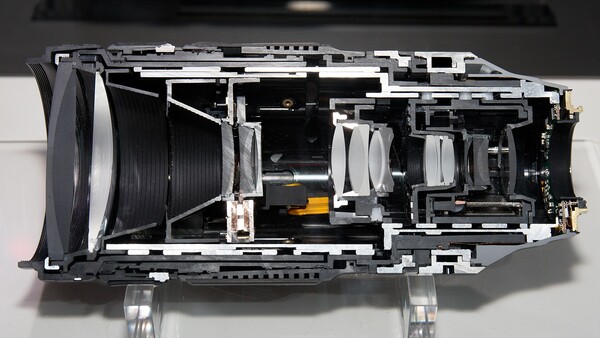
Optical stabilization goes by IS at Canon, VR at Nikon, OSS at Sony, OS at Sigma, VC at Tamron, and O.I.S. at Panasonic, and underneath the branding they all do the same thing. One small group of elements inside the lens, the correction group, gets pushed sideways, perpendicular to the optical axis. Bending the light path by a tiny amount walks the projected image back to where it was before you flinched, so the same detail lands on the same pixels for the whole exposure.
The instruction to move comes from a gyroscope, specifically a microelectromechanical angular velocity sensor small enough to sit on a circuit board next to the lens contacts. It does not report where the lens is pointed. It reports how fast the lens is rotating, and the processor integrates that rate over time to work out how far off target the image has drifted. That distinction matters later, because a gyro's signal drifts slowly on its own, and correcting for that drift is one of the real limits on how long an exposure a stabilizer can hold.
Shifting a group is not the only way to bend light on purpose. Canon's broadcast lenses and its stabilized binoculars use a vari-angle prism instead, a bellows of high-refractive-index liquid sealed between two glass plates that changes its wedge angle to steer the optical axis, which handles a wider band of vibration frequencies than a shifting group does. Nothing in a still camera works that way, which is why the moving group and the moving sensor are the two designs that matter here.
The muscle is a voice coil motor, the same principle that moves the cone in a loudspeaker. Run current through a coil of wire sitting in the field of a permanent magnet and you get force, with direction and strength set by the current. Tamron describes its VC unit as a three-coil arrangement with the stabilizing element riding on three balls to cut friction. Position sensors watch where the group actually sits and feed that back to the controller, so the loop corrects against real positions instead of firing blind.
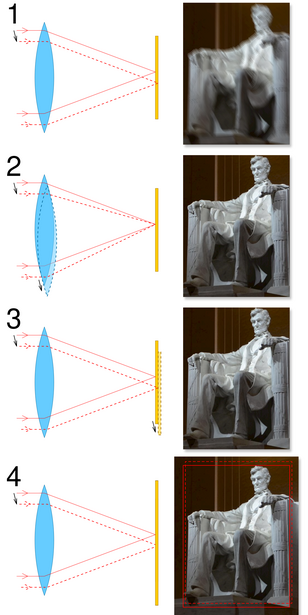
A gyro can only see rotation, which leaves a gap. Move the camera in a straight line without rotating it, and the gyro reports nothing at all, even though the image has moved. Canon plugged that hole in 2009 with Hybrid IS, adding an acceleration sensor alongside the gyros in the EF 100mm f/2.8L Macro IS USM so the lens could also fight the sideways drift that dominates at close focusing distances.
How IBIS Floats the Sensor on Magnets
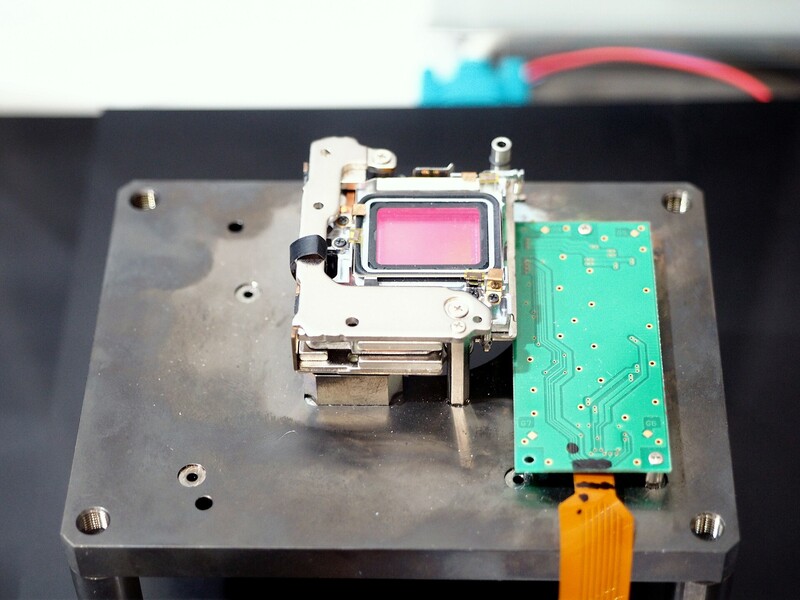
In-body stabilization throws out the moving glass and moves the target instead. The sensor is mounted on a carriage that floats between permanent magnets and coils, held flat and free to slide in the plane of the image. When Olympus walked through its own design, the engineers described a carrier riding on ceramic bearings less than a millimeter across, held flat to within a few thousandths of a millimeter while it moves.
Marketing counts five axes, and the count is honest even though the stage only has three ways to move. Pitch and yaw, the up-down and left-right tilts that ruin most handheld frames, are canceled by sliding the sensor in the image plane. Roll, the rotation around the lens axis that happens when your wrists twist, is canceled by running the coils against each other so the whole carriage turns. Horizontal and vertical shift, the pure sideways translation that gyros cannot see, use the same sliding motion as pitch and yaw. Three degrees of freedom, five kinds of shake.
Roll is the axis that a lens cannot help with. Shifting a lens group translates the image; it cannot rotate it. Only a sensor that turns, or software that turns the picture afterward, fixes roll, and roll misbehaves in a way that hides from the usual test. In the math behind CIPA's measurement protocol, roll blur does not depend on focal length at all. It scales with distance from the center of the frame, which means it is exactly zero at the middle of the picture and worst in the corners, roughly 13 mm out from center in 35mm equivalent terms at the 60% image height the standard now checks. A camera with no roll correction can look sharp in the middle of the frame and smeared at the edges.
The two shift axes barely matter at normal distances and matter enormously up close. Focus at infinity and sliding the camera sideways by a millimeter changes nothing you can measure. At 1:1 magnification, that same millimeter of sway moves the image a full millimeter across a sensor only 24 mm tall. If you do any handheld macro work, the shift axes are the ones doing the heavy lifting, which is why the systems designed for close-up work bolt an accelerometer onto the gyro package.
Why Sensor Shift and Lens Shift Beat Either Alone
Canon calls it Coordinated Control IS, OM System calls it Sync IS, Panasonic calls it Dual I.S., and Nikon calls it Synchro VR. In every case the body and the lens stop working as rivals and split the job, with the two systems trading data over the lens mount so they do not correct the same shake twice.
The reason it helps most on long lenses is arithmetic. The image displacement from a tilt is proportional to focal length, so a tenth of a degree of pitch moves the image about 0.04 mm at 24mm and about 1 mm at 600mm. The sensor carriage has to physically cover that distance, and it does not have much room before it runs past the clean part of the lens's image circle. A correction group buried in a long telephoto has optical leverage the sensor stage does not: a small movement of that group swings the image a long way, so the lens can absorb the big angular corrections while the body handles roll, shift, and the fine work.
The published numbers show the split clearly. The OM System OM-1 Mark II claims up to 8.5 EV steps from the body alone, measured with the M.Zuiko Digital ED 12-40mm f/2.8 PRO II at 40mm, or 80mm in full frame terms. It claims the same 8.5 EV steps with Sync IS, but that figure is measured with the M.Zuiko Digital ED 150-400mm f/4.5 TC1.25x IS PRO at 150mm, which is 300mm equivalent. Holding the same rating at nearly four times the focal length is the entire point of pairing the two systems. Nikon's numbers move in smaller increments: the NIKKOR Z 600mm f/4 TC VR S is rated at 5.0 stops on its own and 5.5 stops on a body that supports Synchro VR.
What a CIPA Stop Rating Actually Measures
Those stop counts are not marketing invention. They come from a published CIPA standard with a specific and fairly brutal test protocol. The camera is bolted to a certified vibration rig that replays recorded human hand shake, 32 seconds of angle data sampled at 500 Hz. Which recording gets used depends on how heavy the camera and lens are together: one waveform for total masses under 400 g, another for 600 g and up, and both for anything in between. The camera photographs a chart of black and white edges from a distance of 20 times the 35mm equivalent focal length, 200 or more frames at every shutter speed, all of them with stabilization switched on. A separate run of at least ten frames, taken with the rig stopped and stabilization off, measures how much the camera and lens degrade the picture on their own, and the unstabilized shake all of it gets compared against is calculated from the waveform rather than photographed. Measure the blur at each edge, average it, and the rating is how many stops of shutter speed you can give away before average blur crosses a fixed threshold. Results are rounded to the nearest half stop.
The threshold is where comparability falls apart. The 2015 version of the standard shook the camera in yaw and pitch only, measured the center of the frame only, and called an image acceptable if blur stayed under 63 micrometers. The 2024 revision tightens that threshold to 20 micrometers, adds a roll waveform to the shake, and adds a second measurement out at 60% image height. Those two changes are not conditioned the same way. The three waveforms are applied together in every measurement, in the standard's words "regardless of whether image stabilizer performance at image height 60% is measured or not," while the 60% figure itself is taken when a maker wants to describe corner performance and can be dropped when the position cannot be measured cleanly. CIPA says plainly in the standard's own notes that the tighter bar may change the number of stops a camera measures, and that requiring three rotation components to be separated rather than two raises the technical difficulty and is likely to reduce the number of stops a camera can claim. Same camera, newer test, probably a smaller number.
You can watch that play out in current spec sheets. Canon rates the EOS R5 Mark II at up to 8.5 stops in the center and up to 7.5 stops at the periphery, a figure it quotes for the in-body unit working in tandem with the optical stabilizer in a compatible lens. Splitting a rating into center and periphery is itself a 2024 construction, since the older standard looked at the middle of the frame only. OM System's 8.5 EV steps come from a body-only test at 80mm equivalent, and its footnote cites CIPA measurement conditions without naming a standard year. The two numbers are identical and describe different achievements. The biggest published claim we can find belongs to the Hasselblad X2D II 100C, whose spec sheet lists 10 stops at the image center and 8 at the edges, measured by Hasselblad with the XCD 3.5/120 Macro. Change the lens, the focal length, or the standard year, and the number changes with it.
Two more things the rating does not cover. Shift correction is outside it entirely: the standard tells manufacturers that any claim for axes other than yaw, pitch, and roll has to be labeled as measured by proprietary methods that do not conform to CIPA. Electronic and hybrid stabilization get a separate document altogether. So when a camera advertises eight stops and 5-axis stabilization in the same breath, the eight stops describe the rotational axes, not all five.
None of this makes the ratings dishonest. It makes them a lab result produced by a machine replaying an averaged shake recording, with a chart at a fixed distance, and a threshold set by panel tests of what looks sharp on a monitor. You are not that machine, you have a heartbeat, and you probably are not braced against a granite bench. Plan on landing a stop or two short of the headline figure and treat anything better as a gift.
What Stabilization Still Cannot Do
It cannot freeze a subject. Stabilization holds the frame still relative to the scene, and that is all. Shoot a running child at 1/8 s on a stabilized 200mm and the wall behind her will be beautifully sharp while she turns into a smear. Every stop of stabilization buys you light, not motion control, and no amount of it substitutes for a shutter speed that matches what your subject is doing.

Tripods complicate it. With the camera locked down there is no hand shake to cancel, and a stabilizer hunting for motion that is not there can inject its own. Sony's help guide advises setting SteadyShot to off when the camera is on a tripod. Some long lenses are designed to recognize tripod vibration and back off on their own, and some bodies detect the condition automatically, so the safe move is to check the manual for the exact combination in your hands rather than trusting a blanket rule.
Panning needs a mode change. A stabilizer that does its job will fight a deliberate sweep across a racetrack, treating your pan as shake to be canceled. Canon's answer is IS Mode 2, which detects the pan and stabilizes only the axis perpendicular to it, and Mode 3, which holds off until the exposure actually starts so the viewfinder does not lag behind fast action. Other makers offer their own horizontal and vertical panning settings, and many recent bodies pick up on a pan without being told.
Video adds another layer on top of optical and sensor-shift correction, and it costs pixels. Electronic stabilization crops into the frame and shifts each output frame inside that margin, which is why Sony's own help guide warns that the angle of view narrows in Active mode, and that Dynamic Active goes further by cropping and enlarging pixels. That margin is the price of admission. A 24mm lens in a heavy electronic mode is no longer a 24mm lens, and on a rolling shutter sensor the software may also be warping each frame to undo skew, which can look uncanny when it guesses wrong.
The practical move is to stop reading the headline number and start reading the footnote under it: which lens, which focal length, which standard year, center or periphery. Then run your own test. Brace yourself the way you actually shoot, fire ten frames each at 1/60 s, 1/30 s, 1/15 s, and 1/8 s, and count how many survive at 100%. That hit rate is your rating, it will not match the box, and it is the only one that helps when the light is going and you have one shot left.
Lead image: a Fujinon XF 100-400mm f/4.5-5.6 R LM OIS WR cut in half, showing the glass groups and the electronics that shift them. Photo by Morio, CC BY-SA 4.0. Source.








Join the Fstoppers community for free
-
Post comments and join in the discussions
-
Browse the site ad-free
-
Share your work and get featured in the community
-
Compete in the photo contests for fun and prizes
4 Comments
“Results are rounded to the nearest half stop.”
Does this mean that results can be rounded upward? I would think that results should only be rounded downward to the next half stop.
It does. That's actually quite common for apertures and focal lengths if you look at patents.
There’s no getting around it: Alex Cooke is one smart cookie. Thanks for all the great work you do for Fstoppers.
That made my day! Thank you so much, Tom!