

The first question most photographers ask after buying a camera is "what lens should I get next?" The second question, usually triggered by a forum post or a YouTube video, is "should I get a prime or a zoom?" And the advice they receive is almost always the same: primes are sharper, primes force you to think, primes make you a better photographer.
That advice is outdated, incomplete, and sometimes flat-out wrong. Modern zoom lenses from Sigma, Tamron, Sony, Canon, and Nikon regularly match or exceed the sharpness of primes at overlapping focal lengths. The Tamron 35-150mm f/2-2.8 Di III VXD, the Sony FE 24-70mm f/2.8 GM II, and the Nikon Z 24-120mm f/4 S all produce images that are optically indistinguishable from their prime counterparts under normal shooting conditions. The sharpness argument, while not entirely dead, is no longer a reliable reason to choose a prime over a zoom.
So what are the real reasons? There are five, and none of them are sharpness.
Aperture: The Actual Optical Advantage of Primes
This is the tradeoff that matters most, and it is the one beginners understand the least.
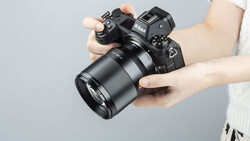
A typical fast prime like the Canon RF 50mm f/1.8 STM opens to f/1.8. A typical standard zoom like the Canon RF 24-105mm f/4 L IS USM opens to f/4 at the same focal length. That is a difference of about 2.3 stops, which means the prime gathers roughly five times more light than the zoom at its widest aperture. The practical consequences are immediate and visible: shallower depth of field for more pronounced background blur, faster shutter speeds in low light, and lower ISO for cleaner files.

This gap is not subtle. A portrait shot at 50mm f/1.8 has a distinctly different look from the same portrait shot at 50mm f/4. The background melts away at f/1.8 in a way that f/4 cannot replicate, and the subject separates from the environment more dramatically. For any photographer interested in portraits, street photography in low light, or creative depth-of-field control, this aperture advantage is the primary reason to own a fast prime.
But What About f/2 and f/1.8 Zooms?
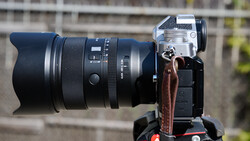
Fast-aperture zooms exist, and they are impressive engineering achievements. The Sigma 28-45mm f/1.8 DG DN Art is the first full frame f/1.8 zoom ever made. Canon produced the RF 28-70mm f/2 L USM, which maintained f/2 across its entire range. The Canon RF 24-105mm f/2.8 L IS USM Z pushes f/2.8 across an enormous zoom range with built-in stabilization.
The catch is that the physics of fast-aperture zooms are punishing. The Sigma 28-45mm f/1.8 weighs 950 grams and costs around $1,350, and its zoom range is quite narrow (28 to 45mm is less than a 2x range). Canon's RF 28-70mm f/2 weighed 1,430 grams, over three pounds, and cost $3,100 before being discontinued. The Canon RF 24-105mm f/2.8 Z weighs 1,330 grams and costs around $3,000. These lenses are optically remarkable, but they are designed for working professionals who need that specific combination of speed and flexibility and are willing to carry the weight and absorb the cost.
For a beginner, the meaningful comparison is not "prime vs. ultra-fast zoom." It is a $200 to $500 prime at 160 to 420 grams vs. a $1,000 to $3,000 zoom at a kilogram or more. A Nikon Z 50mm f/1.8 S at 415 grams and around $530 delivers an aperture advantage that would cost several times as much and weigh far more to replicate in a zoom. That price-to-performance ratio is why affordable fast primes remain the single best lens investment most beginners can make.
Size and Weight: The Lifestyle Tradeoff
A Sony FE 50mm f/1.8 weighs about 190 grams. A Sony FE 24-70mm f/2.8 GM II weighs 695 grams. A camera with a pancake or compact prime can fit in a jacket pocket or a small sling bag. A camera with a professional zoom requires a dedicated camera bag and changes the logistics of carrying your gear for the entire day.
This is not a minor consideration, and it compounds over time. A lighter setup gets carried more often, and a camera that stays home does not take pictures. For travel, street photography, casual everyday shooting, and any situation where the camera needs to be unobtrusive, a small prime transforms the camera from a commitment into a companion.
The counterargument is real: a single zoom replaces two or three primes in the bag, which can actually reduce total carry weight if you would otherwise bring multiple lenses. A Tamron 28-75mm f/2.8 Di III VXD G2 at 540 grams replaces a 28mm, 35mm, and 50mm prime and weighs less than the three of them combined. Whether a prime or a zoom is the lighter option depends on how many focal lengths you actually need on a given outing.
Focal Length Discipline vs. Flexibility
This is the most interesting tradeoff for beginners and the least discussed in practical terms.
A zoom lets you adjust framing without moving your feet. This is convenient and prevents missed shots in fast-moving situations: events, travel, kids, anything where the moment does not wait for you to walk ten feet closer. A photographer at a family gathering or a kids' soccer game needs the flexibility to go from a wide shot to a tight crop without changing position, and a zoom handles that without friction.

A prime forces you to move. If the framing is wrong, you walk forward, backward, or find a different angle entirely. This physical engagement with the scene teaches spatial awareness, composition through positioning, and the relationship between camera distance and perspective. You learn how 35mm feels different from 50mm not as a number on a dial but as a physical position relative to your subject. Many photographers credit shooting with a single prime for the period when their compositional instincts developed fastest.
Neither approach is wrong. They teach different things. If you are in the early stages of learning composition and can afford to miss a few shots while you develop spatial instincts, a prime accelerates that learning. If you are in situations where missing shots has real consequences (paid events, once-in-a-lifetime travel, fast-moving children), a zoom prevents the misses that a fixed focal length would cause.
Cost Structure: One Lens vs. a System
Primes are generally cheaper per individual lens but require more of them to cover the same range. A single Canon RF 24-105mm f/4 L IS USM covers the same focal range as a 24mm, 35mm, 50mm, and 85mm prime combined. The zoom costs more as a single purchase, but less than the four similar quality primes would cost together.
For a beginner on a budget, the most cost-effective combination is usually a kit zoom plus one fast prime. The kit zoom covers the range. The prime teaches depth of field, performs well in low light, and produces the kind of background blur that makes a beginner fall in love with the difference between a dedicated camera and a phone. A Sigma 30mm f/1.4 DC DN Contemporary on an APS-C body or a Nikon Z 40mm f/2 on a Nikon Z body costs less than a nice dinner and opens a creative door that the kit zoom cannot.
Rendering and Character
This one is subjective, but it matters to photographers who care about the look of their images beyond sharpness and exposure.
Some primes produce a quality in the out-of-focus areas (bokeh) that zooms at the same focal length do not replicate. Smoother transitions between sharp and blurred areas, a more three-dimensional quality to subject separation, and a rendering of point light sources that looks rounder and more pleasing. This is lens-specific rather than a universal rule: some zooms render beautifully, and some primes produce clinical, sterile bokeh. But the optical designs that produce the most pleasing out-of-focus rendering tend to be prime designs, because the constraints of a single focal length give the designer more freedom to optimize for character rather than zoom flexibility.

If you have never compared the rendering of a fast prime with a zoom at the same focal length, it is worth doing in person at a camera store. The difference is not always dramatic, but when it is there, it is the kind of difference that makes a photographer reach for a specific lens even when a zoom would be more convenient.
The Decision Framework
If you are deciding between your next lens being a prime or a zoom, the answer depends on how you shoot.
- Buy a fast prime if you want shallower depth of field than your current lens can produce, you shoot in low light and need a wider aperture, you want a smaller and lighter setup for travel or everyday carry, you are learning composition and want the discipline of a fixed focal length, or you are on a tight budget and want the biggest image-quality jump for the least money.
- Buy a zoom if you need focal length flexibility in situations where you cannot move freely, you want one lens that covers multiple scenarios without swapping, you are shooting events, family, travel, or fast-moving subjects where missing a shot is worse than compromising on aperture, or you want to reduce the number of lenses in your bag.
- Buy both (kit zoom plus one fast prime) if you are a beginner building a system. This is the combination that covers the most ground for the least money and teaches the most about how focal length and aperture affect images. Start with the kit zoom for flexibility. Add a fast prime in the 30mm to 50mm range for depth-of-field control and low-light performance. Shoot with both, notice the difference, and let your shooting style tell you which one stays on the camera more often. That answer will guide every lens purchase after it.
If you are still building your foundation with exposure, focus, and composition, the Fstoppers Photography 101 tutorial covers how aperture, shutter speed, and lens selection work together as a system. And if you want to see how different lens choices play out across multiple genres of photography, The Well-Rounded Photographer puts eight instructors in front of you, each making different lens decisions for different creative reasons.
Join the Fstoppers community for free
-
Post comments and join in the discussions
-
Browse the site ad-free
-
Share your work and get featured in the community
-
Compete in the photo contests for fun and prizes
3 Comments
Isn’t it funny that if you do get a zoom, you find you nearly always find a couple of focal lengths you tend to gravitate to. I love my f/4 20-70, but I also l find I wander around with a 35mm stuck on, because that’s more or less the scene I want 7/10 times with my zoom.
Zoom lenses are so good these days that most people, especially beginners, don't need a primes. I would look at primes for two main things. 1. If you want super wide apertures to rake in more light for low light situations or 2. if you want the clinical sharpness of a good high quality prime so you can eek out every single smidge of resolution of a super resolution sensor that 90% of people aren't going to notice.
There is a third reason I would get one too and that's if you want to force your self to learn how to do more with less. Zooms can make you lazy with composition or blind you to the compositional possibilities of what a location is capable of. By and large though most people don't need primes any more. Two modern zooms are more than plenty. Heck even Jake Hicks used old Nikon DSLRS and D lenses for much of his work and his work is incredible. Many of us greatly over estimate what is really needed for what we shoot.
Your first two reasons are not why I own primes. I don’t shoot super wide apertures and don’t want clinical sharpness. I much prefer character and use a variety of f-stops. Primes are smaller and I much prefer just using a single focal length as it simplifies my workflow and I just move with my feet to change perspective.