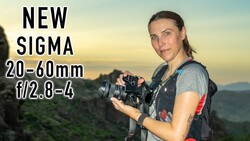
Packing a single lens for a long trip means giving up options you might miss, and the Sigma 20-60mm f/2.8-4 makes that gamble easier to justify. The range covers wide landscapes, tight architecture, and portraits without a bag full of glass.
Shot across Malaysia, Bali, Lombok, and Spain, the review from Jacek Sopotnicki treats the Sigma 20-60mm f/2.8-4 as a working travel companion rather than a spec sheet. It weighs about 350 g, which is roughly 100 g lighter than Sony's competing 20-70mm f/4. Sopotnicki got caught in heavy rain in Kuala Lumpur, and the rubber sealing kept water out. The filter thread is a common 67mm, and the controls stay simple with just a zoom ring and a focus ring.
Center sharpness holds up well through the range, whether you shoot 20mm at f/2.8 or 60mm at f/4. The corners lose some sharpness and contrast, though Sopotnicki calls this ordinary for a lens this versatile, and stopping down to around f/3.5 or f/4 cleans it up. Distortion behaves as expected, with barrel distortion and a slight mustache pattern at 20mm and pincushion at 60mm, both easy to correct in post or with in-camera profiles. Vignetting is the one point he flags most, clearly visible at 20mm and f/2.8 and gone by f/5.6. Bokeh at f/2.8 is genuinely pleasant, and the nine-blade aperture produces surprisingly nice separation at 60mm and f/4.
The f/2.8 aperture is the part that deserves a closer look, because it only lives at the widest end. It disappears by roughly 23mm as the lens ramps toward f/4, so the bright opening is a short window rather than a constant. This is standard behavior for variable-aperture zooms, and it shapes how you shoot with one. Treat the widest few millimeters as your low-light and shallow-depth zone, and expect f/4 for most of the range. Photographers moving from a constant-aperture zoom feel this most, and knowing where the aperture shifts lets you compose around it instead of fighting it. The tradeoff buys size, weight, and price, which is why lenses like this keep showing up in travel kits.
Autofocus is fast, responsive, and quiet enough for video, locking onto the eye in portraits. Focus breathing stays minimal at both ends of the zoom. Close-focus performance impressed Sopotnicki, letting him nearly touch his subject at 20mm while keeping the center sharp wide open. Stop down to f/11 through f/16 and the lens renders clean sunstars, useful for tripod work at night or when the sun catches an edge.
On price, the Sigma runs close to half the cost of Sony's 20-70mm while coming in smaller and lighter, and the compromise is the 10mm of reach you give up at the long end in exchange for f/2.8 at the wide end. Sopotnicki decided this was the first lens he'd trust as his only travel option, leaving his usual 16-35mm and 50mm f/1.4 at home.
Watch the full review above to see how the lens held up across four countries and whether it earns a spot in your travel bag.
Join the Fstoppers community for free
-
Post comments and join in the discussions
-
Browse the site ad-free
-
Share your work and get featured in the community
-
Compete in the photo contests for fun and prizes
3 Comments
With that zoom range ? I wouldn't travel solely with that lens.
Back in the late 2000's there were some big travel lenses in magazines. But here the thing that is the draw is the f/2.8-4 and if you think a 20-60mm is good you might as well just use your phone camera it has a 10x selection. As far as travel do you really need a f/2.8-4? most photography is at f/8 (be there at f/8) or a little higher, yes night shots yes would be nice but even then today with auto ISO and todays NR software even when travel you are using mainly auto mode any way just like the day of old with film or the next best was a all in one point and shoot with a protruding telephoto Vivitar Vivicam8300s (still available today) that put all images on a sim card that takes the place of film. there are many more pocket cameras that will out do this little lens.
Do not get caught up with the film days fast glass lenses not needed in todays digital cameras and software (the magic maker).
I know I have pointed this out many many times but for travel or just for that time when your are driving or just on a walkabout with your camera in a non descript bag with maybe just the one lens and a additional lens for that super wide panorama look. If a Sony user I recommend the two below. 1. The Sony 2015 FE 24-240mm f/3.5-6.3 OSS and in APS-C mode 36-360 in camera crop you have 24-360 at your option with OSS to help with steadiness and faster SS's
2. The 2013 Sony APS-C E 10-18mm (15-27mm in 35mm) f/4 OSS BUT in Full Frame you get 12-18mm and also threads for filters up front better than carrying around the FE 12-24mm f/2.8 GM or f/4 G. I have two one for my day bag and one for my night bag.
To me, clearly the wrong question because I´d never want to miss the zoom range up to 200mm, no matter whether I´m hiking, shooting landcapes or visiting a city. The question fits a report about a superzoom or a wider zoom range.
The interesting part about the 20-50/60/70mm is whether it can replace a UWA zoom or not, e.g. in a two lens set-up. When is 20mm enough and when is it not?