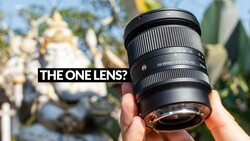
Sigma just put a 20-60mm zoom against a rattlesnake at sunrise in the Sonoran Desert, and the lens walked away as the star. A 20mm wide end, a variable f/2.8-4 aperture, and a body compact enough to forget on a hot desert climb make this a different kind of everyday zoom.
Leigh of Leigh & Raymond Photography takes the new Sigma 20-60mm f/2.8-4 DG Contemporary on a pre-sunrise hike, shooting stills and video on a Lumix S5 II. She tested the L-mount version, though it also ships in E-mount. The lens is small and light, which is exactly why she reached for it on a punishing, hot walk through brush and rocks. When your gear disappears into the setup, you climb over boulders and skirt a rattlesnake without ever thinking about the camera around your neck. Leigh points out that a heavier kit would have ended up stuffed in her hydration vest instead of ready in her hands.
The 20mm wide end is where this lens separates itself from the usual walkaround glass. Most people carry a 24-70mm or a 24-105mm, so you give up some reach at the long end and gain width at the short end. That 4mm gap sounds trivial until you look at the numbers Sigma handed Leigh: the field of view at 24mm is only about 70 percent of what you get at 20mm. She also found macro capability she didn't expect, getting close enough to fill the frame with a small desert plant. The Contemporary badge sits in the middle of Sigma's three lines, alongside Sports and Art, and it's built to balance image quality, handling, and cost.
The comparison that makes this video worth your time is the head-to-head against the Lumix 20-60mm f/3.5-5.6, a lens Leigh and Raymond bought with their first Lumix body, the S5. On paper the Sigma wins with a wider aperture across the range, and Leigh made real use of that extra light starting in the dark. She set up a studio scene and shot 20 frames on the S5 II, varying aperture, focus point, and focal length, then pushed the worst-case corner sharpness at the widest aperture and longest focal length. Zoomed in hard and flipping between the two, she found no meaningful difference in image quality.
Zoom ranges like this one reflect a wider rethink of what a single lens should cover. For years the safe answer was a 24-70mm, a range built around the assumption that most work sits at portrait-friendly focal lengths. Landscape and street shooters have quietly pushed the other direction, trading a little reach for the ability to fit more of a scene without swapping glass or backing up. A 20mm wide end handles tight interiors, sweeping desert vistas, and environmental street frames from one body, and pairing that with close-focus macro means fewer reasons to carry a second lens. If your shooting looks like Leigh's, moving light and mixed subjects on foot, that width plus a brighter aperture covers far more ground than the spec sheet suggests. This fits anyone who wants one lens to stay mounted for whatever the day throws at them.
If you already own the Lumix, she's honest that you probably don't need the Sigma unless the wider aperture earns its keep for how you shoot. For anyone starting fresh and hunting a do-everything zoom, this one belongs on the shortlist.
Watch Leigh's full desert hike and studio test in the video above to see the corner-sharpness comparison for yourself.


Join the Fstoppers community for free
-
Post comments and join in the discussions
-
Browse the site ad-free
-
Share your work and get featured in the community
-
Compete in the photo contests for fun and prizes
No comments yet