Fog changes a landscape into something you can actually shoot, but the fog alone won't hand you a photo. You still have to find a subject worth pointing the camera at, and then you have to work it.
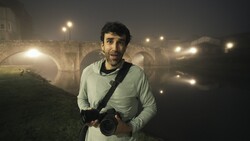
Filming through a cold, wet morning in his homeland of Galicia, Adrian Vila walks through his last few days in Spain before heading back to the US for a road trip across the American West. He points out that most of the trees around him make for poor images because they overlap, carry weeds, or lack clean shapes. When he finds one that stands out, he refuses to settle for the first frame. He shoots it from the first angle, drops lower to the ground, tries something different, and leaves with dozens of photos of that single tree before moving to the next. The wide angle lens comes out for the "cruceiro," a stone cross along the path locals climb to reach their church.
The technical habits he shares are the kind you can put to use immediately. In fog, he takes two or three identical frames of the same composition, refocusing each time, because the camera can lock onto a random water drop and leave you with a blurry file. He applies the same rule when it's snowing or raining. He also warns about swapping lenses in wet conditions and turns his back to the fog while doing it so moisture doesn't land on the sensor. Later, he reaches for longer focal lengths to compress the crosses along the path against the church behind them, and he stitches a panorama of a tree whose shape mimics the trees in the background.
The strongest thread running through the whole outing is subtraction. He passes on a pole that would flatten into a shapeless silhouette in black and white, walks away from a rock with a background he doesn't love, and skips the windmills entirely because he'd already shot them and didn't feel the subject. This is the discipline that separates a wet, atmospheric morning from a folder full of mediocre frames. Fog and low clouds raise the ceiling on what a scene can become, but they also flatter weak compositions just enough to fool you in the moment. Learning to say no to an "almost" shot, even a pretty one, is a skill that carries over to any weather, any location. It's also a reminder that atmosphere is a multiplier, not a subject. When he moves down to the valley chasing cloudy skies and possible rain for mood, he's chasing conditions that will lift a good composition, not rescue a bad one.
A couple of days later, he's back on a hill he's shot before, this time with nothing in front of the lens after a filter ruined his earlier images. It's the end of August, 9 °C, and raining, and he's fully embracing the cold while the rain builds low clouds across the valley. He knows the locals prefer sun, but for photography he wants the fog and the weather.
Follow along with the full morning and the return trip in the video above.


Join the Fstoppers community for free
-
Post comments and join in the discussions
-
Browse the site ad-free
-
Share your work and get featured in the community
-
Compete in the photo contests for fun and prizes
No comments yet