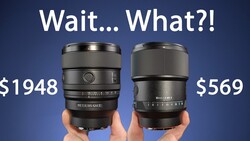
Put two portrait shots side by side, one taken with an $1,800 Sony lens and one taken with a $99 lens, and most people can't call which is which at a glance. That gap between price and image quality is worth understanding before you spend money on your next portrait lens.
The comparison comes from Mark Bennett, who lines up the Sony G Master 85mm f/1.4 GM II against the TTArtisan 85mm f/1.8 Neo. Shot at f/1.8, where the TTArtisan tops out, the Sony is a hair sharper. Bennett notes the two lenses white balance nearly identically, and the skin tones and colors track closely.
The build is where the price shows. The TTArtisan runs mostly plastic and weighs 333 g without caps, and it carries no switches or buttons. There is no manual focus ring at all. The grip on the barrel does not turn, so you set manual focus through the camera body if you want it. Bennett flags this as a dealbreaker for anyone who enjoys a hands-on manual focus experience. The lens has a 62mm filter thread and a rear cap with a USB-C port for firmware updates from the TTArtisan website, which means losing that cap costs you the ability to update.
Performance is where Bennett lands squarely in favor of the lens. Autofocus is accurate and consistent, slower than higher-end Sigma, Viltrox, or Sony glass, but faster than the older Sony 85mm f/1.8 he bought years ago. Eye autofocus and tracking held up in real shooting. There is moderate focus breathing, so video shooters racking focus or anyone planning to focus stack should account for it. The bokeh is smooth with clean, round specular highlights in the center, some cat's-eye shaping toward the corners, and fall-off he rates above the Sony 85mm f/1.8. Chromatic aberration appears wide open in high-contrast scenes and clears by f/4, which is standard for an 85mm at this aperture.
The wider story is that full-frame autofocus glass under $100 simply did not exist a few years ago, and TTArtisan is part of a group of Chinese manufacturers reshaping the budget end of the market. Viltrox, 7Artisans, and TTArtisan have all pushed autofocus lenses at prices that used to buy you a manual-focus prime and nothing more. What this means for you is a real path into portrait shooting without committing four figures to a single focal length. An 85mm gives you working distance from your subject and clean background separation, and Bennett uses it well beyond head-and-shoulders portraits for general shooting on a trip back to St. John's, Newfoundland. If you rarely reach for this focal length or you're building a first kit, a $99 option lets you learn what an 85mm does for your work before deciding whether a G Master belongs in your bag.
Distortion is minimal enough that Bennett sees no need for profile correction, while vignetting is heavy at f/1.8 and clears by f/4. Sun stars and flare resistance both came out better than he expected from a lens at this price, which he singles out because he assumed they would be the weak points. Watch the video above to see the side-by-side test charts and decide for yourself whether Bennett's verdict on the $99 lens holds up.

Join the Fstoppers community for free
-
Post comments and join in the discussions
-
Browse the site ad-free
-
Share your work and get featured in the community
-
Compete in the photo contests for fun and prizes
No comments yet