
If you were stranded on an island, or perhaps more realistically, dropped into the bustling streets of Jakarta or a temple in Bali, and could only choose one prime lens, which would it be? The 50mm or the 85mm? Let's find out.
It is one of the most debated questions in photography. Both lenses are legendary in their own right. The 50mm is the storyteller, the lens that sees the world roughly as you do. The 85mm is the isolator, the lens that flatters subjects and melts away distractions.
I have spent almost two years shooting with both, from the controlled environment of model shoots to the chaotic, vibrant streets of Southeast Asia. In this article, I want to dive deeper into the why: the creative choices that dictate which lens I reach for.
The Case for the 85mm: The Master of Isolation
The 85mm lens, often f/1.8 or f/1.4, is traditionally hailed as the quintessential portrait lens. It slightly flattens features, which is generally more flattering than the potential distortion of a wider lens, and it offers superior background compression.
The Sniper Approach
For street and travel photography, the 85mm allows you to be an observer. You can stand across the street and capture a candid moment without infiltrating the scene.
Separation and Bokeh
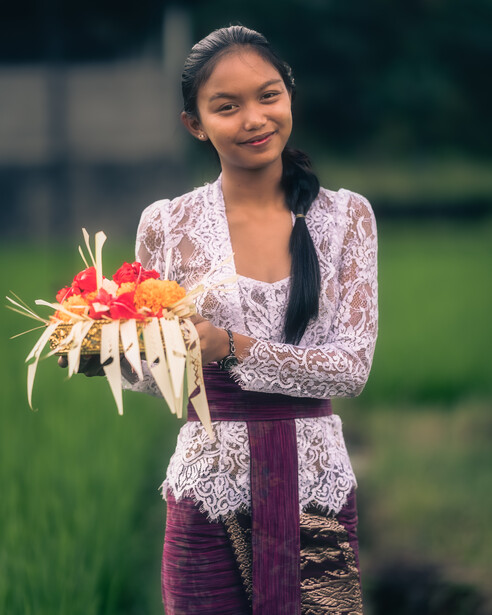
The biggest strength of the 85mm is its ability to separate the subject from the background. When I find the background chaotic, I use this lens for portraits and street scenes. The lens compresses the background while also blurring out the clutter. The result is a clean, professional-looking image where the subject pops. Here is an image from a shoot I did in Bali, Indonesia, where I used an 85mm lens for portraits to achieve background separation and creamy bokeh.
The Case for the 50mm: The Storyteller
I often reach for my 50mm lens because it helps me tell stories.
The Human Perspective
The 50mm focal length roughly approximates the field of view of the human eye, excluding our peripheral vision. When you look at a photo taken at 50mm, it feels natural.
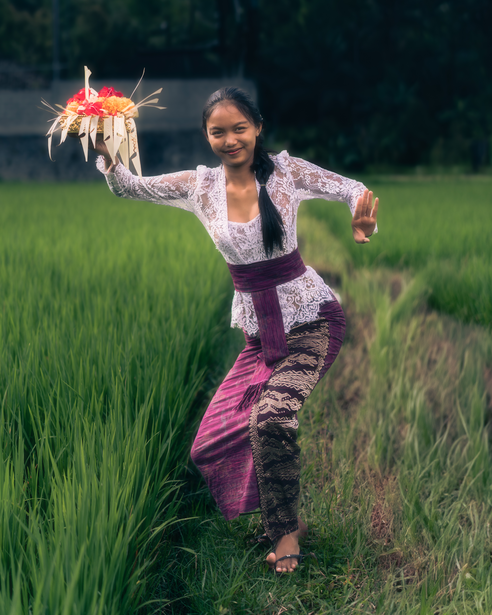
This is why I prefer it for environmental travel photography. When I travel, I don't just want a photo of a person; I want a photo of a person in their world.
Space Constraints
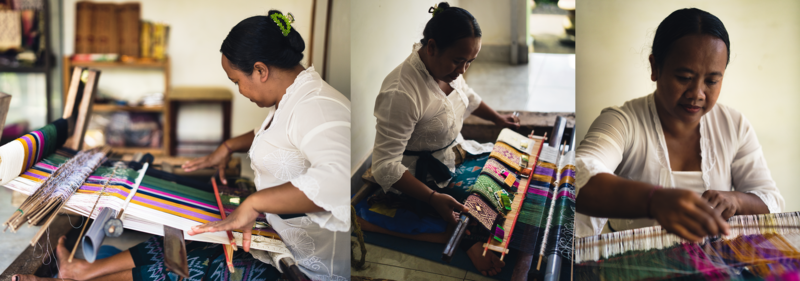
Practicality often dictates the choice. During a trip to a village in Bali, I found a traditional dress weaver working in a small, cramped shop. I wanted to capture her at her loom.
- With an 85mm, I would have had to back up through the wall to get her torso in the frame. It was simply too tight.
- With a 50mm lens, I was able to stand and shoot from various angles, framing her perfectly and capturing not just her face but also her hands and the loom.
Field of View: Zooming With Your Feet
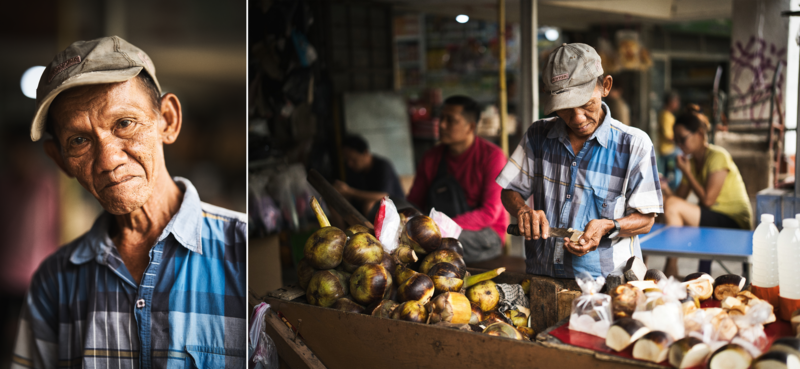
With an 85mm, you are often locked into a specific framing. If you want a wider shot, you have to move far back. With a 50mm lens, you can zoom with your feet.
- For portraits, take two steps forward. You get a beautiful, intimate shot.
- For the environmental shot, take two steps back. You now have the full context of the street or landscape.
Conclusion: Why I Choose the 50mm
I own and use both lenses. I use a Sigma 85mm f/1.4 for specific headshots or when I need to clean up a very messy background. It is a specialized tool that does its job perfectly.
However, if I am walking out the door to document a trip, explore a city, or tell a story, the 50mm is on my camera most of the time.
The 50mm forces you to compose more thoughtfully. It forces you to interact with your subject. It captures the world as it feels to be in it, rather than observing it through a telescope. It is the perfect balance between the context of the environment and the intimacy of portraiture.
Ultimately, the choice is yours. If you love that creamy, isolated background and prefer to keep your distance, the 85mm is your king. But if you want to be a storyteller, get a 50mm, and don't be afraid to get close.

Join the Fstoppers community for free
-
Post comments and join in the discussions
-
Browse the site ad-free
-
Share your work and get featured in the community
-
Compete in the photo contests for fun and prizes
3 Comments
Wow a choice! I also have both but seldom use either, why? Well like you I am a mover looking for a capture no one else see's! My lens of choice that is on my camera the most while out and about is the Sony FE 24-240mm F3.5-6.3 OSS Full-frame Telephoto Zoom Lens with Optical SteadyShot on a A7RM5 it can be used in APS-C mode for a 36-360mm in camera crop. I can select 50 or 85 in the zooming but also can go 24mm for a very wide night landscape or out for a scouting for when birds are nesting I can zoom in the range of my FE 200-600mm but I can see a bird building a nest and while in flight carrying limbs to build with.
Today even most photographers crop in! Ok everyone wants that bokeh or bokeh balls but that can be done in post even with Lrc.
Also the need for the f/ low number for the dimly lit it is no longer the film days we have auto ISO and noise reduction in most all Editor's that are superb to the days just years ago. We can crop and enlarge to a more pixel image.
Some would call all of it cheating per say. But we all do edit images one way or another for color, sharpness etc..
With a camera with IBIS and a lens with OSS you can also capture during the blue hour even bracketing at 5 at +/- 2EV hand held, Yes Camera NR is off during bracketing but even the second stage ISO gives a clean noise free image.
all are with the 24-240mm ready when needed.
The 50mm or 85mm? I prefer the 85mm but why choose when the ideal answer is the 24mm to 120mm zoom lens then you have the best of both worlds and only one lens in your camera case. The Nikon NIKKOR Z 24-120mm f/4 S Lens is the best for this situation it's a quality lens with sharp results. That's my opinion.