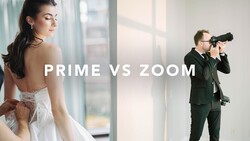
Choosing between zooms and primes is not a gear argument, it’s a working method decision that shows up in your keeper rate and your stress level. If you shoot travel, landscapes, or people on the move, the wrong lens choice turns into missed frames and constant second-guessing.
Coming to you from Samuel Elkins, this practical video lays out why Elkins keeps reaching for zooms even though he owns primes. He frames it around real constraints: limited space in a bag, limited time on a location, and scenes where swapping lenses is either slow or impossible. He points to that familiar moment when you carry several primes, then spend half your attention deciding what stays on the camera. With a zoom, you stop wondering whether you should have gone wider or tighter and start reacting to what’s in front of you. He also ties it to storytelling when you bring one body and one lens, which is often the reality on personal trips and small jobs.
Elkins gets specific with the GFX kit he actually uses. He calls the GF 45-100mm f/4 R LM OIS WR his most versatile option on the system, describing it as his “one lens” pick even though it is not his favorite. He explains how that range lets you move from a wider, environmental feel to tighter, more intimate frames without changing anything except the zoom ring, including quick switches between portraits, details, and scenes. He contrasts that with the GF 32-64mm f/4 R LM WR, which he says is his personal favorite, and he hints at how those two lenses cover most situations he runs into. He also brings up pairing options like the GF 100-200mm f/5.6 R LM OIS WR.
Where the video earns your time is the trade-off talk, especially if you’ve been told that primes are the “serious” choice. Elkins acknowledges the classic prime advantages: wider apertures, more background blur, and a reputation for sharpness, then says that sharpness gap has not been his experience with GFX zooms. He is blunt about the biggest zoom downside being size and weight. If you care about being less noticeable, or you want a specific look like a tight portrait with heavy blur, he points to lenses like the GF 110mm f/2 R LM WR and basically says you already know why you want it. He also ties zooms to client work: crowded sets, fixed distances, and the need for variety fast, where changing focal length is the simplest way to avoid a gallery of near-duplicates. He even nods to the way many people shoot street with one focal length for years and admits that approach does not match how he likes to see, which is a useful gut-check against copying someone else’s habits. Check out the video above for the full rundown from Elkins.

Join the Fstoppers community for free
-
Post comments and join in the discussions
-
Browse the site ad-free
-
Share your work and get featured in the community
-
Compete in the photo contests for fun and prizes
10 Comments
"Zoom, or prime?"
It isn't really a binary choice to make.
Every single photographer who I know personally uses a combination of zooms and primes in their regular workflow. I wonder why anyone thinks that it is a decision to have only one, or only the other. Because in the real world that is a decision that no one has to make because we all just get both.
I choose to have only prime lenses, and typically only take two with me, even when travelling.
You, and others, may wonder why. You may disagree, and you may have your opinions. But with respect, I couldn't give a flying fig what anyone thinks. My photography, my fun, my choices. 🙂
Your choice is different from the norm, and from everyone I know, but that is a good thing. It's great that you know exactly what you want to shoot with and what you don't want to shoot with.
And I don't want you flying fig, anyway. Hahaha!
You can't say 'my photography, my fun, my choices' on the internet because someone will certainly come along to tell you how wrong you are 😉. I know this from bitter experience.
What makes you think it is the norm to have both zooms and primes? Street photographers for the most part only use primes plus wedding, fashion/portrait, product, travel photographers may also only use primes. There are photographers that only use zooms and of course many will have both. 'We all get both' might apply to you and the people you know but it is definitely not something that applies to the vast majority. All the street photographers I've met over the years all use primes.
I personally know hundreds of photographers. Almost every one of them is a wildlife photographer. Almost every one of them has a big prime like a 500 f4 or a 600 f4, and a medium zoom like a 100-400mm or a 100-500mm. And the ones who don't have a big prime, specifically reptile and amphibian photographers, have the medium zoom and a macro prime.
So that is why I think it is normal to have both zooms and primes .... because it actually is.
Street photographers don't even count, because I do not know any of them, and therefore can not issue any thoughts or opinions about what they shoot with.
Your statement should say using zooms and primes is the norm amongst the wildlife photographers you’ve personally met. That is essentially the extent of your experience as you state. The fact you dismiss street photographers because you don’t know any doesn’t take away from the basic fact the vast majority use primes and not zooms. I did mention other genres where photographers can and do use primes exclusively. Try looking outside of your own limited experience before making sweeping generalisations.
If we stop arguing the internet will come to a screeching halt.
I am a hobby photographer and use only 2 zooms. a Canon 24 -105 F4 and a Canon 70-200 F4 both L and both used. For me it would be a pain to carry a bunch of primes.
Primes are generally used buy people who don't need the flexibility of a zoom and prefer to shoot with just one or two (mostly) particular focal lengths. I spend the majority of the time shooting with just a 40mm lens so a zoom would be very unnecessary for me.